JL-9
Chinese advanced trainer jet, operational since the 2000s, extensively used for fighter-bomber training by the People's Liberation Army Air Force. Key figures: top speed 1,100 km/h, range 863 km, service ceiling 16,000 m, max takeoff weight 9,800 kg, built 13. In service with 3 air forces as of 2026 — China (85), Myanmar (8), Sudan (6).
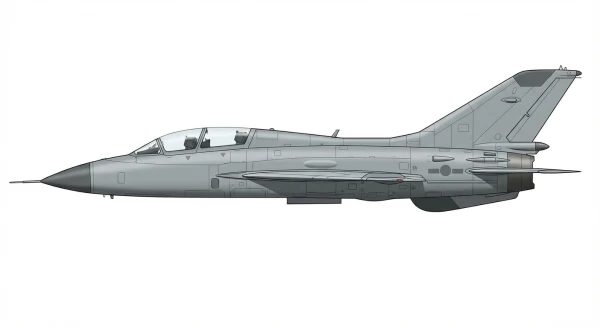
| Length | 14.6 m (47.7 ft) |
| Wingspan | 8.3 m (27.3 ft) |
| Height | 4.1 m (13.5 ft) |
| Wing area | 24.9 m² (267.8 sqft) |
| Empty weight | 7,800 kg (17,196 lbs) |
| Max. takeoff weight | 9,800 kg (21,605 lbs) |
| Powerplant | 1 × turbojet Guizhou WP-13F 4,497 kgf each |
| Ejection seat | TYD-6 |
| Maximum speed | 1100 km/h (Mach 1.1) |
| Operational range | 863 km (536 mi) |
| Service ceiling | 16,000 m (52,493 ft) |
| Climb rate | 260.0 m/s (853.0 ft/s) |


Description
The Guizhou JL-9, also marketed as the FTC-2000 Mountain Eagle, was developed by the Guizhou Aviation Industry Import/Export Company (GAIEC) as a cost-effective trainer for fourth-generation fighter aircraft. The aircraft was publicly unveiled at the 2001 China International Aviation & Aerospace Exhibition and is reportedly manufactured at a GAIC facility in Anshun, Guizhou. It was designed to compete with the Hongdu JL-10, offering a more economical solution for advanced trainer requirements. In 2011, a carrier-landing trainer variant, the JL-9G, was revealed. Mass production of the FTC-2000G variant commenced in September 2018, with the first mass-produced aircraft performing its maiden flight later the same month. An order for the FTC-2000G was placed by Myanmar in April 2020, with deliveries scheduled between 2021 and 2023.
Design
The Guizhou JL-9 design is derived from the JJ-7/FT-7, a two-seat trainer version of the Chengdu J-7 (a Chinese variant of the MiG-21). Design modifications include a new wing and a forward fuselage with side air intakes and a glass cockpit. Components such as the engine, empennage, and mechanical controls are retained from the JJ-7/FT-7. The FTC-2000G variant features a diverterless supersonic inlet.
Armament
The FTC-2000 is equipped with a single 23 mm cannon and five hardpoints capable of carrying a maximum payload of 2,000 kg (4,409 lb). These hardpoints can be configured for various stores, including up to three external fuel tanks. For air-to-air combat, the aircraft can be armed with PL-8 and PL-9 short-range missiles. The FTC-2000G variant increases the number of hardpoints to seven, with a maximum payload of 3 tons, and adds compatibility with SD-10 beyond-visual-range air-to-air missiles and CM-102 anti-radiation missiles.
Operational History
The People's Liberation Army Naval Air Force (PLANAF) operated a regiment of JL-9s by 2014. The People's Liberation Army Air Force (PLAAF) initiated JL-9 usage for training in October 2015. The Sudanese Air Force has operated the FTC-2000; in April 2023, one Sudanese FTC-2000 was destroyed at Merowe Air Base. Satellite imagery confirmed the presence of three additional FTC-2000s at the base during the assault. On January 16, 2024, a Myanmar Air Force FTC-2000G was downed in Shan State by a Kachin Independence Army FN-6 missile, resulting in the deaths of both pilots.
Variants
Main Variants:
-
FTC-2000: The original export model, primarily intended for the international market.
-
FTC-2000G: A dual-seat light combat aircraft and lead-in fighter trainer variant designed as a cost-effective fighter replacement, featuring a diverterless supersonic inlet and seven hardpoints.
-
JL-9: The initial variant developed for domestic use by the People's Liberation Army.
-
JL-9G: A carrier-trainer variant for the People's Liberation Army Naval Air Force, modified for carrier training including ski-jump ramp takeoffs and simulated arrested landings on land.
Frequently Asked Questions
What type of aircraft is the JL-9?
What is the maximum speed of the JL-9?
What is the range of the JL-9?
When did the JL-9 first fly?
How many JL-9 have been built?
Which countries operate the JL-9?
What is the service ceiling of the JL-9?
- APR 72026 Updated Picture credits updated in a site-wide editorial pass
- APR 52026 Updated Ejection seat added
- FEB 72026 Updated Top speed added
- JAN 122026 Updated Range updated in a site-wide editorial pass