Lasta-95
Serbian training aircraft, operational from the late 20th century, utilized by Iraq and Serbia for military pilot training. Key figures: top speed 345 km/h, range 1,160 km, service ceiling 6,000 m, built 37. In service with 2 air forces as of 2026 — Iraq (19), Serbia (14).
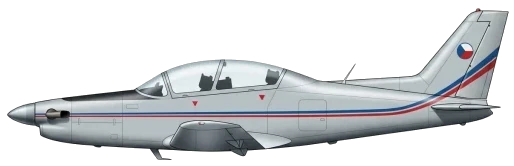
| Wingspan | 9.7 m (31.8 ft) |
| Empty weight | 888 kg (1,958 lbs) |
| Maximum speed | 345 km/h (214 mph) |
| Operational range | 1,160 km (721 mi) |
| Service ceiling | 6,000 m (19,685 ft) |
| Climb rate | 8.5 m/s (27.9 ft/s) |


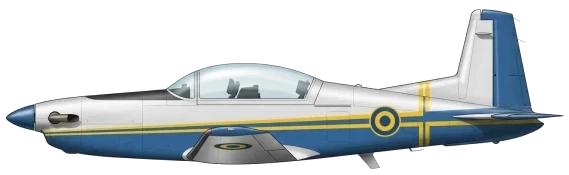
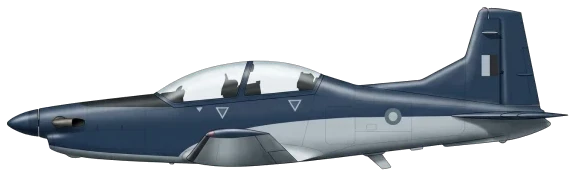
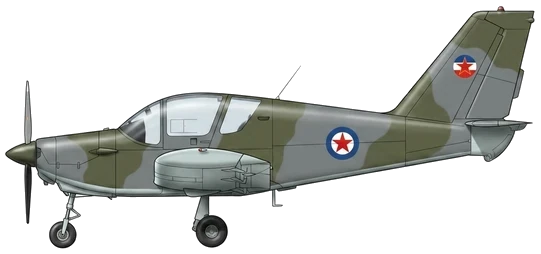
Description
The Utva Lasta 95 is a Serbian tandem two-seat piston-engined military trainer built by Utva Aviation Industry, a subsidiary of Yugoimport SDPR. It is used for basic and initial pilot training, aerobatics, instrument and navigation flying, and basic weapons training, with a secondary light attack and counter-insurgency capability. The first aircraft were delivered to the Iraqi Air Force in 2010, and the type entered Serbian service by 2017.
Development
The Lasta was conceived as a replacement for the Utva 75 and, in part, the Soko G-2 Galeb, then the standard trainers of the Yugoslav Air Force. The first prototype, Lasta 1, was completed in spring 1985 and flew on 2 September 1985. Design work on the modified Lasta 2 began in January 1989 after revised air force requirements; it was lighter, had a shorter fuselage and a new electronics suite including a Ferranti ISIS D-282 fire control system. By the early 1990s Utva and its partners had produced parts for ten pre-production airframes. During the 1999 NATO bombing of Yugoslavia, all five existing prototypes were destroyed in the attack on the Utva plant; a sixth prototype survived damaged and was donated to the Aviation Museum in Belgrade. Development restarted in 2006 as the Lasta 95, retaining the Lasta 2 layout with updated systems. The prototype of the Lasta 3 configuration flew on 26 February 2009.
Design
The Lasta 95 is a low-wing monoplane with a metal airframe, trapezoidal wings of 9.7 m span and 12.9 m² area, and retractable tricycle landing gear suitable for rough-field operations. Length is 7.965 m, empty weight 888 kg, and maximum take-off weight 1,210 kg in the aerobatic category and 1,450 kg in the armed utility category. Power comes from a 232 kW (311 hp) Lycoming AEIO-580-B1A six-cylinder air-cooled horizontally opposed engine driving a two-blade Hartzell HC-C2YR-4CF/FC constant-speed propeller. Maximum speed is 345 km/h, cruise 280 km/h, range 1,160 km, service ceiling 6,000 m, and g limits +6/-3. Avionics include GPS, ILS for CAT II operations, and a Mode S transponder; the Serbian version uses a Garmin G500 glass cockpit with PFD and MFD, an AKN-09 Teleoptik Zemun gunsight, Bendix/King UHF radios, and an instrument flying simulation system. The airframe was designed to FAR/JAR 23 aerobatic category standards. Ejection seats can be fitted at the cost of higher weight and price.
Armament
Two underwing hardpoints carry up to 100–120 kg each. Stores include bombs, 7.62×54mmR or 12.7×108 mm machine gun pods, and 57 mm rocket pods with seven rounds each.
Operational History
The Iraqi Air Force ordered 20 aircraft in 2007 with an option for 16 more. Deliveries began in 2010 and the last of the 20 arrived in 2012; media reports indicate their use during the Iraqi campaign against ISIL. The Serbian Air Force and Air Defence had 14 Lasta 95V-54 in service by 2017. Algeria, Angola and Libya have been reported as interested in the type.
Variants
- Lasta 1: Original 1985 prototype developed to replace the Utva 75.
- Lasta 2: Lighter 1989 redesign with shorter fuselage and Ferranti ISIS D-282 fire control system.
- Lasta 95N: Production version supplied to Iraq.
- Lasta 95V-54: Serbian Air Force version with Garmin G500 glass cockpit, AKN-09 gunsight and composite components.
- Lasta 95P-2: Export equivalent of the 95V-54, adaptable to customer requirements.
Frequently Asked Questions
What type of aircraft is the Lasta-95?
What is the maximum speed of the Lasta-95?
What is the range of the Lasta-95?
When did the Lasta-95 first fly?
How many Lasta-95 have been built?
Which countries operate the Lasta-95?
What is the service ceiling of the Lasta-95?
- AUG 302026 Updated Description updated
- AUG 52026 Updated Climb rate added
- APR 82026 Updated Empty weight added
- APR 72026 Updated Sources and cross-references refreshed
- FEB 72026 Updated Top speed added; ceiling added; range added; wingspan added