IAR-99 Șoim
Romanian jet trainer, noteworthy for its use in the Romanian Air Force since the late 20th century. Key figures: top speed 865 km/h, range 1,100 km, service ceiling 12,900 m, max takeoff weight 5,560 kg, built 28. In service with 1 air force as of 2026 — Romania (21).
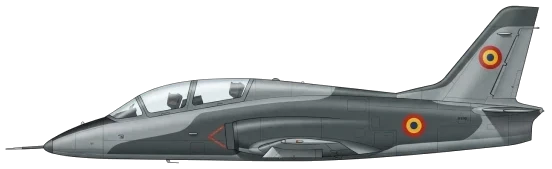
| Length | 11.0 m (36.1 ft) |
| Wingspan | 9.9 m (32.3 ft) |
| Height | 3.9 m (12.8 ft) |
| Wing area | 18.7 m² (201.3 sqft) |
| Empty weight | 3,200 kg (7,055 lbs) |
| Max. takeoff weight | 5,560 kg (12,258 lbs) |
| Powerplant | 1 × turbojet Rolls-Royce Viper Mk632-41M 1,814 kgf each |
| Ejection seat | Martin-Baker Mk 10 |
| Maximum speed | 865 km/h (537 mph) |
| Operational range | 1,100 km (684 mi) |
| Service ceiling | 12,900 m (42,323 ft) |
| Climb rate | 57.5 m/s (188.6 ft/s) |
| Takeoff distance | 450 m (1,476 ft) |

- Air-to-Air Short-Range Python 3
- Air-to-Air Short-Range R550 Magic
- Air-to-Air Short-Range Vympel R-60 / K-60 (AA-8 Aphid)
- Low-Drag Mk 82
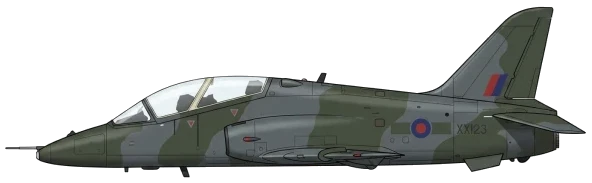
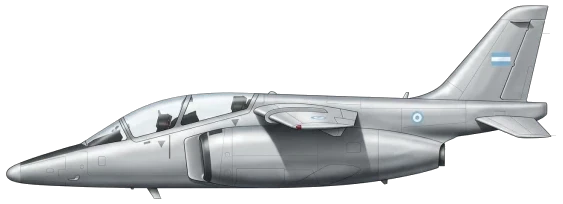
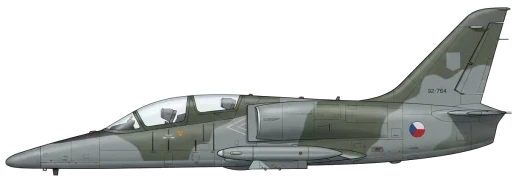
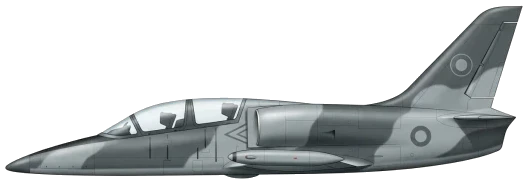
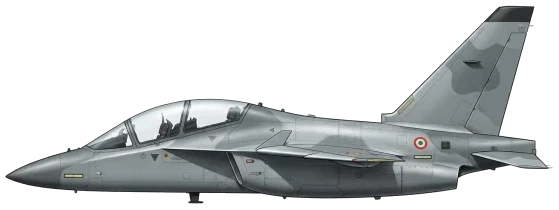
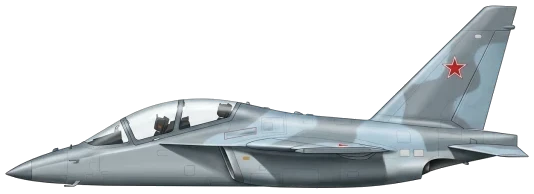
Description
The IAR 99 Șoim is an advanced trainer and light attack aircraft designed and produced by the Romanian manufacturer Avioane Craiova. The first jet aircraft entirely designed and built in Romania, it made its first flight on 21 December 1985 and entered service with the Romanian Air Force in the late 1980s, progressively replacing the Aero L-29 Delfin and L-39 Albatros as the principal jet trainer. It also performs close air support and reconnaissance missions. No export sale has been concluded to date.
Development
Studies began in 1975 and funding for the first aircraft was approved in 1979 at I.Av. Craiova, then engaged in production of the IAR 93. The programme's existence was revealed at the 1983 Paris Air Show. Prototype S-001 flew on 21 December 1985 with Lt-Col. Vagner Ștefănel at the controls; S-002 was used for static tests and S-003 was the second flying prototype. Series production began in 1987, with 17 aircraft delivered to the Romanian Air Force in 1989. In 1990, airframes 708 and 709 received Honeywell avionics under a cooperation with Jaffe Aircraft Corporation and were presented at Farnborough for the American JPATS programme, without an order; aircraft 712 was fitted with Collins avionics in 1991. The modernisation programme resumed in 1996 with Elbit as integrator, with a view to a companion trainer for the MiG-21 Lancer; aircraft 718 flew in this form on 22 May 1997. A contract of 20 April 2000 for 24 aircraft was cut to 12 on 14 December 2000: seven new-build (719–725) and five modernised airframes (709, 711, 712, 713, 717), delivered between 2003 and 2008. In December 2020, Elbit Systems was awarded the modernisation of the 10 remaining IAR 99 Standard aircraft; the first aircraft was modernised in December 2023.
Design
The fuselage is of all-metal semi-monocoque construction with an oval cross-section, with a fully faired retractable tricycle undercarriage on oleo-pneumatic shock absorbers. Power comes from a Turbomecanica/Rolls-Royce Viper Mk632-41M non-afterburning turbojet of 17.79 kN, fed by two lateral air intakes; no airbrake is fitted. The low-set cantilever wing, with straight leading and trailing edges and three degrees of dihedral, is built around two spars and carries ailerons and trim tabs. The tandem two-seat cockpit, with Martin-Baker Mk 10 zero-zero ejection seats, places the rear seat 35 cm higher; the one-piece canopy of aircraft 701–707 was replaced by a two-piece canopy. The Elbit avionics are built around a MIL-STD-1553B bus with colour LCD displays, HOTAS, HUD and DASH helmets. Equipment includes VHF/UHF, IFF, VOR/ILS, DME, ADF, a Northrop Grumman inertial navigation system and Trimble GPS, as well as a datalink-based virtual training system simulating weapons firing and air combat. The electronic warfare suite combines an Elisra radar warning receiver, a countermeasures pod and a decoy dispenser.
Armament
Fixed armament comprises a 23 mm GSh-23L cannon. Four underwing hardpoints of 250 kg each, two of them "wet" for 225 l drop tanks, and one 400 kg centreline station allow a total load of 450 kg. Stores include LPR 57 rockets, R-60, Python and R.550 Magic air-to-air missiles, as well as BEM 250, BE 100, BE 50 and Mk 82 bombs, infrared-guided Opher bombs and laser-guided bombs.
Operational History
The Romanian Air Force operates 21 aircraft and is the type's sole user. The IAR 99Cs replaced the L-39 Albatros at the training school. A sale of ten aircraft to Botswana, based on the IAR-109 Swift standard, was blocked in parliament in the early 1990s; a proposal for two aircraft for Mauritania, together with six maritime patrol IAR 93s, came to nothing. Several losses have been recorded, including S-001 on 26 June 1990 (two killed) and 718 on 23 August 2012.
Variants
- IAR-99 "Standard": initial variant designed as a companion trainer for the IAR-93.
- IAR-109 "Swift": airframe 7003 modified with IAI Lahav in 1992 (HOTAS, wide-angle HUD, ring-laser gyro INS, Eastern and Western weapons), converted back to the Standard after the Botswana failure.
- IAR-99C "Șoim": modernised version fitted with Elbit Systems avionics.
- IAR-99TD: technology demonstrator serving as the basis for the future IAR-99NG, with Vixen 500E radar and a new engine.
- IAR-99SM/SR: Standard modernised as a companion trainer for the F-16/F-35, and C modernised as a light attack aircraft with air-to-air capability.
Frequently Asked Questions
What type of aircraft is the IAR-99 Șoim?
What is the maximum speed of the IAR-99 Șoim?
What is the range of the IAR-99 Șoim?
When did the IAR-99 Șoim first fly?
How many IAR-99 Șoim have been built?
Which countries operate the IAR-99 Șoim?
What is the service ceiling of the IAR-99 Șoim?
- AUG 302026 Updated Description updated
- APR 72026 Updated Sources and cross-references refreshed
- FEB 72026 Updated Range added