PA-31 Navajo
American light, twin-engined aircraft, used extensively for air taxi, flight training, and personal use during the late 20th century. Key figures: top speed 420 km/h, range 1,875 km, service ceiling 8,016 m, max takeoff weight 2,948 kg, built 3,942. In service with 7 air forces as of 2026 — Colombia (2), Antigua and Barbuda (1), Dominican Republic (1) and 4 others.
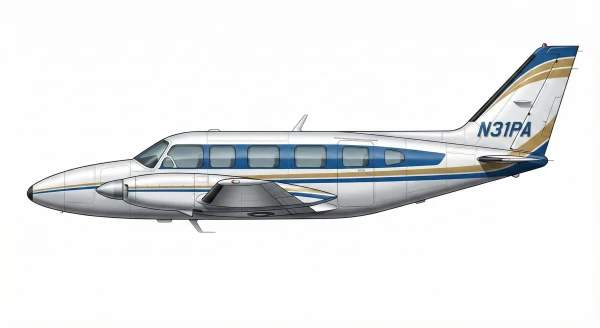
| Length | 9.9 m (32.6 ft) |
| Wingspan | 12.4 m (40.8 ft) |
| Height | 4.0 m (13.0 ft) |
| Wing area | 21 m² (226.0 sqft) |
| Empty weight | 1,783 kg (3,931 lbs) |
| Max. takeoff weight | 2,948 kg (6,499 lbs) |
| Powerplant | 2 × pistons engine Lycoming TIO-540-A 231 kW each |
| Maximum speed | 420 km/h (261 mph) |
| Operational range | 1,875 km (1,165 mi) |
| Service ceiling | 8,016 m (26,299 ft) |
| Climb rate | 7.3 m/s (24.0 ft/s) |
-
 Colombia
2
Colombia
2
- 🇦🇬 Antigua and Barbuda 1
-
 Dominican Republic
1
Dominican Republic
1
-
 Guatemala
1
Guatemala
1
-
 Honduras
1
Honduras
1
-
 Panama
1
Panama
1
-
 United States
1
United States
1
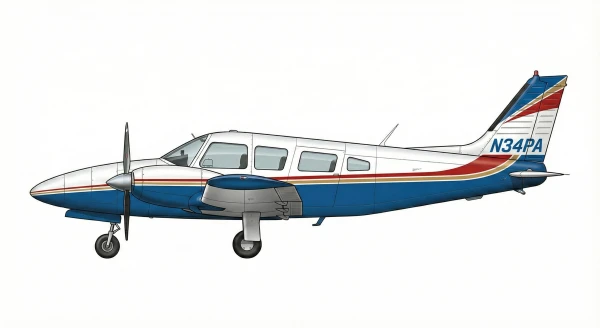
Description
At the behest of William T. Piper, Piper Aircraft began developing a six- to eight-seat twin-engined corporate and commuter transport aircraft in 1962, under the project name Inca. The PA-31 conducted its first flight on September 30, 1964, and was announced later that year. It was initially powered by two 310 hp (231 kW) Lycoming TIO-540-A turbocharged engines. As testing progressed, cabin windows were added to each side of the fuselage, and the engines were repositioned forward. The PA-31, named "Navajo", received FAA certification on February 24, 1966, with a maximum takeoff weight (MTOW) of 6,500 lb (2,948 kg). Deliveries commenced in 1967. The PA-31 series was also manufactured under license in Argentina, Colombia, and Brazil, from kits supplied by Piper. Production ran from 1967 to 1984.
Design
The PA-31 Navajo is a low-wing monoplane with a conventional tail configuration. It was constructed for utility, small cargo, feeder airlines, and corporate transport. The initial design was influenced by the PA-30 Twin Comanche, featuring a similar engine cowling. Early models were equipped with two 310 hp Lycoming TIO-540-A turbocharged engines. Variants such as the PA-31P Pressurized Navajo featured 425 hp Lycoming TIGO-541-E engines and a pressurized cabin. The PA-31-350 Navajo Chieftain introduced a stretched fuselage for increased seating, along with counter-rotating propellers. The 1971 Navajo B variant included air conditioning, increased baggage space, and optional pilot access doors.
The Piper PA-31 Navajo is a civil utility aircraft. Its payload capacity is for passenger and cargo transport. The original PA-31 Navajo has a maximum takeoff weight of 6,500 lb (2,948 kg). Variants like the PA-31-350T1020 were configured for commuter airline use, allowing for increased seating capacity. The PA-31T3 variant could be fitted with an optional underbelly cargo pod.
Operational History
The Navajo family has seen widespread operational use since its introduction among air charter companies, feeder airlines, and commuter air carriers. Air West, a predecessor to Hughes Airwest, operated the PA-31 in scheduled passenger airline service in the U.S. starting in 1968. West Coast Airlines initiated passenger service in 1967, designating the aircraft the "MiniLiner". Military forces have also employed the Navajo in various roles, including the Chilean Navy, Colombian Air Force and Navy, Dominican Republic Air Force, Finnish Air Force, French Navy, Honduran Air Force, Kenya Air Force, Spanish Air Force, and the Aeroplane and Armament Experimental Establishment in the United Kingdom. The Finnish Air Force utilized the PA-31-350 Chieftain for liaison and light transport, while the Kenya Air Force operated a Navajo Chieftain for VIP transport.
Variants
Main Variants:
-
PA-31 Navajo: The initial production version, unofficially known as the PA-31-310.
-
PA-31-300 Navajo: This variant used normally aspirated engines, with 14 units built.
-
PA-31 Navajo B: Introduced in 1971, this variant featured 310 hp (231 kW) Lycoming TIO-540-E turbo-charged piston engines, along with air conditioning and an optional pilot access door.
-
PA-31P Pressurized Navajo: Piper's first pressurized aircraft, this version was powered by two 425-hp (317-kW) Lycoming TIGO-541-E1A piston engines.
-
PA-31-350 Chieftain: This stretched version featured 350-hp (261-kW) counter-rotating engines and increased seating capacity.
Frequently Asked Questions
What type of aircraft is the PA-31 Navajo?
What is the maximum speed of the PA-31 Navajo?
What is the range of the PA-31 Navajo?
When did the PA-31 Navajo first fly?
How many PA-31 Navajo have been built?
Which countries operate the PA-31 Navajo?
What is the service ceiling of the PA-31 Navajo?
- JUL 232026 Updated Sources and cross-references refreshed
- APR 72026 Updated Picture credits updated in a site-wide editorial pass
- JAN 122026 Updated Range updated in a site-wide editorial pass