Su-47 "Berkut" Firkin
Russian experimental supersonic fighter jet, designed in the late 20th century, yet never deployed to operational service. Key figures: top speed 2,500 km/h, range 3,300 km, service ceiling 18,000 m, max takeoff weight 35,000 kg, unit price $75M, built 1.
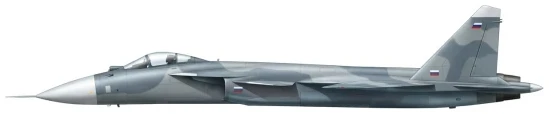
| Crew | 1 |
| Length | 22.6 m (74.1 ft) |
| Wingspan | 15.2 m (49.7 ft) |
| Height | 6.3 m (20.7 ft) |
| Wing area | 61.9 m² (666.0 sqft) |
| Empty weight | 16,375 kg (36,101 lbs) |
| Max. takeoff weight | 35,000 kg (77,162 lbs) |
| Powerplant | 2 × turbofans Aviadvigatel D-30F6 15,602 kgf each |
| Ejection seat | Zvezda K-36DM |
| Maximum speed | 2500 km/h (Mach 2.5) |
| Operational range | 3,300 km (2,051 mi) |
| Service ceiling | 18,000 m (59,055 ft) |
| Climb rate | 233.0 m/s (764.4 ft/s) |
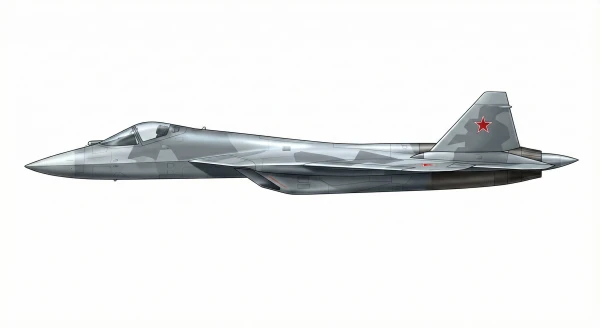

Description
The Sukhoi Su-47 Berkut, NATO reporting name Firkin, is a Russian twin-engine, forward-swept wing technology demonstrator developed by the JSC Sukhoi Company. Designated S-32 and S-37 during initial development, the single aircraft produced never entered serial production or military service. First flown in 1997, the Su-47 served as an experimental testbed for composite materials, fly-by-wire controls, and forward-swept wing design, yielding technologies later applied to the Su-35 and Su-57 fighters.
Development
The project originated in 1983 upon an order from the Soviet Air Force. State funding was frozen following the fall of the USSR, prompting Sukhoi to privately fund the project's continuation. Sukhoi redesignated the aircraft from S-37 to Su-47 in 2002. Only one prototype was built. Development of the forward-swept wing configuration was not pursued for production because its aerodynamic advantages occurred primarily at transonic speeds, while conventional aft-swept wings proved superior at supersonic speeds.
Design
The Su-47 utilizes a tandem-triple aerodynamic configuration featuring forward-mounted canards, forward-swept wings, and tailplanes. To withstand the structural twisting loads generated by forward wing sweep, the wing skins are constructed of composite materials designed to twist opposite to geometric twisting when bending under load. The aircraft shares its forward fuselage, vertical tails, and landing gear with the Su-27 family to reduce development costs. Power is provided by two Soloviev D-30F11 afterburning turbofan engines, each generating 93.1 kN dry thrust and 153 kN with afterburner, with thrust-vectoring engine modifications planned to provide ±20° deflection in pitch and yaw. System accommodations include space for a nose-mounted mission radar, tail-mounted electronic countermeasures radomes, and a rearward-facing radar housed in one of two unequal-length tailbooms.
Armament
The airframe includes an internal weapons bay for ordnance carriage. System specifications also incorporate provisions for conformal weapon storage.
Operational History
As a technology demonstrator, the Su-47 did not undergo combat deployments or achieve export sales. The single aircraft made regular flight appearances at Russia's MAKS air show from 1997 through 2007, followed by a public display at the MAKS-2019 air show in Zhukovsky.
Frequently Asked Questions
What type of aircraft is the Su-47 "Berkut" Firkin?
What is the maximum speed of the Su-47 "Berkut" Firkin?
What is the range of the Su-47 "Berkut" Firkin?
When did the Su-47 "Berkut" Firkin first fly?
How many Su-47 "Berkut" Firkin have been built?
How much does a Su-47 "Berkut" Firkin cost?
What is the service ceiling of the Su-47 "Berkut" Firkin?
- AUG 62026 Updated Description updated
- AUG 52026 Updated Powerplant and thrust updated
- APR 72026 Updated Sources and cross-references refreshed
- APR 52026 Updated Ejection seat added
- JAN 242026 Updated Thrust updated
- JAN 122026 Updated Range updated in a site-wide editorial pass