TS-8 Bies
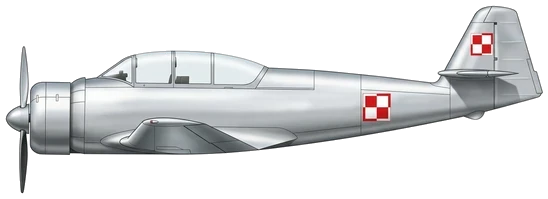
Polish two-seat piston-engined trainer with retractable tricycle landing gear, first flown in 1955 and flown by the Polish Air Force from 1957 until replaced by the TS-11 Iskra. Key figures: top speed 312 km/h, range 800 km, service ceiling 6,000 m, max takeoff weight 1,600 kg, built 251.
| Crew | 2 (student, instructor) |
| Length | 8.5 m (27.9 ft) |
| Wingspan | 10.5 m (34.4 ft) |
| Height | 3 m (9.8 ft) |
| Wing area | 19.1 m² (205.6 sqft) |
| Empty weight | 1,070 kg (2,359 lbs) |
| Max. takeoff weight | 1,600 kg (3,527 lbs) |
| Powerplant | 1 × radial engine Narkiewicz WN-3 240 kW each |
| Maximum speed | 312 km/h (194 mph) |
| Operational range | 800 km (497 mi) |
| Service ceiling | 6,000 m (19,685 ft) |
| Climb rate | 6.8 m/s (22.3 ft/s) |
Description
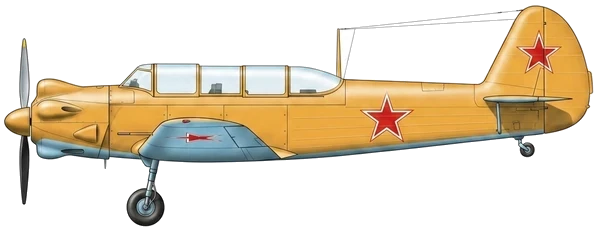
The PZL TS-8 Bies is a Polish two-seat piston-engined trainer designed at the Institute of Aviation in Warsaw and built by WSK-Okęcie and WSK Mielec. It entered Polish Air Force service in 1957 and was replaced from the mid-1960s, after which aero clubs flew it into the 1970s. It was the first modern all-metal aircraft designed and built in Poland after the Second World War, and it used a Polish engine.
Development
The Polish Air Force required a trainer with retractable tricycle landing gear to prepare pilots for jet aircraft, replacing the fixed-gear Junak 3 and the tailwheel Yak-11. The Institute of Aviation's airframe bureau began work in 1953; the "TS" designation comes from its chief designer's initials, and "Bies" is a folk name for the devil. The first prototype flew on 23 July 1955, and two more followed on 13 March and 18 August 1956. A prototype set three international class records for altitude, speed and distance, and the second was shown at the 1957 Paris Air Show. WSK-Okęcie built a pre-series of 10 TS-8 BI in 1957, and WSK Mielec produced 229 TS-8 BII between 1958 and 1960. Around 250 aircraft were built in total.
Design
The TS-8 is an all-metal cantilever low-wing monoplane with a semi-monocoque fuselage of oval cross-section. The three-part single-spar wing has an inverted gull shape seen from the front, and the tricycle landing gear retracts into the wings and fuselage. A WN-3 seven-cylinder radial engine rated at 240 kW (320 hp), with 250 kW (340 hp) of emergency power, drives a two-blade propeller of 2.20 m diameter. Student and instructor sit in tandem under rearward-sliding canopy sections, with dual controls. The aircraft was used for basic, aerobatic and instrument training; its handling was good, but the engine was noisy.
Armament
Production trainers carried no armament. The TS-8 BI pre-series had one 12.7 mm machine gun and two pylons for practice bombs, with underwing racks rated for up to 200 kg.
Operational History
The Polish Air Force began withdrawing the TS-8 in the mid-1960s as PZL TS-11 Iskra jet trainers arrived; the Polish Navy also operated the type. More than 100 retired aircraft went to aero clubs, where most served until 1978. One aircraft landed safely after its WN-3 engine tore away in flight, and a TS-8 crashed at Dziwiszów in 1968. Indonesia operated two aircraft from Bandung. Three remain airworthy, and several more are preserved.
Variants
- TS-8: Prototypes, three built.
- TS-8 BI: Pre-series of 10 built by WSK-Okęcie in 1957, the only armed version.
- TS-8 BII: Improved main production version, 229 built by WSK Mielec from 1958 to 1960.
- TS-8 BIII: Final production batch of 10 with improved avionics.
Frequently Asked Questions
What type of aircraft is the TS-8 Bies?
What is the maximum speed of the TS-8 Bies?
What is the range of the TS-8 Bies?
When did the TS-8 Bies first fly?
How many TS-8 Bies have been built?
Which countries operate the TS-8 Bies?
What is the service ceiling of the TS-8 Bies?
- OCT 32026 Created Page created: TS-8 Bies