T-28 Trojan
American radial-engine military trainer and counter-insurgency aircraft, introduced in the 1950s, used extensively for pilot training and ground support missions. Key figures: top speed 552 km/h, range 1,710 km, service ceiling 10,800 m, max takeoff weight 3,856 kg, built 1,948.
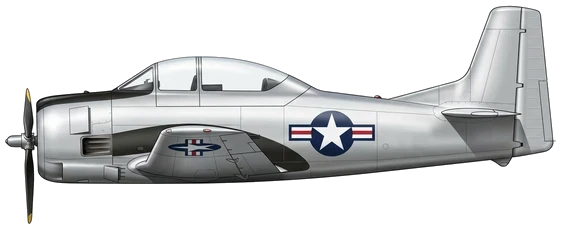
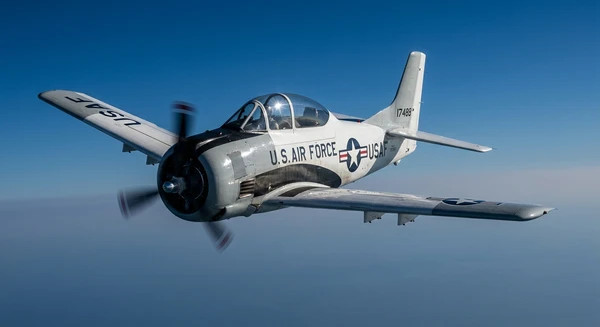
| Crew | 2 |
| Length | 10.1 m (33.0 ft) |
| Wingspan | 12.2 m (40.1 ft) |
| Height | 3.9 m (12.7 ft) |
| Wing area | 24.9 m² (268.0 sqft) |
| Empty weight | 2,914 kg (6,424 lbs) |
| Max. takeoff weight | 3,856 kg (8,501 lbs) |
| Powerplant | 1 × Wright R-1820-86 Cyclone 9-cylinder air-cooled radial engine 1,063 kW each |
| Maximum speed | 552 km/h (343 mph) |
| Operational range | 1,710 km (1,063 mi) |
| Service ceiling | 10,800 m (35,433 ft) |
| Climb rate | 18.0 m/s (59.1 ft/s) |
- Gun Pod 12.7 mm machine gun pods
- Rocket Pod MATRA Type 122 6 x 68 mm
- Unguided Bomb 120 kg HE/GP iron bomb
- Rocket Pod MATRA Type 361 36 x 37 mm
- Rocket Pod SNEB 7 x 55 mm
- Rocket Pod SERAM T10 heavy rocket launchers
- Unguided Bomb Napalm (bidons spéciaux)
Description
The North American Aviation T-28 Trojan, designated XT-28 (company designation NA-159), performed its first flight on 24 September 1949. Designed to replace the T-6 Texan, the aircraft arrived at Eglin Air Force Base in June 1950 for suitability tests. Between 1950 and 1957, a total of 1,948 aircraft were produced. While originally designed as a trainer, the T-28 was later remanufactured for counter-insurgency and general aviation roles by companies including Hamilton Aircraft, PacAero, and Fairchild Hiller.
Design
The T-28 is a radial-engine monoplane. The T-28A utilized an 800 hp Wright R-1300-1 engine with a two-bladed propeller, while the T-28B featured a 1,425 hp Wright R-1820-86 engine and a three-bladed propeller. The T-28C was equipped with a tailhook and shortened propeller blades for carrier-landing training. The T-28D-5 variant incorporated internal wing ammo pans to improve aerodynamics and center of gravity when using gun pods. The French T-28S Fennec utilized a supercharged Wright R-1820-97 engine, side-armor, and an electrically powered sliding canopy. Experimental turboprop versions, such as the YAT-28E, used a 2,445 hp Lycoming YT-55L-9 engine.
Armament
Armament configurations varied by mission type. The T-28D featured two underwing hardpoints, while the AT-28D was equipped with six hardpoints. The T-28S Fennec typically carried two 12.7 mm machine gun pods and two MATRA Type 122 rocket pods, with the capability to mount 120 kg bombs and various SNEB or MATRA rocket launchers. The experimental YAT-28E featured 12 hardpoints with a total capacity of 6,000 lb.
Operational History
The USAF used the T-28 for primary pilot training until the early 1960s, while the U.S. Navy, Marine Corps, and Coast Guard operated the type as a primary trainer until 1984. In combat, the T-28 saw service during the Vietnam War with the USAF and the Republic of Vietnam Air Force (RVNAF). The North Vietnamese Air Force operated a single captured T-28, which recorded its first aerial victory against a C-123 on 15 February 1964. France deployed the T-28S Fennec for close support missions in Algeria. Other combat deployments occurred in the Belgian Congo via the CIA, the Khmer Republic, and the Philippines during the 1989 coup attempt. Export customers included Argentina, Brazil, Morocco, Thailand, and Taiwan.
Variants
- T-28A: U.S. Air Force version powered by an 800 hp Wright R-1300-1 radial engine.
- T-28B: U.S. Navy land-based trainer featuring a 1,425 hp Wright R-1820-86 engine and a belly-mounted speed brake.
- T-28C: U.S. Navy carrier-landing trainer equipped with a tailhook and shortened propeller blades.
- T-28D Nomad: Conversions for counter-insurgency and reconnaissance roles in Vietnam, typically featuring underwing hardpoints.
- T-28S Fennec: French-modified T-28A airframes fitted with 1,200 hp supercharged engines and four underwing hardpoints for North African operations.
Frequently Asked Questions
What type of aircraft is the T-28 Trojan?
What is the maximum speed of the T-28 Trojan?
What is the range of the T-28 Trojan?
When did the T-28 Trojan first fly?
How many T-28 Trojan have been built?
Which countries operate the T-28 Trojan?
What is the service ceiling of the T-28 Trojan?
- MAY 102026 Created Page created: T-28 Trojan