Twin Pioneer
British twin-engined STOL light transport first flown in 1955, flown by the RAF and Royal Malaysian Air Force from short, rough strips in Aden, the Gulf and Borneo. Key figures: top speed 266 km/h, range 1,273 km, service ceiling 5,182 m, max takeoff weight 6,622 kg, built 87.
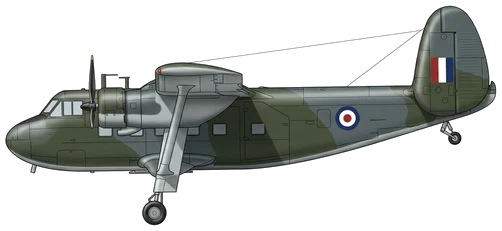
| Crew | 2 (pilot, co-pilot) |
| Length | 13.8 m (45.2 ft) |
| Wingspan | 23.3 m (76.5 ft) |
| Height | 3.7 m (12.2 ft) |
| Wing area | 62.3 m² (670.1 sqft) |
| Empty weight | 4,354 kg (9,599 lbs) |
| Max. takeoff weight | 6,622 kg (14,599 lbs) |
| Powerplant | 2 × piston engines Alvis Leonides 514/8 403 kW each |
| Maximum speed | 266 km/h (165 mph) |
| Operational range | 1,273 km (791 mi) |
| Service ceiling | 5,182 m (17,001 ft) |
| Climb rate | 6.35 m/s (20.8 ft/s) |
- Up to 907 kg (2,000 lb) of bombs on racks under the undercarriage sponsons
Description
The Scottish Aviation Twin Pioneer is a British twin-engined STOL transport built by Scottish Aviation Limited at Prestwick Airport, Scotland, during the 1950s for civil and military operators. It was developed as a twin-engined counterpart to the single-engined Pioneer and, like that aircraft, could operate from a strip 30 m (99 ft) wide by 275 m (902 ft) long. It entered Royal Air Force service in 1958 as the Twin Pioneer CC.Mk 1 and was used in Aden, the Persian Gulf, Malaya and Borneo.
Development
The prototype, G-ANTP, first flew at Prestwick on 25 June 1955. It was shown at the Society of British Aircraft Constructors Show at Farnborough in September 1955. Three pre-production aircraft were built for trials, sales and demonstrations. In 1958 the 33rd airframe became the prototype for the Series 2, which used Pratt & Whitney R-1340 Wasp engines and was ordered by Philippine Air Lines. The Series 3, with the Alvis Leonides 531, followed in 1959.
In 1957 two fatal accidents were caused by fatigue failure that detached the outer wing panel in flight. Kroonduif's JZ-PPX crashed off Japen Island on 30 August 1957. G-AOEO crashed near Fezzan, Libya, on 7 December 1957, killing all six aboard, among them a co-founder of Scottish Aviation. The wing structure was redesigned, and the accidents reduced sales.
Design
The Twin Pioneer is a high-wing cabin monoplane with a NACA 4415 aerofoil, a triple fin and rudder assembly, and fixed tailwheel undercarriage. The CC Mk.1 has a wingspan of 23.32 m and a length of 13.79 m. Its maximum take-off weight is 6,622 kg. It is powered by two Alvis Leonides 514/8 nine-cylinder radials rated at 540 hp for take-off, driving three-bladed de Havilland constant-speed feathering propellers.
The crew is two pilots. The cabin holds 16 passengers, 12 equipped troops, 10 paratroopers, 12 litters or 1,542 kg of air-droppable cargo. Military versions carry 371 imp gal of fuel plus up to two 100 imp gal cabin tanks, against 247 imp gal in civil versions. Stall speed is 97 km/h and range is 1,273 km. Take-off distance to 15 m is 340 m.
Armament
The military version could carry external stores under the stub wings. Up to 907 kg (2,000 lb) of bombs could be mounted under the undercarriage sponsons.
Operational History
The RAF ordered 39 aircraft, built between 1958 and 1959. They served with No. 21 Squadron, which reformed at Benson in May 1959 and moved to Kenya and then, in June 1965, to Aden. Other users were No. 78 Squadron at Khormaksar, No. 152 Squadron at Muharraq and No. 209 Squadron at Seletar. The type moved troops and supplies, supported the Sultan of Oman and served in the Malayan Emergency and the Borneo confrontation. No. 78 Squadron lost two aircraft on one day to double engine failures. No. 230 Squadron was the last RAF operator, and the Empire Test Pilots' School used one aircraft from 1965 to 1974.
On 16 January 1962 a Twin Pioneer became the first aircraft delivered to the Royal Malaysian Air Force, which received 15 and operated the type for 12 years. The Indonesian Air Force and the Sultan of Oman's Air Force were also military operators. Civil users included Rio Tinto, the Austrian and Swiss government survey departments, Kroonduif in Dutch New Guinea, and airlines in Asia, Africa and Europe.
Variants
- Series 1: Production model with 560 hp Alvis Leonides 514 engines, 23 built, many later converted to Series 3 standard.
- CC.Mk 1: RAF military version of the Series 1, 32 built.
- Series 2: Production model with 600 hp Pratt & Whitney R-1340 engines, 6 built.
- Series 3: Production model with 640 hp Alvis Leonides 531 engines, 18 built.
- CC.Mk 2: RAF military version of the Series 3, 7 built.
Frequently Asked Questions
What type of aircraft is the Twin Pioneer?
What is the maximum speed of the Twin Pioneer?
What is the range of the Twin Pioneer?
When did the Twin Pioneer first fly?
How many Twin Pioneer have been built?
Which countries operate the Twin Pioneer?
What is the service ceiling of the Twin Pioneer?
- OCT 12026 Created Page created: Twin Pioneer