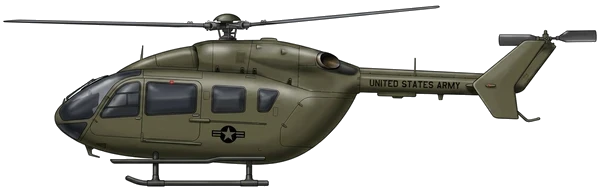
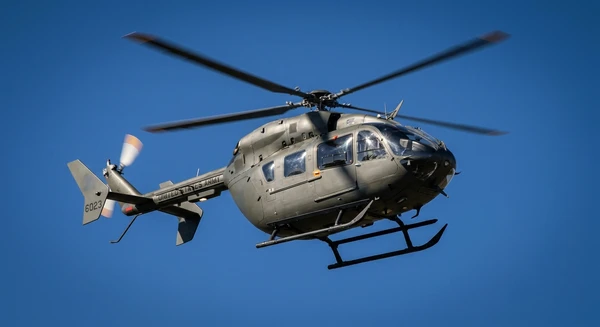
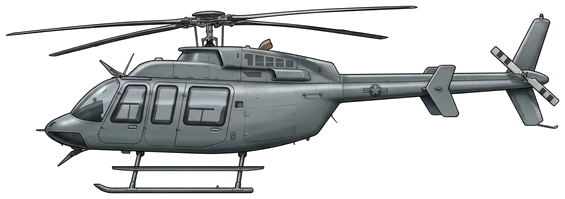
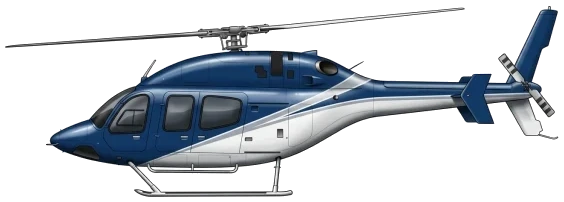
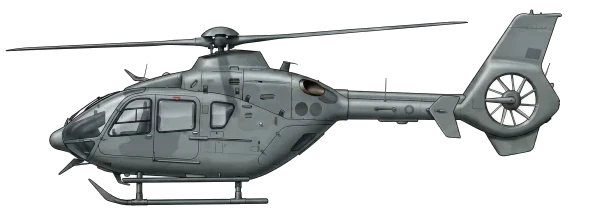
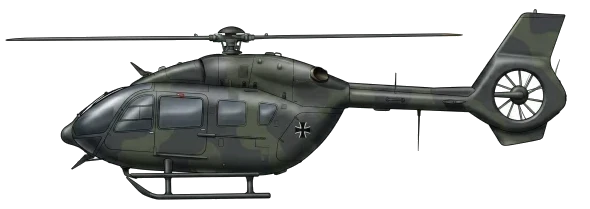
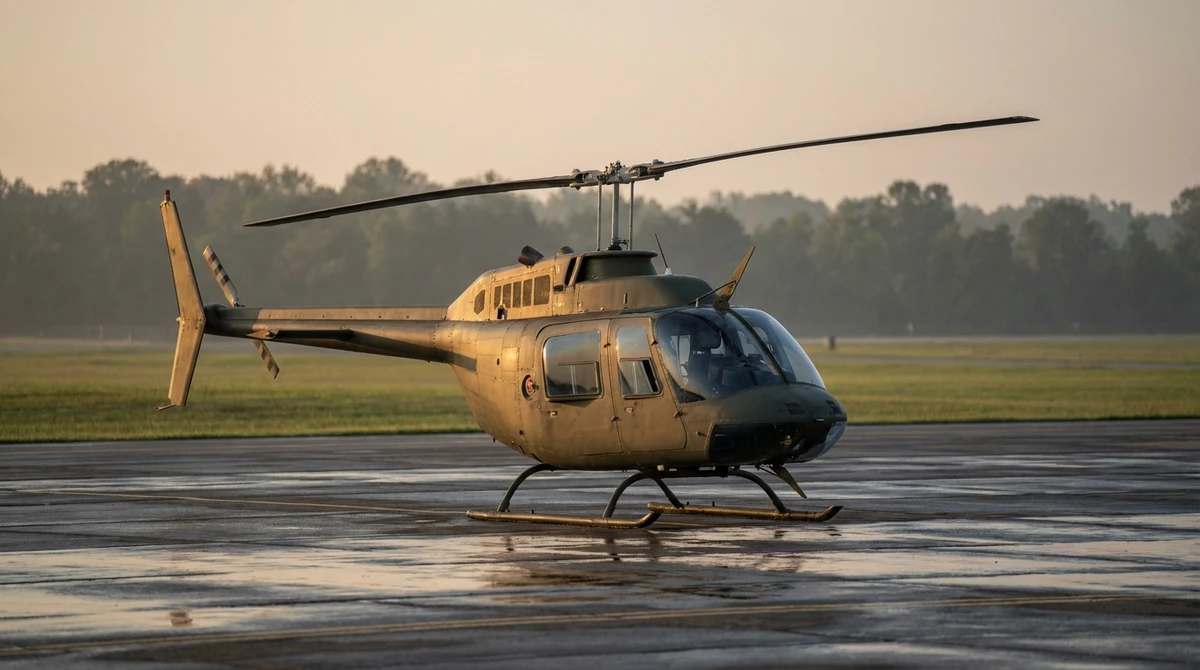
The Airbus Helicopters UH-72 Lakota is a twin-engine light utility helicopter based on the civilian Eurocopter EC145. It was developed to fulfill the United States Army's Light Utility Helicopter (LUH) requirement, initiated in 2004 following the cancellation of the RAH-66 Comanche program. In June 2006, the Army selected the EADS North America UH-145 proposal, designating it the UH-72A. American Eurocopter was awarded an initial contract for 345 aircraft to replace Bell UH-1H/V Iroquois and Bell OH-58A/C Kiowa helicopters. First delivery occurred in December 2006, and full-rate production was approved in August 2007, with assembly taking place in Columbus, Mississippi. By 2022, over 460 UH-72A and B models had been produced.
Design
The UH-72A features a single four-bladed main rotor, a traditional tail rotor, and clamshell rear access doors. Power is provided by two Turbomeca Arriel 1E2 turboshaft engines, each producing 738 shp. The aircraft has a fully integrated computerized cockpit and is equipped with an AN/ARC-231 radio. Its payload capacity is 3,953 lb (1,793 kg). For domestic security and patrol missions, the helicopter can be equipped with the Security & Support Mission Equipment Package (S&S MEP), which includes an electro-optical/infrared sensor, laser pointer turret, moving map system, searchlight, and a rescue hoist. The upgraded UH-72B features a five-bladed main rotor, a Fenestron ducted tail rotor, more powerful engines with automated Full Authority Digital Engine Control (FADEC), and the Helionix avionics suite.
Armament
The UH-72 is unarmed in its standard utility configurations. Proposed armed variants, such as the AAS-72X developed for the cancelled Armed Aerial Scout program, featured two external hardpoints and turret-mounted optical sensors.
Operational History
The U.S. Army and Army National Guard operate the UH-72 for non-combat logistics, medical evacuation (MEDEVAC), homeland security, disaster response, and pilot training, freeing Sikorsky UH-60 Black Hawks for combat deployments. The U.S. Navy also operates the UH-72A at the Naval Test Pilot School. While not cleared for combat zone deployments, the UH-72 made its first overseas deployment in 2018 when the 1-376th Aviation Battalion deployed to Germany to perform MEDEVAC duties at Hohenfels and Grafenwoehr. Thailand is the sole export customer, receiving six UH-72As for the Royal Thai Army between 2014 and 2015.
Variants
- UH-72A Lakota: An unarmed utility military version of the EC145 equipped with a four-bladed main rotor and traditional tail rotor.
- UH-72B Lakota: An upgraded configuration based on the civilian H145 featuring a five-bladed main rotor, a Fenestron tail rotor, more powerful engines, and the Helionix avionics suite.
- UH-72B Unmanned Logistics Connector: A proposed autonomous variant of the UH-72B designed to provide uncrewed logistical support for the USMC and U.S. Army, designated as MQ-72C as of June 2025.
- AAS-72X: A proposed armed scout and multi-role version of the UH-72A equipped with two external hardpoints and a turret-mounted vision system.
- AAS-72X+: A proposed armed variant based on the EC145T2 featuring more powerful engines, a Fenestron tail rotor, and a digital glass cockpit.