An-30 Clank
Soviet photo-mapping aircraft, operational in Cold War-era, widely utilised for aerial cartography and surveillance roles. Key figures: top speed 540 km/h, range 2,630 km, service ceiling 8,300 m, max takeoff weight 23,000 kg, unit price $7M, built 123. In service with 5 air forces as of 2026 — Russia (16), Sudan (4), China (3) and 2 others.
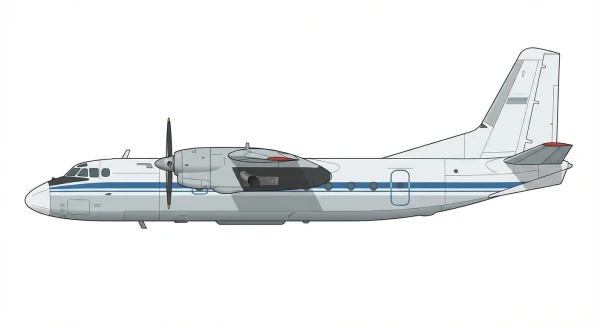
| Length | 24.3 m (79.6 ft) |
| Wingspan | 29.2 m (95.8 ft) |
| Height | 8.3 m (27.3 ft) |
| Wing area | 75 m² (807.3 sqft) |
| Empty weight | 15,590 kg (34,370 lbs) |
| Max. takeoff weight | 23,000 kg (50,706 lbs) |
| Powerplant | 2 × turboprops Ivchenko-Progress AI-24T 2,074 kW each |
| Maximum speed | 540 km/h (336 mph) |
| Operational range | 2,630 km (1,634 mi) |
| Service ceiling | 8,300 m (27,231 ft) |


Description
The Antonov An-30 (NATO reporting name: Clank, nicknamed Nastia in Soviet service) is a twin-turboprop aerial survey and cartography aircraft derived from the An-24, developed in the Soviet Union and built by Antonov in Kiev. It is the second member of the An-24 family, preceding the An-26 and An-32. Civil certification was completed in 1974, and the type is known for its extensively glazed nose and raised, humped flight deck, as well as for its later use in Open Skies Treaty observation flights.
Development
The first aerial survey version of the An-24 was designed by the Beriev OKB as the An-24FK (fotokartograficheskiy, photo mapping). The prototype was converted from a production An-24A in Beriev's No. 49 construction shop during 1966 and first flew on 21 August 1967. State acceptance trials concluded in 1970 and civil certification in 1974. Redesignated An-30, production began at the Antonov factory in Kiev in 1971 and ran until 1980 in two main versions; sources give 123 production aircraft, with 115 built and 23 sold abroad.
Design
The An-30 uses the An-24 airframe with an entirely new fuselage forward of frame 11. The glazed nose houses the navigator and navigation equipment, including an optical sight for photographic accuracy, and computer flight-path control for repeatable survey runs; this equipment replaced the An-24's radar. Fitting it required raising the flight deck by 41 cm, producing the aircraft's characteristic hump. The radio operator and flight engineer sat in the first cabin aft of and below the flight deck, while the mission cabin further aft had five camera windows in the floor, closed by covers stowed in fairings under the fuselage, plus two camera operator stations and a crew rest area. Four or five cameras were carried: three mounted vertically for mapping and two angled 28° to each side for oblique photography, usable between 2,000 and 7,000 m at scales from 1:200,000 to 1:15,000,000. Power came from two Ivchenko AI-24VT turboprops rated at 2,820 ehp, supplemented by a Soyuz (Tumansky) RU-19A-300 turbojet.
Operational History
Besides survey work, the An-30 has flown Open Skies Treaty surveillance for Bulgaria, the Czech Republic, Romania, Russia and Ukraine. The An-30M weather-control variant ejected dry ice to seed clouds, suppress hailstorms, or secure clear weather for events such as the 1 May parades and the 850th anniversary of Moscow in September 1997. Exports went to Afghanistan, Bulgaria, China, Cuba, Czechoslovakia, Mongolia and Vietnam. An-30s completely mapped Afghanistan in 1982; one was shot down by a MANPADS south of the Panjshir Valley near Kabul on 11 March 1985. Cuban An-30s operated in Angola in 1987. On 22 April 2014 a Ukrainian An-30 was hit by small-arms fire over Sloviansk and landed with minor damage; on 6 June 2014 a Ukrainian An-30B was shot down near Slavyansk by a MANPADS.
Variants
- An-24FK: Sole prototype converted from an An-24 with glazed navigator's nose and elevated cockpit.
- An-30A: Civil version; 65 to the Soviet Ministry of Civil Aviation, six to other Soviet organisations, 18 for export including seven to China.
- An-30B: Soviet Air Force version with different avionics; 26 built, most retrofitted with chaff/flare dispensers.
- An-30D Sibiryak: Long-range 1990 conversion with increased fuel, data-link and rescue equipment; five converted for ice and fisheries monitoring and transport.
- An-30R: NBC reconnaissance conversion with air-sampling pods; RA-30055 monitored the Chernobyl No. 4 reactor plume and was withdrawn as permanently radioactive.
Frequently Asked Questions
What type of aircraft is the An-30 Clank?
What is the maximum speed of the An-30 Clank?
What is the range of the An-30 Clank?
When did the An-30 Clank first fly?
How many An-30 Clank have been built?
Which countries operate the An-30 Clank?
How much does a An-30 Clank cost?
What is the service ceiling of the An-30 Clank?
- AUG 302026 Updated Description updated
- JUL 232026 Updated Sources and cross-references refreshed
- APR 72026 Updated Sources and cross-references refreshed
- MAR 172026 Updated Description updated
- FEB 72026 Updated Range added