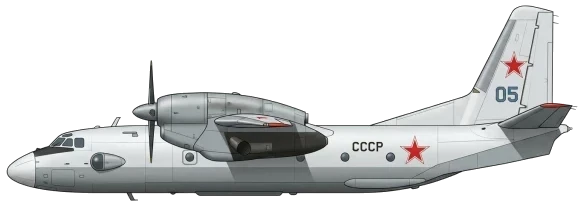
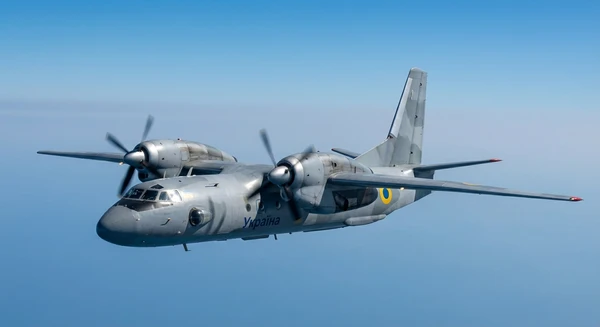
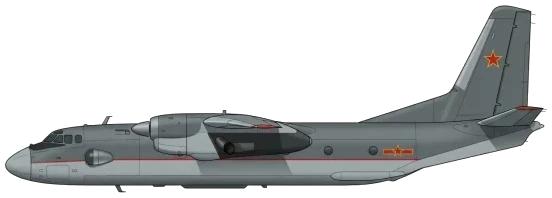
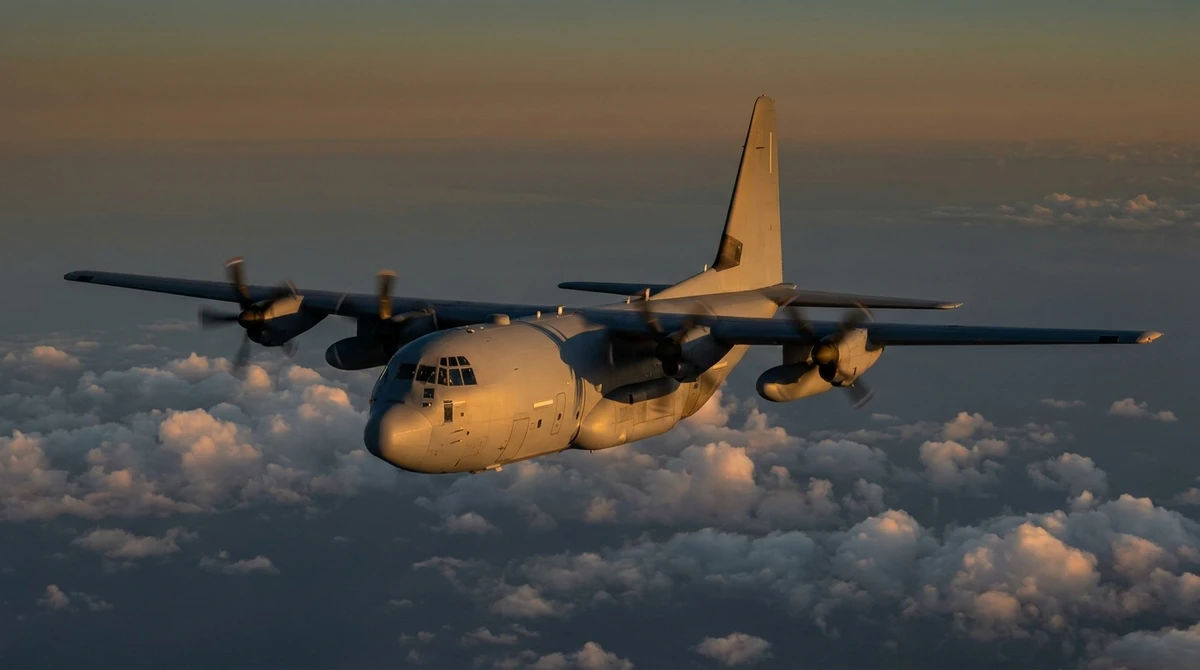
The Antonov An-32 (NATO reporting name: Cline) is a twin-engined turboprop military transport aircraft designed in the Soviet Union by Antonov and manufactured at the Government Aircraft Factory in Kyiv, Ukraine. Developed as an upgraded derivative of the An-26, the type entered service in the 1980s for tactical air transport, cargo air-dropping, troop transport, and medevac roles. The aircraft is designed for operations in adverse weather conditions and hot and high environments, maintaining takeoff capabilities at elevations up to 4,500 meters and ambient temperatures reaching 55 °C.
Development
Design of the An-32 began as a re-engined variant of the An-26 within the An-24 family, succeeding the An-24, An-30, and An-26. The prototype made its first flight in July 1976 and was presented at the Paris Air Show in May 1977. Serial production ran from 1980 to 2012 in Kyiv, averaging approximately 40 airframes per year during the late 1980s and early 1990s. Over 240 aircraft were produced, including more than 120 delivered to the Indian Air Force following an order arranged under Soviet-Indian diplomatic agreements.
Design
The An-32 features high-lift wings with automatic leading-edge slats, triple-slotted trailing-edge flaps, and an enlarged tailplane. To avoid foreign object damage on unprepared airstrips, the engine nacelles are mounted 1.5 meters above the wing, allowing clearance for larger four-bladed propellers. Power is provided by two Ivchenko AI-20 turboprop engines rated at 5,100 hp each, yielding nearly double the output of the An-26's AI-24 engines. The aircraft operates with a four-person crew and carries a maximum payload of 6,700 kg, 50 passengers, 42 paratroopers, or 24 stretchers with three medical personnel.
Operational History
The An-32 entered operational service in the 1980s and was adopted by military operators including Russia, Ukraine, India, Iraq, Bangladesh, Mexico, Peru, and Sudan. The Indian Air Force became the largest operator, procuring 125 airframes and initiating modernization programs in 2009 and 2024 to upgrade avionics, oxygen systems, and crew seating. In 2014, the Iraqi Air Force used its An-32B fleet as bombers during operations against ISIS in Iraq.
Variants
-
An-32A: The initial civil production variant, built primarily to transport assemblies between government factory enterprises.
-
An-32B: An improved transport version developed with enhanced operational capabilities.
-
An-32B-100: A modernized variant of the An-32B featuring an increased maximum takeoff weight of 28.5 tons and a payload capacity of 7.5 tons.
-
An-32P Firekiller: A specialized aerial firefighting version fitted with two external tanks capable of discharging eight tons of liquid retardant.
-
An-32 RE: A modernized upgrade package for the An-32B incorporating new avionics, a 28.5-ton MTOW, and a 7.5-ton payload limit.