Boeing 767
American wide-body jet airliner, widely known for its extensive use in commercial aviation since the 1980s. Key figures: top speed 912 km/h, range 7,200 km, service ceiling 13,137 m, max takeoff weight 136,078 kg, unit price $160M, built 1,288. In service with 2 air forces as of 2026 — Japan (4), Chile (1).
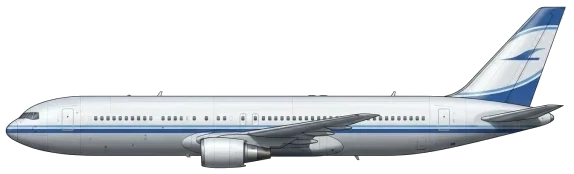
| Length | 48.5 m (159.1 ft) |
| Wingspan | 47.6 m (156.2 ft) |
| Height | 16 m (52.5 ft) |
| Wing area | 283 m² (3046.2 sqft) |
| Empty weight | 80,286 kg (177,000 lbs) |
| Max. takeoff weight | 136,078 kg (300,000 lbs) |
| Powerplant | 2 × turbofans Pratt & Whitney JT9D-7R4D 21,772 kgf each |
| Maximum speed | 912 km/h (567 mph) |
| Operational range | 7,200 km (4,474 mi) |
| Service ceiling | 13,137 m (43,100 ft) |
| Takeoff distance | 1,768 m (5,801 ft) |


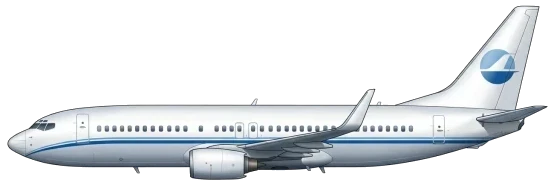
Description
The Boeing 767 is an American wide-body twinjet airliner developed and manufactured by Boeing Commercial Airplanes. It entered service on 8 September 1982 with United Airlines and was Boeing's first wide-body twinjet and its first airliner with a two-crew glass cockpit. Military derivatives include the E-767 airborne early warning aircraft and the KC-767 and KC-46 aerial tankers.
Development
Boeing began the 7X7 study in 1972 for a twin-aisle aircraft smaller than the 747, DC-10 and L-1011, intended to replace the 707. Risk-sharing agreements were signed with Aeritalia of Italy and Japan's Civil Transport Development Corporation, comprising Fuji, Kawasaki and Mitsubishi Heavy Industries. The 767 designation was applied in February 1978 and the programme was launched on 14 July 1978 with an order for 30 767-200s from United Airlines. The prototype, N767BA, rolled out on 4 August 1981 and first flew on 26 September 1981; FAA and UK CAA certification of the JT9D-powered 767-200 followed in July 1982 after 1,600 flight-test hours. Stretched models followed: the 767-300 in October 1986, the 767-300ER in 1988, the 767-300F freighter in October 1995, and the 767-400ER in September 2000. The 1,000th aircraft rolled out on 2 February 2011. As of July 2026, Boeing had received 1,451 orders from 74 customers, with 1,370 delivered.
Design
The 767 is a low-wing cantilever monoplane with a conventional single-fin tail and wings swept 31.5 degrees, using a supercritical aerofoil optimised for Mach 0.8 cruise. Each wing has six-panel leading-edge slats, single- and double-slotted flaps, inboard and outboard ailerons and six spoilers. Carbon-fibre wing surfaces, Kevlar fairings and improved aluminium alloys cut structural weight by 1,900 lb (860 kg). The 16.5 ft (5.03 m) fuselage width permits seven-abreast seating but not paired LD3 containers, prompting development of the LD2 unit load device. Powerplants comprise Pratt & Whitney JT9D (later PW4000), General Electric CF6 or Rolls-Royce RB211 turbofans, initially rated at 48,000 lbf (210 kN). The flight deck uses six Rockwell Collins CRT displays presenting EFIS and EICAS data; the 767-400ER substitutes six LCDs. In 1984 the 767 became the first aircraft certified by the FAA for CAT IIIb landings at 980 ft (300 m) visibility.
Operational History
The 767 recorded a 96.1 percent dispatch rate in its first year. In May 1985 the FAA granted the type its first 120-minute ETOPS approval, beginning with TWA, extended to 180 minutes for CF6-powered aircraft in 1989. An Ethiopian Airlines 767-200ER flew 12,082 km non-stop from Washington to Addis Ababa in May 1984, and an Air Mauritius aircraft covered 8,727 nmi from Halifax to Port Louis on 17 April 1988. Japan operates four E-767s, delivered from March 1998, and four KC-767Js; the Italian Air Force received the first of four KC-767As in January 2011. The USAF selected the KC-767 Advanced Tanker for its KC-X programme on 24 February 2011, covering 179 aircraft. The Colombian Air Force operates the IAI-converted 767 MMTT, and Brazil ordered two 767-300ER tanker conversions in 2013.
Variants
- 767-300ER: Extended-range stretch with 412,000 lb MTOW, entered service with American Airlines in 1988; 583 delivered, the best-selling version.
- 767-300F: Production freighter with main-deck cargo door and strengthened floor, carrying 24 pallets and 30 LD2 containers, in service with UPS from 1995.
- 767-400ER: Second stretch to 205 ft with raked wingtips and CF6 engines, 37 delivered to Continental and Delta from 2000.
- E-767: AWACS platform combining the E-3 Sentry mission system with a 767-200ER airframe; four operated by Japan.
- KC-767: 767-200ER-based tanker with fly-by-wire refuelling boom, operated by Italy and Japan.
Frequently Asked Questions
What type of aircraft is the Boeing 767?
What is the maximum speed of the Boeing 767?
What is the range of the Boeing 767?
When did the Boeing 767 first fly?
How many Boeing 767 have been built?
Which countries operate the Boeing 767?
How much does a Boeing 767 cost?
What is the service ceiling of the Boeing 767?
- AUG 302026 Updated Description updated
- JUL 272026 Updated Name updated
- JUL 242026 Updated Description updated
- APR 72026 Updated Sources and cross-references refreshed
- FEB 72026 Updated Range added