AV-8B Harrier II vs Sea Harrier
AV-8B Harrier II vs Sea Harrier at a glance — top speed 1,070 vs 1,145 km/h, range 3,300 vs 3,222 km, max takeoff weight 14,100 vs 11,884 kg, built 337 vs 111 units.
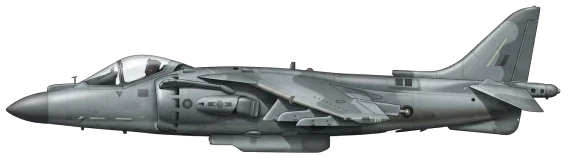
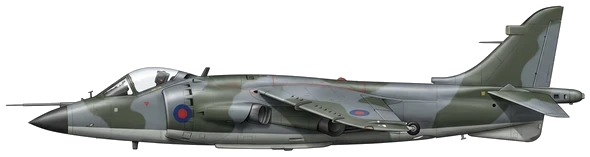
| AV-8B Harrier II | Sea Harrier | |
|---|---|---|
| Origin country | 🇬🇧 United Kingdom🇺🇸 United States | 🇬🇧 United Kingdom |
| Category | Combat Aircraft | Combat Aircraft |
| Manufacturer | McDonnell Douglas | British Aerospace |
| First flight | 6 January 1971 | 20 August 1978 |
| Year introduced | 1983 | 1980 |
| Number produced | 337 units | 111 units |
| Average unit price | $26 million | $15.6 million |
| Wing area | 22.6 m² | 18.7 m² |
| Wingspan | 9.3 m | 7.7 m |
| Height | 3.6 m | 3.7 m |
| Length | 14.1 m | 14.2 m |
| Maximum speed | 1070 km/h | 1145 km/h |
| Operational range | 3,300 km | 3,222 km |
| Service ceiling | 15,240 m | 16,000 m |
| Max. takeoff weight | 14,100 kg | 11,884 kg |
| Empty weight | 6,340 kg | 6,616 kg |
| Total thrust | 1 x 10,500 kgf | 1 x 96 kN |
Detailed Comparison
The McDonnell Douglas AV-8B Harrier II prioritizes payload and loiter time for US Marine Corps close air support, while the British Aerospace Sea Harrier operates as a fleet air defense interceptor for the Royal Navy. Both stem from the Hawker Siddeley V/STOL design but adapt the airframe to opposing combat doctrines.
Development and Design
The AV-8B addressed the severe range and payload limitations of the first-generation AV-8A. McDonnell Douglas replaced the original metal wing with a 22.61 m² supercritical composite structure and added leading-edge root extensions (LERX). This aerodynamic rework sacrificed top speed to maximize low-speed lift, fuel capacity, and turn rate.
Conversely, the Sea Harrier retained a smaller 18.68 m² wing but altered the forward fuselage to accommodate a raised cockpit and maritime radar—initially the Ferranti Blue Fox, later the pulse-doppler Blue Vixen. The airframe utilized corrosion-resistant alloys, accepting weight penalties to ensure operability in high-salinity maritime environments.
Specifications and Performances
The kinematic data quantifies their doctrinal divide:
- The Sea Harrier achieves a 250 m/s climb rate and 1145 km/h top speed, optimized for rapid deck-launched interception of incoming aircraft.
- The AV-8B supports a 14,100 kg maximum takeoff weight and 2200 km range, prioritizing loiter time and munition capacity.
The AV-8B trades intercept capability for the ability to loiter over a battlefield. With a 2,216 kg weight advantage in maximum takeoff capacity over the Sea Harrier (11,884 kg), the AV-8B easily carries 25mm rotary cannons, Maverick missiles, and JDAMs, whereas the Sea Harrier is constrained to lighter air-to-air payloads and limited surface-attack munitions.
Deployment and usage
The Sea Harrier validated the V/STOL fighter concept during the 1982 Falklands War. Operating from HMS Hermes and HMS Invincible, FRS1s recorded 20 air-to-air kills against Argentine aircraft without an air-to-air loss. Pilots utilized the AIM-9L Sidewinder and vectoring in forward flight (VIFFing) to force overshoots and secure firing solutions against faster Mirage III and Dagger fighters.
The AV-8B established its combat record in Operation Desert Storm, flying thousands of ground-attack sorties from amphibious assault ships and forward bases. It suffered losses to infrared surface-to-air missiles due to its low-altitude strike profile and high engine heat signature. McDonnell Douglas corrected the AV-8B's initial lack of beyond-visual-range (BVR) capability by integrating the AN/APG-65 radar in the Harrier II Plus variant, enabling AIM-120 AMRAAM deployment—a capability the Sea Harrier achieved concurrently via the FA2 upgrade and Blue Vixen radar.
Conclusion
The AV-8B Harrier II holds the edge in strike, close air support, and expeditionary endurance. Its composite wing and superior payload capacity make it a more effective platform for sustained ground operations. The Sea Harrier remains superior strictly in rapid-reaction fleet defense, where its 250 m/s climb rate and intercept speed allow it to engage threats before they reach a carrier group. Ultimately, the AV-8B's airframe proved more adaptable, outlasting the Sea Harrier by absorbing radar upgrades that eventually granted it the BVR air-to-air capabilities the Sea Harrier was originally built to execute.


