AW149 vs NH90 / Caiman
AW149 vs NH90 / Caiman at a glance — top speed 310 vs 300 km/h, range 1,009 vs 880 km, max takeoff weight 8,600 vs 10,600 kg, built 31 vs 471 units.
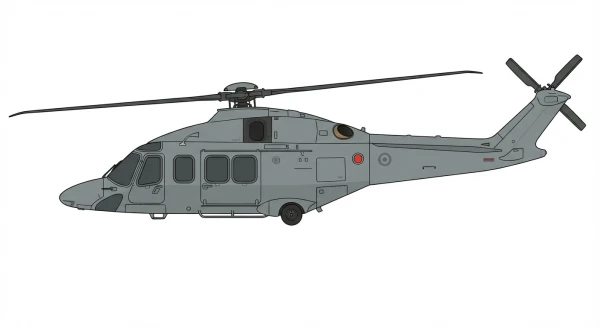
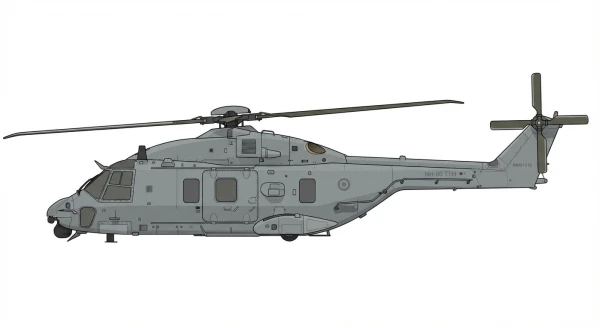
| AW149 | NH90 / Caiman | |
|---|---|---|
| Origin country | 🇬🇧 United Kingdom🇮🇹 Italy | 🇩🇪 Germany🇫🇷 France🇮🇹 Italy🇳🇱 Netherlands |
| Category | Military Helicopters | Military Helicopters |
| Manufacturer | AgustaWestland | NHIndustries |
| First flight | 13 November 2009 | 18 December 1995 |
| Year introduced | 2014 | 2004 |
| Number produced | 31 units | 471 units |
| Average unit price | $16 million | $42 million |
| Wingspan | 14.6 m | 16.3 m |
| Height | 5.1 m | 5.3 m |
| Length | 17.6 m | 19.6 m |
| Maximum speed | 310 km/h | 300 km/h |
| Operational range | 1,009 km | 880 km |
| Service ceiling | 6,095 m | 6,000 m |
| Max. takeoff weight | 8,600 kg | 10,600 kg |
| Empty weight | 4,720 kg | 6,400 kg |
| Total thrust | 2 x 1,476 kW | 2 x 1,693 kW |
Detailed Comparison
The AW149 and NH90 Caiman are both twin-engine, medium-lift military helicopters, yet they stem from different development philosophies and target distinct market segments. The NH90 is a product of a multinational NATO consortium, designed in the 1990s as a high-tech, multi-role platform with specialized naval (NFH) and tactical transport (TTH) variants. The AW149 is a more recent, Italian-British design, conceived as a purpose-built military utility helicopter derived from the successful AW139 family, explicitly marketed as a modern, more affordable alternative to platforms like the UH-60 Black Hawk.
Development and Design
The NH90 was a technological pioneer, being the first production helicopter to feature a full fly-by-wire flight control system. Its design emphasizes advanced features, including a diamond-shaped composite fuselage to reduce radar signature and an option between two powerful engine types. This multinational, technologically ambitious approach resulted in a highly capable but complex and costly aircraft. In contrast, the AW149's development focused on leveraging a proven lineage. It features a larger fuselage and more powerful engines than the AW139, with an emphasis on robustness and adaptability. Key design features include an open-architecture avionics system for easier upgrades and landing gear certified to withstand a high sink rate of 9.5 m/s, underscoring its design for harsh military use.
Specifications and Performances
While similar in size, the NH90 is the larger and heavier aircraft, with a Maximum Takeoff Weight (MTOW) of 10,600 kg compared to the AW149's 8,600 kg. This gives the NH90 a greater potential payload capacity, supported by more powerful Rolls-Royce RTM322 engines. The AW149, powered by General Electric CT7s, has a slightly higher maximum speed of 310 km/h versus the NH90's 300 km/h. A critical differentiator is acquisition cost; at approximately $16 million, the AW149 is significantly less expensive than the NH90, which is listed at $42 million. This price disparity reflects the NH90's higher complexity and advanced systems.
Deployment and usage
The NH90 has seen widespread service across numerous NATO and allied nations, with over 470 units built. It has been deployed in a variety of roles, from anti-submarine warfare to special operations transport. However, its operational history has been marked by reports of high maintenance demands, low availability, and software issues, leading several operators to reduce their fleets or seek alternatives. The AW149 is a newer entrant with a smaller but growing user base, including Poland, Egypt, and Thailand. It is marketed as a versatile utility platform for troop transport, armed escort, and search and rescue. Its lower complexity and cost are central to its appeal for nations seeking a modern, reliable medium helicopter without the operational overhead of the NH90.
Conclusion
The choice between these two helicopters presents a clear trade-off between capability and cost-effectiveness. The NH90 offers a technologically advanced, highly specialized platform, particularly in its naval NFH variant, but its complexity has resulted in significant acquisition and sustainment costs and documented reliability challenges. The AW149 represents a more contemporary, pragmatic approach. It offers a capable, robust, and adaptable multi-role airframe based on a modern, proven design, at a substantially lower price point and with a focus on operational availability. For militaries seeking a high-end, specialized naval or tactical helicopter and willing to manage its complexity, the NH90 remains a potent option. For those prioritizing affordability, reliability, and versatile utility, the AW149 presents a compelling alternative.