B-52 Stratofortress vs Tu-160 Blackjack
B-52 Stratofortress vs Tu-160 Blackjack at a glance — top speed 1,000 vs 2,220 km/h, range 14,200 vs 12,300 km, max takeoff weight 220,000 vs 274,877 kg, built 744 vs 37 units.
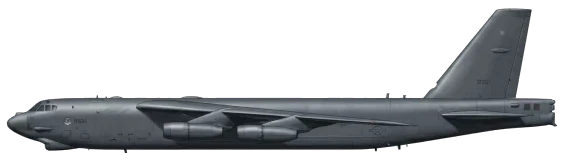
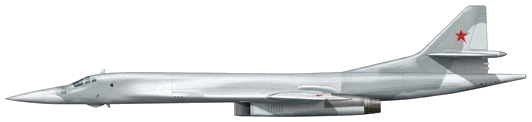
| B-52 Stratofortress | Tu-160 Blackjack | |
|---|---|---|
| Origin country | 🇺🇸 United States | 🇷🇺 Ex-USSR |
| Category | Bombers | Bombers |
| Manufacturer | Boeing | Tupolev |
| First flight | 15 April 1952 | 19 December 1981 |
| Year introduced | 1955 | 1987 |
| Number produced | 744 units | 37 units |
| Average unit price | $9.3 million | $250 million |
| Wing area | 370.0 m² | 232.0 m² |
| Wingspan | 56.4 m | 55.7 m |
| Height | 12.4 m | 13.1 m |
| Length | 48.5 m | 54.1 m |
| Maximum speed | 1000 km/h | 2220 km/h |
| Operational range | 14,200 km | 12,300 km |
| Service ceiling | 15,000 m | 16,000 m |
| Max. takeoff weight | 220,000 kg | 274,877 kg |
| Empty weight | 83,250 kg | 109,769 kg |
| Total thrust | 8 x 7,747 kgf | 4 x 24,983 kgf |
Detailed Comparison
Boeing’s B-52 Stratofortress, a subsonic bomber from the 1950s, contrasts directly with Tupolev’s Tu-160 Blackjack, a 1980s variable-geometry supersonic missile carrier. The B-52 prioritizes high volume production (744 units built) and payload versatility, while the Tu-160 (37 built) relies on kinematic speed and heavy standoff munitions to bypass contested airspace.
Development and Design
The B-52 was engineered in 1946 around the constraints of early jet propulsion, resulting in an eight-engine, swept-wing platform designed to drop gravity nuclear weapons from high altitudes. Over seven decades, its large airframe allowed continuous avionics and payload retrofits, transitioning it from a nuclear penetrator to a conventional arsenal ship. The Tu-160 emerged 30 years later from a Soviet requirement to penetrate NATO air defenses using speed and low-altitude terrain-following flight. Its variable-sweep wings and titanium-heavy structure (30 percent of empty weight) optimize it for Mach 2 dash profiles. Where the B-52 relies on external pylons and a standard bomb bay for varied munitions, the Tu-160 stores its 45,000 kg payload entirely within two internal rotary launchers, reducing drag for supersonic flight.
Specifications and Performances
The Tu-160 holds a strict kinematic advantage, achieving Mach 2.05 (2,220 km/h) compared to the B-52’s subsonic 1,000 km/h limit. However, the B-52 offsets this speed deficit with an unrefueled range of 14,200 km against the Tu-160’s 12,300 km.
- The B-52 operates at a lower Max Takeoff Weight (220,000 kg) than the Tu-160 (274,877 kg), yet achieves greater range due to its TF33 turbofans and straight-forward aerodynamics.
- The Tu-160’s four Kuznetsov NK-32 afterburning engines generate 14,016 kgf thrust each to push a heavy airframe through the sound barrier, but consume fuel at a rate that limits loiter time compared to the Boeing platform.
Cost and scale heavily favor the B-52. With a unit cost estimated at $70 million versus the Tu-160's $250 million, the U.S. Air Force sustains a fleet mass that Russia cannot replicate.
Deployment and usage
The B-52 possesses a combat record spanning Vietnam, the 1991 Gulf War, the Balkans, and counter-insurgency operations in Afghanistan and Iraq. It functions as a close air support platform dropping JDAMs and as a standoff shooter using AGM-86 ALCMs. The Tu-160 operates within a narrower scope. Its combat debut occurred in 2015 launching Kh-101 cruise missiles into Syria. Since 2022, Russia has used the Tu-160 as a standoff launch platform against Ukrainian infrastructure, remaining deep within Russian airspace to avoid interception. It does not perform close air support or deploy unguided ordnance in combat.
Conclusion
The B-52 has the edge in permissive airspace and protracted conventional conflicts. Its $70 million unit cost, payload diversity, and 20-hour endurance make it highly efficient for continuous theater bombardment. The Tu-160 wins in standoff deterrence against heavily defended airspace. Its Mach 2 dash capability and integration of 6,500 km-range Kh-BD missiles allow it to execute rapid launch sequences and retreat before interception, a profile the subsonic B-52 cannot replicate. Ultimately, the B-52 is the more practical combat aircraft due to its adaptability and fleet numbers, while the Tu-160 is a niche, low-density asset tied exclusively to long-range cruise missile delivery.