C-17 Globemaster III vs C-5 Galaxy
C-17 Globemaster III vs C-5 Galaxy at a glance — top speed 930 vs 932 km/h, range 4,480 vs 8,900 km, max takeoff weight 259,460 vs 381,017 kg, built 279 vs 131 units.
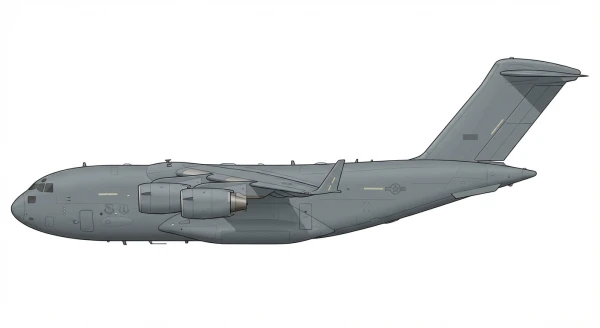
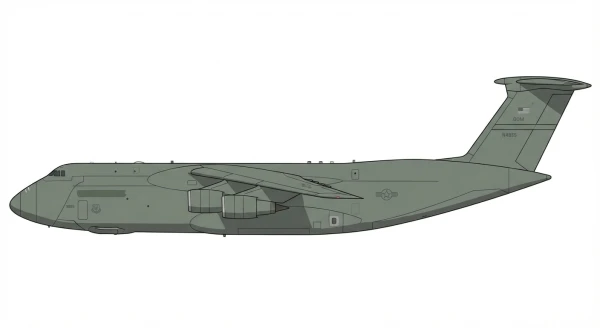
| C-17 Globemaster III | C-5 Galaxy | |
|---|---|---|
| Origin country | 🇺🇸 United States | 🇺🇸 United States |
| Category | Military Transport Aircraft | Military Transport Aircraft |
| Manufacturer | McDonnell Douglas | Lockheed |
| First flight | 15 September 1991 | 30 June 1968 |
| Year introduced | 1993 | 1971 |
| Number produced | 279 units | 131 units |
| Average unit price | $340 million | $168 million |
| Wing area | 353.0 m² | 576.0 m² |
| Wingspan | 51.8 m | 67.9 m |
| Height | 16.8 m | 19.8 m |
| Length | 53.0 m | 75.3 m |
| Maximum speed | 930 km/h | 932 km/h |
| Operational range | 4,480 km | 8,900 km |
| Service ceiling | 13,715 m | 10,600 m |
| Max. takeoff weight | 259,460 kg | 381,017 kg |
| Empty weight | 122,000 kg | 172,365 kg |
| Total thrust | 4 x 18,909 kgf | 4 x 19,674 kgf |
Detailed Comparison
The USAF airlift doctrine distributes its logistics between the Lockheed C-5 Galaxy, tasked with outsized, intercontinental hauling, and the Boeing C-17 Globemaster III, tasked with bypassing theater hubs to transport strategic cargo directly to austere tactical airfields. The C-5 maximizes absolute volume and payload, while the C-17 limits raw lift capacity to achieve high sortie generation rates and rough-field integration.
Development and Design
Lockheed’s C-5 emerged from the 1963 CX-HLC requirement to out-lift the C-141. Early development was marred by severe weight growth, wing structural failures that initially restricted fleet load capacity to 80%, and a congressional investigation over $1 billion in cost overruns. The USAF eventually funded a re-winging program for the C-5A fleet and later initiated the Reliability Enhancement and Re-engining Program (RERP) to upgrade the aircraft to the C-5M standard with General Electric CF6 engines. Conversely, McDonnell Douglas developed the C-17 in the 1980s to directly replace the C-141 while matching the tactical utility of the C-130. The C-17 integrates an internally blown flap system and fully articulated landing gear, allowing a 259,460 kg aircraft to operate from unpaved, forward-deployed airstrips.
Specifications and Performances
Performance metrics dictate their doctrinal roles. The C-5 dwarfs the C-17 in raw capacity, with a maximum takeoff weight of 381,017 kg and a 127,459 kg payload limit. It can accommodate two M1 Abrams tanks or an armored vehicle-launched bridge. The C-5's 8,900 km range enables non-stop intercontinental transits without aerial refueling.
In contrast, the C-17 trades mass for accessibility:
- Payload caps at 77,519 kg, restricting it to a single M1 Abrams tank per flight.
- Unrefueled range sits at 4,480 km, requiring tanker support for transoceanic deployments.
- Takeoffs require 2,500 m of runway, but the aircraft routinely lands on 1,000 m dirt strips using Pratt & Whitney F117 thrust reversers.
Deployment and usage
The C-5 proved its intercontinental utility during the 1973 Yom Kippur War (Operation Nickel Grass) and the 1991 Gulf War, moving outsized cargo that no other allied airframe could accommodate. However, its historical mission capable rates frequently hovered below 60%, anchoring the aircraft to well-paved, established logistical hubs. The C-17 altered tactical airlift doctrine during Operations Enduring Freedom and Iraqi Freedom. By flying armored vehicles directly into forward operating bases like Bagram or dirt strips in northern Iraq, the C-17 eliminated the need to transload cargo onto C-130s. This reliability drove a 279-unit production run and secured exports to Australia, Canada, India, Qatar, and the UK, whereas the C-5 remains strictly a USAF asset.
Conclusion
The C-17 Globemaster III dictates the current tempo of US and allied logistics. While the C-5 remains the only solution for rapidly projecting massed heavy armor and outsized engineering equipment across oceans, its utility is tethered to major hubs and hampered by heavy maintenance demands. The C-17’s ability to bypass intermediate staging bases and transport strategic payloads directly into contested, austere environments makes it the more operationally relevant platform for modern, distributed warfare.