CH-46 Sea Knight vs Mi-8 Hip
CH-46 Sea Knight vs Mi-8 Hip at a glance — top speed 266 vs 250 km/h, range 1,020 vs 495 km, max takeoff weight 11,000 vs 12,000 kg, built 524 vs 17,000 units.
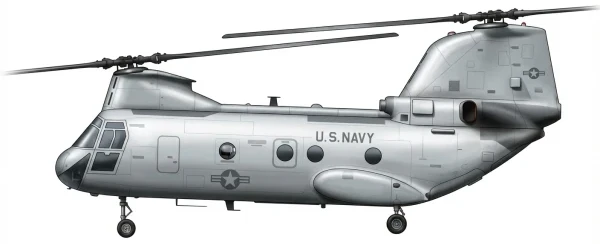
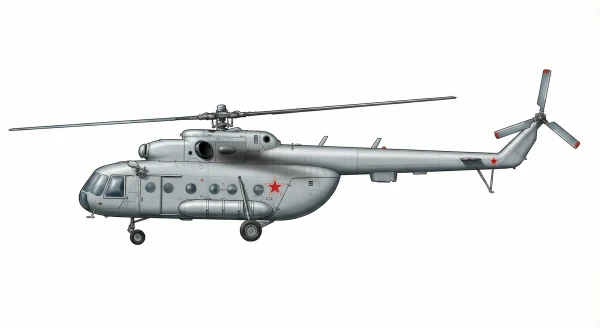
| CH-46 Sea Knight | Mi-8 Hip | |
|---|---|---|
| Origin country | 🇺🇸 United States | 🇷🇺 Ex-USSR |
| Category | Military Helicopters | Military Helicopters |
| Manufacturer | Boeing Vertol | Mil |
| First flight | 22 April 1958 | 24 June 1961 |
| Year introduced | 1964 | 1967 |
| Number produced | 524 units | 17000 units |
| Average unit price | $14 million | $4 million |
| Wingspan | 16.0 m | 21.3 m |
| Height | 5.1 m | 5.7 m |
| Length | 13.9 m | 25.2 m |
| Maximum speed | 266 km/h | 250 km/h |
| Operational range | 1,020 km | 495 km |
| Service ceiling | 4,267 m | 4,500 m |
| Max. takeoff weight | 11,000 kg | 12,000 kg |
| Empty weight | 7,047 kg | 7,160 kg |
| Total thrust | 2 x 1,400 kW | 2 x 1,119 kW |
Detailed Comparison
The Boeing Vertol CH-46 Sea Knight and the Mil Mi-8 Hip emerged during the early Cold War as the primary medium-lift rotorcraft for NATO and the Warsaw Pact, respectively. While the CH-46 prioritized maritime operations and vertical replenishment through a compact, tandem-rotor configuration, the Mi-8 was developed as a rugged, multi-role utility platform capable of transitioning between transport and gunship roles, resulting in the most produced helicopter in history.
Development and Design
The CH-46 utilizes a tandem-rotor design with counter-rotating main rotors, eliminating the need for a tail rotor. This configuration directs all engine power to lift and allows for a shorter fuselage relative to its payload, ideal for confined shipboard operations. It features foldable blades and a tricycle landing gear housed in sponsons to maximize deck stability. Conversely, the Mi-8 employs a conventional layout with a five-blade main rotor and three-blade tail rotor. Its structure prioritizes internal volume and ruggedness over compactness, featuring a simple, robust airframe constructed largely of aluminum. While the CH-46 integrates a rear loading ramp for rapid troop deployment, the Mi-8 typically uses rear clamshell doors. Both utilize twin-turboshaft engines—General Electric T58s for the Sea Knight and Klimov TV2-117s for the Hip—providing necessary redundancy for combat survival.
Specifications and Performance
The Mi-8 holds a slight advantage in raw lifting capacity with a Maximum Takeoff Weight (MTOW) of 12,000 kg compared to the CH-46's 11,000 kg. However, the Sea Knight demonstrates superior aerodynamic efficiency, achieving a higher maximum speed of 266 km/h against the Hip's 250 km/h. Notably, the CH-46 offers significantly greater operational reach, boasting a range of 1,020 km, more than double the Mi-8's 495 km. Physically, the Mi-8 is substantially larger, with a length of 25.24 m compared to the Sea Knight's compact 13.92 m, reflecting the Sea Knight's constraint to fit elevators on amphibious assault ships. The Mi-8's massive production run of over 17,000 units dwarfs the 524 units of the Sea Knight, influencing the unit cost significantly ($4 million for the Mi-8 vs. $14 million for the CH-46).
Deployment and usage
Operational doctrine diverges significantly between the two aircraft. The CH-46 served primarily as a dedicated logistical and troop transport for the U.S. Marine Corps and Navy. It specialized in Vertical Replenishment (VERTREP), CASEVAC, and troop insertion, operating in maritime environments from Vietnam to Iraq until its retirement in 2015. It carried defensive machine guns but never functioned as an assault gunship. The Mi-8, however, blurs the line between utility and attack. With hardpoints for S-8 rockets and anti-tank missiles, armed variants (Mi-8TV/Mi-17) actively support ground infantry, notably seen during the Soviet-Afghan War and modern conflicts in Syria and Ukraine.
Conclusion
The CH-46 Sea Knight was a specialized maritime asset, optimized for the spatial constraints of naval warfare and long-range logistical support. The Mi-8 Hip represents a utilitarian philosophy of mass production and versatility, sacrificing range and speed for sheer durability and the ability to mount heavy armament. While the Sea Knight has been superseded by the MV-22 Osprey, the Mi-8 remains a ubiquitous platform, serving as the backbone of rotary aviation for over 50 nations.