CH-47 Chinook vs UH-60 Black Hawk
CH-47 Chinook vs UH-60 Black Hawk at a glance — top speed 315 vs 294 km/h, range 740 vs 2,221 km, max takeoff weight 22,680 vs 10,659 kg, built 1,200 vs 5,000 units.
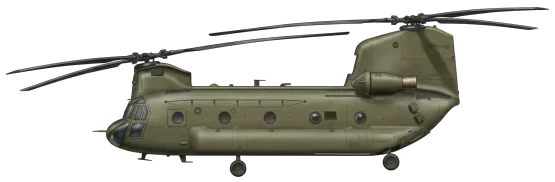
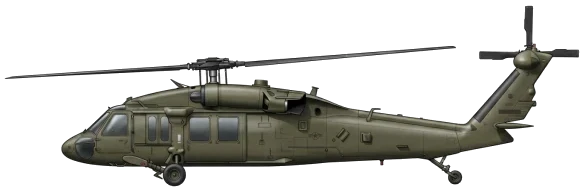
| CH-47 Chinook | UH-60 Black Hawk | |
|---|---|---|
| Origin country | 🇺🇸 United States | 🇺🇸 United States |
| Category | Military Helicopters | Military Helicopters |
| Manufacturer | Boeing | Sikorsky |
| First flight | 21 September 1961 | 29 November 1974 |
| Year introduced | 1962 | 1979 |
| Number produced | 1200 units | 5000 units |
| Average unit price | $38 million | $21 million |
| Wingspan | 18.3 m | 16.4 m |
| Height | 5.7 m | 4.9 m |
| Length | 30.1 m | 19.5 m |
| Maximum speed | 315 km/h | 294 km/h |
| Operational range | 740 km | 2,221 km |
| Service ceiling | 5,639 m | 5,791 m |
| Max. takeoff weight | 22,680 kg | 10,659 kg |
| Empty weight | 10,614 kg | 4,819 kg |
| Total thrust | 2 x 2,796 kW | 2 x 1,208 kW |
Detailed Comparison
The UH-60 Black Hawk and the CH-47 Chinook are foundational assets in U.S. military aviation, fulfilling distinct but complementary roles. The Black Hawk is a multi-role utility helicopter designed for tactical mobility, while the Chinook is a heavy-lift transport helicopter focused on logistical and operational-level movement. The Black Hawk’s conventional single main rotor design contrasts sharply with the Chinook's tandem-rotor configuration, which eliminates the need for a tail rotor and dedicates all engine power to lift and thrust.
Development and Design
The UH-60 was developed in the 1970s as a direct replacement for the UH-1 Huey, incorporating lessons from the Vietnam War. The design priorities were survivability, reliability, and performance. It features a crashworthy airframe, redundant systems, and twin General Electric T700 engines, which provided a significant leap in power and hot-and-high performance over its predecessor. Its agility and smaller footprint are optimized for insertions and extractions in confined areas.
The CH-47's development began earlier, in the late 1950s, to meet a requirement for a heavy-lift, turbine-powered helicopter. The defining feature is its tandem-rotor layout. This design provides immense lifting power and a stable platform that is less sensitive to changes in the center of gravity, a critical attribute for its primary mission of moving troops, artillery, and bulk cargo via internal or external sling loads.
Specifications and Performances
A comparison of performance metrics reveals the aircrafts' differing operational envelopes. The Chinook’s primary advantage is its payload. It can carry 33-55 troops or an external load approaching 10,886 kg, more than double the Black Hawk's capacity of 11 troops or a slung load. With a max takeoff weight of 22,680 kg versus the UH-60's 10,659 kg, the Chinook operates in a different weight class.
Interestingly, despite its size, the CH-47F is faster than the UH-60M, with a maximum speed of 315 km/h compared to the Black Hawk's 294 km/h. It also possesses a significantly higher climb rate (10.1 m/s vs. 3.6 m/s). The Black Hawk, however, offers a greater standard combat range of 593 km without external fuel tanks, compared to the Chinook’s 420 km, making it better suited for longer-range tactical missions.
Deployment and usage
In operational use, these helicopters rarely compete for the same mission. The Black Hawk is the ubiquitous workhorse for air assault, medical evacuation (MEDEVAC), and command and control. Its versatility has led to numerous specialized variants, including the MH-60 for special operations, the SH-60 Seahawk for naval warfare, and the HH-60 Pave Hawk for combat search and rescue.
The Chinook is a strategic and operational enabler, primarily used for moving heavy equipment like M777 howitzers, resupplying forward operating bases, and transporting large infantry elements. In theaters like Afghanistan, its ability to operate at high altitudes with heavy loads made it indispensable. While it can be armed with defensive machine guns, its role is almost exclusively transport, unlike the Black Hawk which can be configured for light attack duties.
Conclusion
The UH-60 Black Hawk and CH-47 Chinook are not interchangeable but are instead integral components of a combined-arms aviation force. The Black Hawk provides essential tactical flexibility and versatility at the squad and platoon level. The Chinook delivers unmatched heavy-lift capability, enabling the movement of critical materiel and personnel on a scale no other helicopter in the U.S. inventory can match. The sustained development and production of both airframes, decades after their first flights, underscore their continued relevance and effectiveness in modern military operations.
-
 United States
544
United States
544
-
 Japan
66
Japan
66
-
 United Kingdom
45
United Kingdom
45
- All 20 operators →
-
United States
2205
-
 South Korea
129
South Korea
129
-
 Colombia
84
Colombia
84
- All 35 operators →