F-102 Delta Dagger vs MiG-21 Fishbed
F-102 Delta Dagger vs MiG-21 Fishbed at a glance — top speed 1,328 vs 2,175 km/h, range 2,170 vs 793 km, max takeoff weight 14,288 vs 10,400 kg, built 1,000 vs 11,496 units.
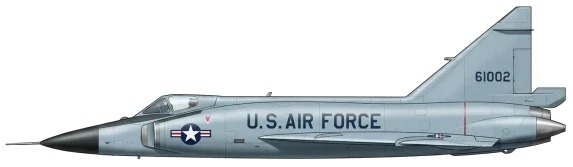
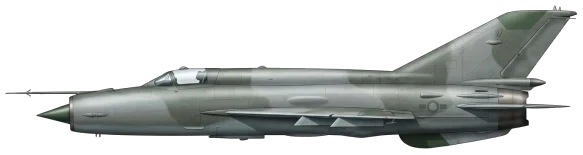
| F-102 Delta Dagger | MiG-21 Fishbed | |
|---|---|---|
| Origin country | 🇺🇸 United States | 🇷🇺 Ex-USSR |
| Category | Combat Aircraft | Combat Aircraft |
| Manufacturer | Convair | Mikoyan-Gurevich |
| First flight | 24 October 1954 | 16 June 1955 |
| Year introduced | 1956 | 1958 |
| Number produced | 1000 units | 11496 units |
| Average unit price | $2.5 million | $2 million |
| Wing area | 61.5 m² | 23.0 m² |
| Wingspan | 11.6 m | 7.2 m |
| Height | 6.5 m | 4.1 m |
| Length | 20.8 m | 14.7 m |
| Maximum speed | 1328 km/h | 2175 km/h |
| Operational range | 2,170 km | 793 km |
| Service ceiling | 16,276 m | 17,500 m |
| Max. takeoff weight | 14,288 kg | 10,400 kg |
| Empty weight | 8,777 kg | 4,871 kg |
| Total thrust | 1 x 7,711 kgf | 1 x 7,095 kgf |
Detailed Comparison
The Convair F-102 Delta Dagger and Mikoyan-Gurevich MiG-21 Fishbed emerged during the 1950s as second-generation jet fighters utilizing delta-wing configurations, yet they filled diverging strategic requirements. The F-102 served as a specialized, all-weather interceptor integrated into a complex ground-control environment to counter Soviet strategic bombers. Conversely, the MiG-21 was designed as a lightweight, frontline tactical fighter and interceptor intended for high-volume production and air superiority against Western counterparts like the F-104.
Development and Design
Convair’s design faced significant aerodynamic hurdles; the initial YF-102 failed to reach supersonic speeds, necessitating a major redesign to incorporate the area rule. This resulted in the distinctive "coke bottle" fuselage. A key innovation was its internal weapons bay to reduce drag, initially housing the Hughes MC-3 fire-control system for automated intercepts using AIM-4 Falcon missiles and unguided rockets. It lacked an internal gun in its primary variants.
The MiG-21 prioritized high thrust-to-weight ratio and simplicity. Its tailed delta configuration and shock-cone intake optimized high-speed performance. Unlike the F-102's reliance on ground control and sophisticated avionics, the MiG-21 was built for visual range combat and ease of maintenance, though it suffered from limited cockpit visibility and short endurance. Its armament was versatile, combining internal cannons (like the GSh-23) with hardpoints for R-3S Atoll missiles and ground ordnance.
Specifications and Performances
Performance metrics distinctly favor the Soviet design in kinematics. The MiG-21 achieves a maximum speed of 2,125 km/h (approx. Mach 2) and a service ceiling of 19,000 m, significantly outclassing the F-102’s 1,328 km/h top speed and 16,276 m ceiling. The MiG-21's lighter empty weight (4,871 kg) against the F-102's 8,777 kg contributes to superior agility.
However, the F-102 offers a substantially greater range of 2,170 km compared to the MiG-21's limited 660 km, reflecting the American need for endurance during continental defense patrols versus the Soviet doctrine of point defense. The F-102's heavier Max Takeoff Weight (14,288 kg) allowed for complex electronics and internal weapon storage, whereas the MiG-21 remained a lightweight day fighter in its initial concept.
Deployment and usage
The F-102 formed the backbone of the US Air Defense Command, deploying to strategic points like Greenland and Europe. In Vietnam, it flew patrols and ground-attack sorties—a role it was ill-suited for—suffering 14 losses. It was largely retired or converted to QF-102A target drones by the 1970s.
The MiG-21 saw global proliferation, serving in over 60 air forces. In Vietnam, it effectively used "hit-and-run" tactics against US strike packages. Its combat history spans the Middle East conflicts and the Indo-Pakistani wars. Extensive modernization programs, such as the Indian MiG-21 Bison, have kept the airframe relevant long past its projected service life.
Conclusion
The F-102 Delta Dagger was a technological stepping stone, validating the area rule and complex fire-control systems for future interceptors. In contrast, the MiG-21 Fishbed proved to be a definitive aviation workhorse; its balance of speed, simplicity, and adaptability allowed it to remain operationally relevant for decades after the F-102 was withdrawn from service. While the F-102 was a specialized solution for a specific timeframe, the MiG-21 became one of the most successful and widely produced combat aircraft in history.


