F-14 Tomcat vs F/A-18 E/F Super Hornet
F-14 Tomcat vs F/A-18 E/F Super Hornet at a glance — top speed 2,485 vs 1,915 km/h, range 3,000 vs 2,346 km, max takeoff weight 33,724 vs 29,900 kg, built 712 vs 632 units.
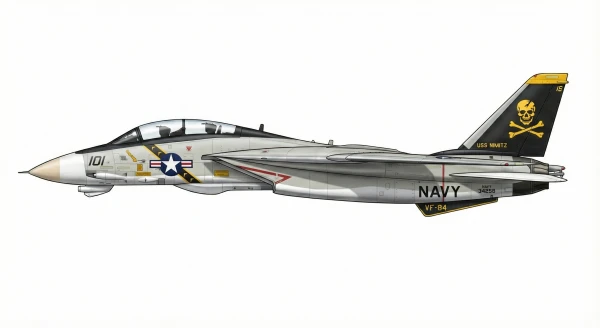
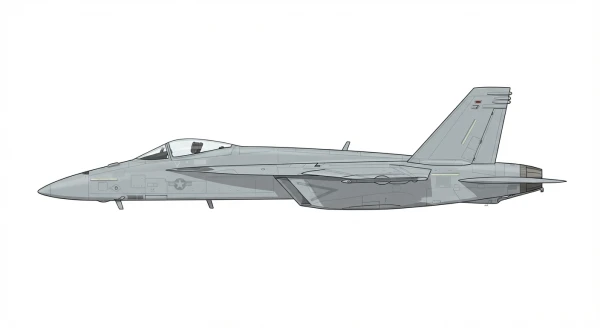
| F-14 Tomcat | F/A-18 E/F Super Hornet | |
|---|---|---|
| Origin country | 🇺🇸 United States | 🇺🇸 United States |
| Category | Combat Aircraft | Combat Aircraft |
| Manufacturer | Grumman | Boeing |
| First flight | 21 December 1970 | 29 November 1995 |
| Year introduced | 1972 | 2001 |
| Number produced | 712 units | 632 units |
| Average unit price | $38 million | $70 million |
| Wing area | 52.5 m² | 46.5 m² |
| Wingspan | 19.6 m | 13.6 m |
| Height | 4.9 m | 4.9 m |
| Length | 19.1 m | 18.3 m |
| Maximum speed | 2485 km/h | 1915 km/h |
| Operational range | 3,000 km | 2,346 km |
| Service ceiling | 17,069 m | 15,940 m |
| Max. takeoff weight | 33,724 kg | 29,900 kg |
| Empty weight | 18,191 kg | 14,550 kg |
| Total thrust | 2 x 12,224 kgf | 2 x 9,979 kgf |
Detailed Comparison
The Grumman F-14 Tomcat was built to defend carrier battle groups from Soviet bombers using standoff missiles, prioritizing speed and reach. Boeing’s F/A-18E/F Super Hornet emerged from the post-Cold War budget environment, prioritizing multirole utility, sortie generation rates, and lower maintenance costs over pure kinematic performance. Where the Tomcat solved a singular intercept problem, the Super Hornet provided a scalable platform for expeditionary strike groups facing asymmetric threats.
Development and Design
Grumman designed the F-14 around the Hughes AN/AWG-9 radar and the 1,000-pound AIM-54 Phoenix missile. Its variable-sweep wings optimized lift across a Mach 2.3 flight envelope, but imposed high weight and maintenance penalties. The original Pratt & Whitney TF30 engines caused chronic compressor stalls, an issue only resolved in the F-14B/D variants with General Electric F110 turbofans. Conversely, the Super Hornet was a pragmatist’s procurement. Arising from the canceled A-12 Avenger II and the prohibitive costs of modernizing the Tomcat, Boeing scaled up the legacy Hornet by 20%. The design sacrificed aerodynamics—specifically high-speed drag induced by its canted pylons—for carrier integration predictability, radar cross-section reduction, and integration of the AN/APG-79 AESA radar.
Specifications and Performances
The F-14 outclasses the Super Hornet in raw kinematic metrics. At 33,724 kg maximum takeoff weight, the Tomcat utilized its 3,000 km range and 2,485 km/h top speed to push the engagement zone hundreds of miles from the carrier. The Super Hornet, limited to a 2,346 km range and a top speed of 1,915 km/h (frequently lower in combat configuration due to drag), relies heavily on external fuel or its organic "buddy store" refueling capability. However, the Super Hornet’s flight control system and enlarged leading-edge extensions yield sharper high-angle-of-attack control. The F414-GE-400 engines generate a 228.0 m/s climb rate, outperforming the Tomcat's 152.0 m/s metric and giving the F/A-18E/F better energy recovery in close-in engagements.
Deployment and usage
The F-14 executed its fleet defense mandate sparingly for the US Navy, downing Libyan Su-22s and MiG-23s. Its highest kill counts occurred in Iranian hands; the Islamic Republic of Iran Air Force claimed over 160 Iraqi kills during the 1980s using the AIM-54. The US Navy eventually adapted the Tomcat for strike missions using the LANTIRN pod before its 2006 retirement. The Super Hornet entered service in 2001 and assumed the bulk of carrier operations in Iraq and Afghanistan. Its deployment history skews heavily toward air-to-ground strike and close air support, though a US F/A-18E downed a Syrian Su-22 in 2017. Recent operations against Houthi infrastructure leverage its integration with AGM-88 HARM and JDAM munitions.
Conclusion
The F-14 Tomcat holds the edge in outer air battle fleet defense and high-speed interception. Its combination of AWG-9/APG-71 radar, Phoenix missiles, and Mach 2 sprint capacity remains unreplicated for sanitizing vast airspace blocks.
The Super Hornet holds the edge in sortie generation, strike integration, and lifecycle sustainability:
- Its APG-79 AESA radar provides higher target resolution and electronic attack variables compared to legacy mechanically scanned arrays.
- High-angle-of-attack flight characteristics allow for aggressive nose-pointing in visual range merges.
- Reduced maintenance man-hours per flight hour ensure the carrier air wing maintains higher daily sortie rates.
Modern naval doctrine requires sustained strike capacity over localized fleet defense. The F/A-18E/F trades the Tomcat’s kinematic dominance for the operational reliability required in current expeditionary missions.