F/A-18 Hornet and Super Hornet Variants: A to D, E/F Blocks and the EA-18G
How the legacy Hornet A to D, the Super Hornet E/F in Blocks I to III and the EA-18G Growler differ, what SLM and Block III add, who flies which, and what follows the last new Super Hornet in 2027.
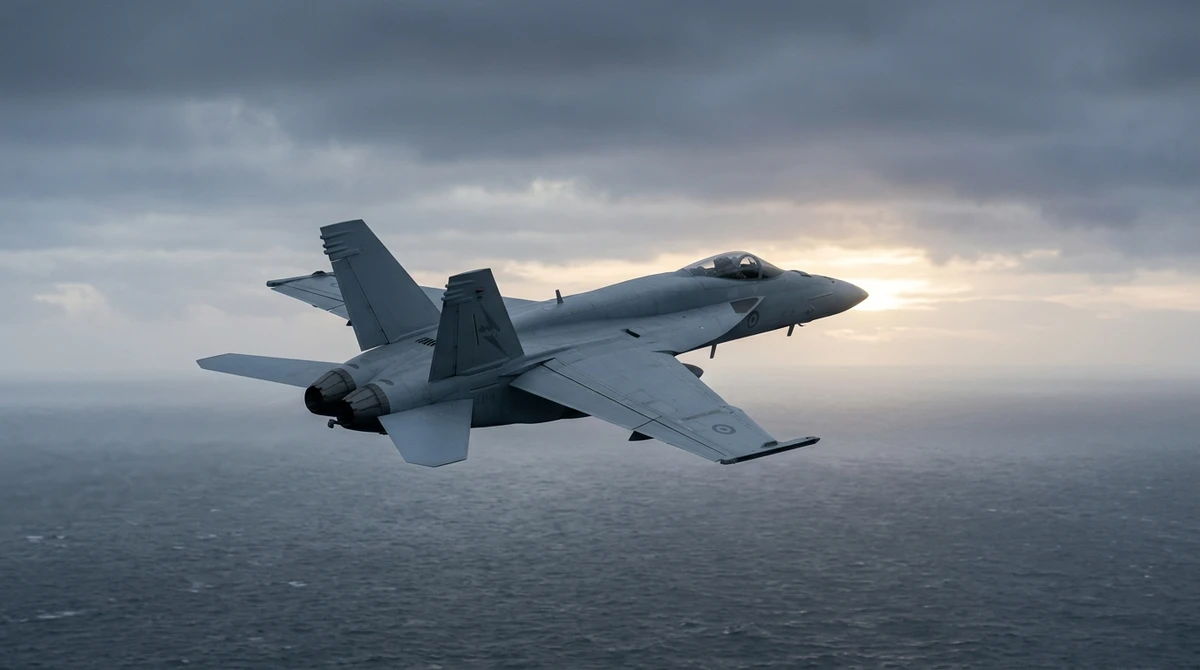
Three different aircraft carry the number 18. The F/A-18 Hornet of 1978, built as the A and B and then as the improved C and D, is the legacy Hornet: 1,480 were built before the line closed in 2000. The F/A-18E/F Super Hornet of 1995 kept the name and the number but is a new airframe, a quarter larger, on new engines; its production run divides into Block I, Block II (the APG-79 radar, from 2005) and Block III (the new cockpit and processor, from 2021). The EA-18G Growler is a two-seat Super Hornet rebuilt as a jammer. The letters follow the US system: F/A for one airframe doing the fighter and attack jobs, E and F as the series letters after D, and EA-18G as electronic-warfare prefix, Hornet design number, next series letter (designations guide). A Lot is the annual contract batch, not a capability.
As of October 2026 the family is at a turning point. The last new-build Super Hornet, one of 17 ordered in March 2024, is due by spring 2027, after which Boeing's St. Louis line closes to the type. The Navy counted 325 F/A-18Es, 250 F/A-18Fs and 160 EA-18Gs in April 2025, and the Service Life Modification program is rebuilding Block II jets as 10,000-hour Block IIIs into the mid-2030s. Boeing won the F/A-XX contract on 29 September 2026. The legacy Hornet, retired by the Navy in 2019 and Australia in 2021, leaves the Marine Corps by 2030, Finland and Switzerland around 2030 and Canada in 2032; Spain has pushed its EF-18s toward 2035 to 2040.
- Legacy Hornet: F/A-18A (single-seat) and B (two-seat), then from 1987 the C and D; the Night Attack C/D arrived in 1989. The Marine Corps is the last US operator, to 2030.
- Super Hornet: F/A-18E and F, a 25 percent larger airframe on F414 engines, first flown 29 November 1995, in fleet service from 1999, operational from 2001.
- Blocks: Block I with the APG-73 radar; Block II from 2005 with the APG-79 AESA; Block III from 2021 with a touchscreen cockpit, a new processor and a 10,000-hour airframe. Service Life Modification turns Block II into Block III.
- Growler: an F/A-18F with ALQ-218 receivers and jamming pods, operational since 2009; the Next Generation Jammer reached initial operational capability in December 2024 and Growler Block II follows.
- After 2027: no new Super Hornets; the fleet rests on SLM until the F/A-XX arrives in the 2030s.
The legacy Hornet: A/B, then C/D
| F/A-18A–D Hornet | F/A-18E/F Super Hornet | EA-18G Growler | |
|---|---|---|---|
| Role | Carrier strike fighterA and C single-seat, B and D two-seat | Carrier strike fighter and tankerE single-seat, F two-seat | Electronic attackTwo-seat, built on the F/A-18F |
| First flight | 18 Nov 1978 | 29 Nov 1995 | 15 Aug 2006 |
| Service entry | 7 Jan 1983 (Marine Corps)1 Jul 1984 (Navy) | 1999 fleet serviceIOC Sept 2001, VFA-115 | IOC 22 Sept 2009 |
| Airframe | Baseline | Fuselage 34 in longer, wing area up 25%, 42% fewer structural parts | Super Hornet airframe, more than 90% common |
| Engines | Two F404 | Two F414, 22,000 lbf each in afterburner | Two F414 |
| Radar | APG-65, then APG-73 from 1994 | APG-73 (Block I), APG-79 AESA (Block II and III) | APG-79 AESA |
| Hardpoints | 9 | 11 | Wingtips carry ALQ-218 receivers; gun removed |
| Built | 1,480, 1980–2000 | More than 630 by 2020; last delivery spring 2027 | 172 by Oct 2021 |
The Hornet was ordered as two aircraft, an F-18 fighter and an A-18 attack aircraft, before one airframe proved able to do both. The first production F/A-18A flew on 12 April 1980; the type entered service with Marine Corps squadron VMFA-314 on 7 January 1983 and with Navy squadrons VFA-113 and VFA-25 on 1 July 1984, and the two-seat F/A-18B is the combat-capable trainer. After 380 F/A-18As, production shifted to the F/A-18C in September 1987. The C and its two-seat F/A-18D were a block upgrade: upgraded radar and avionics, provision for the AIM-120 AMRAAM, a new ejection seat and a self-protection jammer. The D is the Marine Corps' all-weather strike and forward-air-control aircraft, with a weapons and sensors officer in the back seat; part of the D fleet was configured for reconnaissance as the F/A-18D(RC).
The Night Attack Hornet and the Lots
Hornets were bought in annual procurement lots, and the lot says which hardware a jet was built with. The best-known cut is the Night Attack configuration, delivered from November 1989 with Lot 12: a navigation FLIR pod, the AAS-38A NITE Hawk targeting pod with its own laser designator, night-vision goggles, color displays and a digital moving map. The APG-73 radar replaced the APG-65 from 1994. Production ended in 2000: the last F/A-18C was assembled in Finland and delivered in August 2000, the last F/A-18D went to the Marine Corps the same month. The Navy's last active-duty F/A-18C flight was on 2 October 2019; the Marine Corps flies on with the C and the D.
The Super Hornet: a new airframe under an old number
The Navy ordered the Super Hornet in 1992 with development cost capped at $4.88 billion in 1990 dollars, and kept the F/A-18 designation to present the program to Congress as a low-risk derivative, although the aircraft is largely new. The forward fuselage is the Hornet's; aft of it the fuselage is stretched by 34 inches, wing area grows by 25 percent, the leading-edge extensions are enlarged, the intakes become rectangular carets and two wing stations are added for 11 hardpoints, with 42 percent fewer structural parts. The General Electric F414, developed from the F404, gives 22,000 lbf in afterburner, about 35 percent more thrust across most of the envelope; unlike the Hornet, the Super Hornet also flies as a buddy tanker.
The first Super Hornet flew on 29 November 1995. Low-rate production began in March 1997 and full-rate production in September 1997, the month after Boeing absorbed McDonnell Douglas. Fleet service began in 1999 with the training squadron VFA-122, initial operational capability came in September 2001 with VFA-115 at Lemoore, and the first combat sorties were flown over Iraq on 6 November 2002. After the F-14's retirement in 2006 every combat jet on a US carrier was a Hornet of one kind or another until the F-35C arrived; that transition is covered in the F-35 guide.
Blocks and Lots: I, II and III
| Block | Deliveries | What it added | Numbers |
|---|---|---|---|
| Block I | 1997 to about 2004 | APG-73 radar, ALQ-165 jammer, ALE-50 decoy90% avionics commonality with the F/A-18C/D of the time | 135 later retrofitted with the AESA radar (announced Jan 2008) |
| Block II | 2005 to Apr 2020 | APG-79 AESA radar, helmet-mounted cueing, ALQ-214 countermeasures, night-vision cockpit lightingFirst AESA squadron VFA-213 safe-for-flight Oct 2006 | 608 (322 E, 286 F) |
| Block III (new-build) | Sept 2021 to spring 2027 | 10 × 19 in touchscreen cockpit, DTP-N processor, TTNT datalink, reduced signature, 10,000-hour airframeConformal fuel tanks dropped by the Navy in 2021 | 78 under a $4 billion contract, then 17 more ($1.3 billion, Mar 2024) |
| Block III (SLM conversion) | Apr 2024 to the mid-2030s | Block II airframes rebuilt to Block III with 4,000 extra hours | About 125 under contracts since 2018, plus 60 ($931 million, Dec 2025) |
A Super Hornet Block is a production standard, closer to an F-16 Block than to the F-35's software releases. Block I aircraft carried the Hornet's APG-73 radar and the ALQ-165 jammer, with avionics 90 percent common with the F/A-18C/D of the day. Block II, built from 2005, brought the Raytheon APG-79 active electronically scanned array, able to run air-to-air and air-to-ground modes at once, with the joint helmet-mounted cueing system and the ALQ-214 countermeasures suite; VFA-213 was the first squadron cleared on the AESA jet, in October 2006, and in January 2008 the Navy said 135 earlier aircraft would be retrofitted with the radar. Raytheon had delivered its 100th APG-79 by July 2008, with 437 on contract. The final Block II was delivered in April 2020; the Block II total is 608 aircraft, 322 single-seat and 286 two-seat.
Block III, and the fuel tanks that fell away
The first operational Block III was delivered on 27 September 2021 to Air Test and Evaluation Squadron 23 at Patuxent River. Boeing describes it as an advanced cockpit system with a 10-inch by 19-inch touchscreen, enhanced networking, open mission systems, a reduced radar signature and a 10,000-hour service life, with 78 aircraft under contract and deliveries "through the mid-2030s" from one new-build line and two Service Life Modification lines. The networking is the Distributed Targeting Processor-Network (DTP-N), with 17 times the computing power of the previous mission computer, and the Tactical Targeting Network Technology (TTNT) datalink.
Conformal fuel tanks were part of the original Block III pitch: two tanks of 515 US gallons were to raise the combat radius of an identically armed jet from 594 to 714 nautical miles. The Navy issued a stop-work order on 6 January 2021 citing "cost, schedule, and performance" and problems found in carrier-environment testing, and Boeing said it was "not presently expecting to deliver any Block III jets with CFTs to the Navy", while confirming the jets leave the line with the provisions to accept them later. Block III as delivered is therefore a cockpit, processor, network and airframe-life standard, not a range standard.
Service Life Modification: turning Block II into Block III
Super Hornets were built for 6,000 hours. Service Life Modification (SLM) first took them to 7,500, with the first SLM jet delivered on 6 February 2020 from lines in St. Louis and San Antonio. From 2023 the second phase added the Block III kit and the extension to 10,000 hours: the first Block II jet was inducted in mid-2023 and returned in April 2024, in about a year against a 15-month target, according to Boeing's program vice president. Fleet Readiness Center Southwest completed the first conversion done entirely by Navy personnel in April 2026, by which time about 125 aircraft had been placed under SLM contracts since 2018, plus 60 under a $931 million contract of December 2025. Boeing said on 24 September 2025 that SLM work would leave St. Louis by 2027, "projected to continue through the mid-2030s" elsewhere. Every Block II that passes through SLM receives the Block III suite.
The EA-18G Growler and its Block II
The Growler is the F/A-18F turned into the replacement for the EA-6B Prowler. Boeing won the development contract in December 2003 and the first Growler, EA-1, flew at St. Louis on 15 August 2006; initial operational capability came on 22 September 2009, with VAQ-132 the first deployable squadron. The aircraft shares more than 90 percent of its parts with the Super Hornet, carries ALQ-218 wideband receivers on the wingtips in place of the Sidewinder rails and ALQ-99 jamming pods under the wings, and loses its gun to a pallet of electronics; 172 had been built by October 2021. Australia took 12 new-build Growlers in 2015 to 2017, lost one to an engine fire in January 2018 and received a replacement from Navy stock in February 2023.
Two upgrade lines run on the Growler. The Next Generation Jammer replaces the ALQ-99 pod by pod: the Raytheon ALQ-249 NGJ Mid-Band reached initial operational capability in December 2024, after low-rate production from March 2023, and L3Harris won the Low-Band increment in August 2024. VAQ-133 had already flown NGJ-MB pods on the USS Abraham Lincoln's 2024 Red Sea deployment, the pod's first cruise and first combat. Growler Block II is the airframe's own refresh: the Next Generation Electronic Attack Unit (NGEAU) for receivers and processing, plus the advanced cockpit and other internal changes common to the Super Hornet Block III; Boeing received a $53.1 million order in June 2025 for 30 NGEAU B-kits and 22 spares, due in December 2028. Australia's 24 NGEAUs sit in a $2 billion package approved on 16 June 2025.
The end of production and the F/A-XX
The Navy had planned to stop buying Super Hornets and close the line in 2025. Congress funded a final batch, and on 19 March 2024 the Navy ordered 17 Block III aircraft for $1.3 billion, with the last delivery due by spring 2027, after which the St. Louis line closes to the type; the build rate was slowing from two jets a month to one and a half, and international campaigns in previous years had been unsuccessful, according to Boeing's program vice president. Northrop Grumman, which builds the center and aft fuselages, completed its last set in January 2026.
The successor is the F/A-XX. The Pentagon's fiscal 2027 request held it to $140 million, after Congress had raised fiscal 2026 funding from a requested $74 million to $897 million plus $750 million in the reconciliation bill. On 29 September 2026 the Navy awarded Boeing the full-scale development contract, valued at more than $20 billion and covering test aircraft for ground, airworthiness, systems and weapons testing; the aircraft is to augment and then replace the Super Hornet and the Growler from the 2030s, and Northrop Grumman was the losing bidder. Until then the Super Hornet fleet rests on SLM.
Who flies which version
| Country | Hornet A–D | Super Hornet E/F | Growler | Outlook |
|---|---|---|---|---|
| United States | Marine Corps C and DNavy retired the type in 2019 | 325 E and 250 F (Apr 2025) | 160 (Apr 2025) | Hornet gone by Aug 2030; SLM to the mid-2030s; F/A-XX from the 2030s |
| Australia | Retired 29 Nov 2021 | 24 F/A-18F, Block II | 12 | Both fleets to 2040; Growler NGEAU approved Jun 2025 |
| Canada | CF-188A/B, about 80, plus ex-Australian jets | – | – | HEP to 2032, then F-35A |
| Finland | F/A-18C/D, 64 delivered | – | – | F-35A from Sept 2026; Hornet retired by 2030 |
| Kuwait | 33 F/A-18C/D (2023) | 22 E and 6 F, delivered 2021 | – | Transition to the Super Hornet running late |
| Malaysia | 7 F/A-18D | – | – | Kuwaiti Hornet purchase cancelled Feb 2026 |
| Spain | EF-18A/B, about 60 | – | – | Eurofighter Halcón from 2026; Hornets to 2035–2040 |
| Switzerland | 30 F/A-18C/D | – | – | F-35A 2027–2030; Hornet to the early 2030s |
Eight countries fly a member of the family; three bought the Super Hornet and two the Growler. The operator lists are GMN inventory data; the figures below come from the sources listed at the end of this guide.
- United States: the Navy flies the Super Hornet and the Growler; the Marine Corps flies the F/A-18C and D. The Corps ends Hornet operations at MCAS Beaufort by 1 August 2028, MCAS Miramar by 1 August 2029 and NAS JRB Fort Worth by 1 August 2030, under a May 2026 administrative message, toward an all-F-35 force of 420 aircraft. VMFA-232, VMFA-323 and the reserve squadrons VMFA-112 and VMFA-134 convert to the F-35C; VMFA-112 at Fort Worth, flying the two-seat D, begins in fiscal 2029.
- Australia: 75 F/A-18A/Bs, in service from 1985, retired on 29 November 2021 after almost 408,000 flight hours; 18 flyable aircraft and 7 for parts went to Canada. Its 24 F/A-18Fs, Block II jets in service from December 2010, and 12 Growlers are to serve to 2040 under the 2024 Integrated Investment Program, and Canberra has not said the F/A-18Fs will go to Block III.
- Canada: 138 CF-188s (98 A, 40 B), the official designation of the CF-18, delivered from 1982, with 80 in inventory in 2020. The Hornet Extension Project gives up to 84 aircraft interoperability upgrades and 36 of them new radars and missiles: 38 APG-79(V)4 AESA radars and 50 AIM-9X Block II approved in June 2020 for $862.3 million. HEP cost C$1.3 billion, reached initial operational capability on 24 June 2024 and closes in December 2026, to keep the fleet flying until 2032, when the F-35A fleet is to be fully operational.
- Finland: took the last F/A-18C built, assembled in Finland, in August 2000. Its first two F-35As landed at Rovaniemi on 18 September 2026; the Lapland Air Wing reaches F-35 initial operational capability in 2028, and the Hornet retires in 2030 when the F-35 reaches full operational capability.
- Kuwait: ordered 32 F/A-18Cs and 8 Ds in 1988 and still flew 33 in June 2023, when the US approved $1.8 billion of support for both fleets. Boeing completed its 28 Super Hornets, 22 E and 6 F, on 2 September 2021, handing them to the US Navy for onward transfer; Malaysia's defense minister said in September 2025 that Kuwait's new jets had been "further delayed".
- Malaysia: eight F/A-18Ds delivered in 1997, seven since a takeoff crash at Kuantan on 21 August 2025. The long-negotiated purchase of Kuwait's surplus C/Ds was cancelled by the cabinet on 6 February 2026, the deputy defense minister told parliament, over the uncertain delivery date and long-term support.
- Spain: the EF-18A/B is the Spanish Hornet, 91 in 2020 and about 60 now. Twenty Halcón I Eurofighters, signed in 2022, replace the Canary Islands Hornets from late 2026; 25 Halcón II aircraft, signed in December 2024, replace part of the mainland fleet from 2030. A government reply to parliament of 23 February 2026 said the remaining F-18s could serve to "2035-2040", against the earlier plan of 2030.
- Switzerland: bought 26 C and 8 D models, delivered 1996 to 1999, and operates 30. The Federal Council confirmed on 1 June 2026 that a CHF 450 million life extension clearing each aircraft to 6,000 hours was complete, enough for the early 2030s but no further. The squadrons move to Emmen from 2027 to free Payerne and Meiringen for the F-35A, delivered 2027 to 2030, now 30 aircraft rather than 36.
What comes next
| Program | Aircraft | What it does | Status |
|---|---|---|---|
| Service Life Modification | US Navy Block II Super Hornets | 6,000 to 10,000 hours plus the Block III suite | Running to the mid-2030s; St. Louis work ends 2027 |
| Block III new-build | 78 + 17 F/A-18E/F | Touchscreen cockpit, DTP-N, TTNT, 10,000 hours | Last delivery by spring 2027 |
| Next Generation Jammer | EA-18G (US, Australia) | ALQ-249 Mid-Band replaces the ALQ-99; Low-Band follows | Mid-Band IOC Dec 2024; Low-Band contracted Aug 2024 |
| Growler Block II (NGEAU) | EA-18G (US, Australia) | New electronic-attack unit, advanced cockpit | US B-kits due Dec 2028; 24 for Australia approved Jun 2025 |
| Hornet Extension Project | Up to 84 CF-188, 36 with APG-79(V)4 | Interoperability, then radar and missiles | IOC Jun 2024; closes Dec 2026; fleet to 2032 |
- Production: the last new Super Hornet by spring 2027; every future Growler is a modified existing airframe.
- Navy fleet: SLM conversions to Block III through the mid-2030s; Growler Block II kits to December 2028; F/A-XX development under Boeing from September 2026, fielding in the 2030s.
- Legacy Hornet: Marine Corps out by 1 August 2030; Finland in 2030; Switzerland in the early 2030s; Canada in 2032; Spain to 2035–2040; Kuwait and Malaysia with no announced end date.
- Export Super Hornets: Australia's to 2040 with Growler Block II but no stated Block III decision; Kuwait's awaiting a transition described as delayed in 2025.