F-15 Eagle vs F-35 Lightning II
F-15 Eagle vs F-35 Lightning II at a glance — top speed 2,655 vs 1,960 km/h, range 3,971 vs 2,800 km, max takeoff weight 30,844 vs 27,216 kg, built 1,198 vs 965 units.
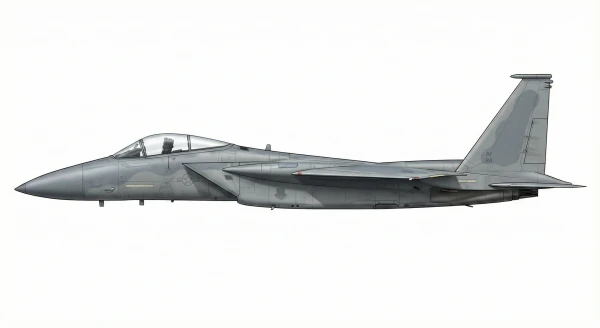
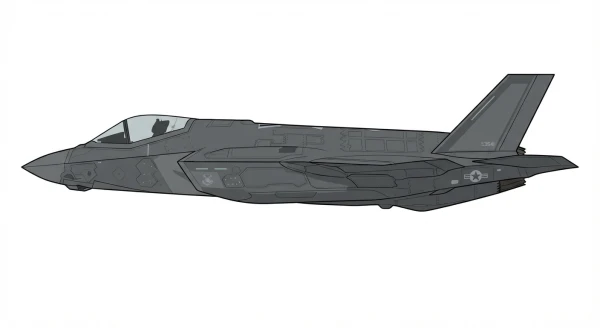
| F-15 Eagle | F-35 Lightning II | |
|---|---|---|
| Origin country | 🇺🇸 United States | 🇺🇸 United States |
| Category | Combat Aircraft | Combat Aircraft |
| Manufacturer | McDonnell Douglas | Lockheed Martin |
| First flight | 27 July 1972 | 15 December 2006 |
| Year introduced | 1976 | 2013 |
| Number produced | 1198 units | 965 units |
| Average unit price | $29 million | $103 million |
| Wing area | 56.5 m² | 43.0 m² |
| Wingspan | 13.1 m | 11.0 m |
| Height | 5.6 m | 4.4 m |
| Length | 19.4 m | 15.6 m |
| Maximum speed | 2655 km/h | 1960 km/h |
| Operational range | 3,971 km | 2,800 km |
| Service ceiling | 19,812 m | 15,000 m |
| Max. takeoff weight | 30,844 kg | 27,216 kg |
| Empty weight | 12,701 kg | 14,651 kg |
| Total thrust | 2 x 10,782 kgf | 1 x 19,500 kgf |
Detailed Comparison
Designed to counter the Soviet MiG-25, the McDonnell Douglas F-15 Eagle relies on kinetic performance and radar power to establish air superiority. In contrast, the Lockheed Martin F-35 Lightning II trades aerodynamic performance for very low observable (VLO) stealth, sensor fusion, and multirole capability under the Joint Strike Fighter program. The ongoing procurement of both airframes by the USAF—including the recent F-15EX acquisition—indicates a doctrine where fifth-generation sensor nodes require fourth-generation missile trucks to operate at mass.
Development and Design
The F-15 originated from Vietnam War air combat studies and energy-maneuverability theory. The F-X requirements dictated a twin-engine, dedicated air-to-air fighter with a thrust-to-weight ratio approaching 1:1, explicitly minimizing air-to-ground compromises. Conversely, F-35 development prioritized multi-service commonality. The mandate to incorporate a lift fan for the Marine Corps’ F-35B short takeoff and vertical landing (STOVL) variant forced a wider fuselage and a single-engine configuration across the A, B, and C variants. Rather than kinetic dominance, Lockheed Martin built the F-35 around the AN/APG-81 AESA radar, Distributed Aperture System (DAS), and Electro-Optical Targeting System (EOTS) to provide spherical battlespace awareness.
Specifications and Performances
The F-15 prioritizes raw kinematics. Its twin Pratt & Whitney F100 engines generate over 15,800 kgf of thrust each, driving the 12,701 kg airframe to Mach 2.5 with a 254 m/s climb rate. The F-35 is aerodynamically constrained by its stealth and multirole mandates. Weighing 14,651 kg empty—nearly 2,000 kg heavier than the larger F-15—it relies on a single F135 engine producing 19,500 kgf of thrust. It is limited to Mach 1.6 and possesses a lower thrust-to-weight ratio. However, the F-35's internal weapons bay allows it to fly at combat weight without increasing its radar cross-section or drag profile, whereas an externally armed F-15 becomes a high-drag radar reflector.
Deployment and usage
The F-15 holds an air-to-air record of 104 kills to zero losses. Israeli F-15s destroyed 41 Syrian aircraft in the 1982 Lebanon War, and USAF Eagles achieved 36 of 39 aerial victories during the 1991 Gulf War. The F-35's combat record is in its infancy, with the Israeli Air Force conducting its first strikes over Syria in 2018. In combat exercises like Red Flag, F-35s act as network quarterbacks. They penetrate contested airspace and relay targeting data via the Multifunction Advanced Data Link (MADL) to legacy fighters operating from standoff distances.
Conclusion
The F-35 possesses the definitive edge in highly contested airspace. Against modern Integrated Air Defense Systems (IADS) and low-observable adversaries, the non-stealthy F-15 cannot survive. However, the F-15 retains the advantage in specific mission profiles:
- Homeland defense and bomber interception
- Long-range engagements requiring Mach 2+ sprint speeds
- High-volume weapons carriage, functioning as a standoff missile truck
When airspace is protected by advanced surface-to-air missiles, the F-35 is the requisite penetrating asset. When airspace is permissive or long-range munitions must be delivered in volume, the F-15 remains the superior platform.