F-35 Lightning II vs Su-57 Felon
F-35 Lightning II vs Su-57 Felon at a glance — top speed 1,960 vs 2,135 km/h, range 2,800 vs 4,500 km, max takeoff weight 27,216 vs 35,000 kg, built 965 vs 32 units.
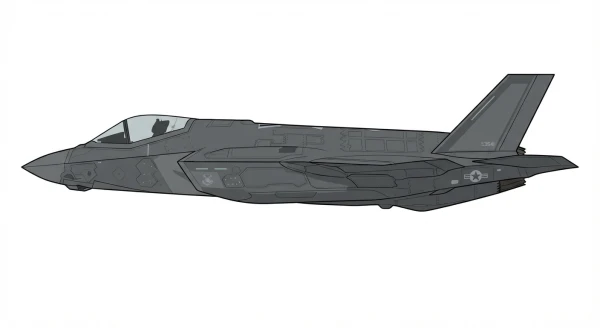
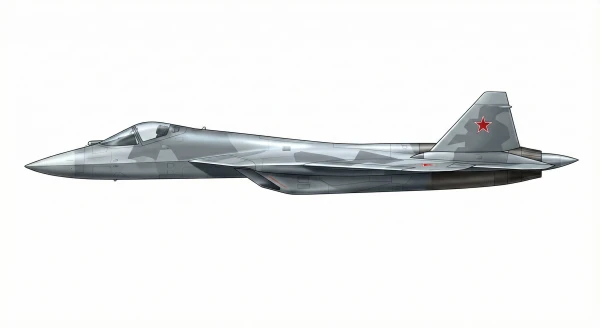
| F-35 Lightning II | Su-57 Felon | |
|---|---|---|
| Origin country | 🇺🇸 United States | 🇷🇺 Russia |
| Category | Combat Aircraft | Combat Aircraft |
| Manufacturer | Lockheed Martin | Sukhoi |
| First flight | 15 December 2006 | 29 January 2010 |
| Year introduced | 2013 | 2020 |
| Number produced | 965 units | 32 units |
| Average unit price | $103 million | $42 million |
| Wing area | 43.0 m² | 78.8 m² |
| Wingspan | 11.0 m | 14.1 m |
| Height | 4.4 m | 4.6 m |
| Length | 15.6 m | 20.1 m |
| Maximum speed | 1960 km/h | 2135 km/h |
| Operational range | 2,800 km | 4,500 km |
| Service ceiling | 15,000 m | 20,000 m |
| Max. takeoff weight | 27,216 kg | 35,000 kg |
| Empty weight | 14,651 kg | 18,500 kg |
| Total thrust | 1 x 19,500 kgf | 2 x 14,500 kgf |
Detailed Comparison
The F-35 Lightning II is a single-engine, multi-variant combat aircraft defined by its all-aspect stealth, advanced sensor fusion, and widespread integration into US and allied forces. In contrast, the twin-engine Su-57 Felon is a Russian platform prioritizing speed, a high service ceiling, and extreme maneuverability, while incorporating frontal stealth characteristics. This fundamental difference in design philosophy is reflected in their development, scale, and operational employment, with the F-35 being a mature, mass-produced system and the Su-57 a numerically limited asset.
Development and Design
The F-35 emerged from the US Joint Strike Fighter (JSF) program, an ambitious multinational effort to create a common platform for three distinct service roles. Its design is dominated by the requirements for low observability (stealth) and network-centric warfare. The airframe’s shape, materials, and internal weapons bay are all optimized to minimize its radar cross-section. Its defining innovation is the fusion of data from its AN/APG-81 AESA radar, Distributed Aperture System (DAS), and Electro-Optical Targeting System (EOTS), which provides the pilot with unparalleled situational awareness.
The Su-57 was developed through Russia's PAK FA program as a successor to the Su-27 and MiG-29. Its protracted development resulted in a design that blends fifth-generation features with traditional Russian strengths in aerodynamics. While it incorporates frontal stealth elements like planform edge alignment and internal weapons bays, its design prioritizes kinematic performance. Features like canted thrust-vectoring nozzles and Leading Edge Vortex Controllers (LEVCONs) give it exceptional supermaneuverability at high angles of attack.
Specifications and Performances
A comparison of performance metrics reveals their divergent priorities. The Su-57's twin Saturn AL-41F1 engines give it a clear advantage in raw performance, achieving a higher maximum speed (2135 km/h vs. the F-35’s 1930 km/h) and a substantially higher service ceiling (20,000 m vs. 15,000 m). Its larger airframe and wing area (78.8 m² vs 43.0 m²) also contribute to a significantly greater stated ferry range. The single-engine F-35, while not designed for kinematic superiority, leverages its advanced engine and systems for versatile multirole performance across its three variants (CTOL, STOVL, and carrier-based).
Deployment and usage
The disparity in production and deployment is stark. With over 965 aircraft built, the F-35 is a mature platform operated by numerous nations. It has a significant operational history, including combat use by the US, UK, and Israel, and is a central component in major international exercises like Red Flag. In contrast, the Su-57's deployment is limited to the Russian Aerospace Forces, with only around 32 aircraft produced. Its combat experience is minimal, consisting of limited combat trials in Syria and use during the invasion of Ukraine, primarily to launch long-range munitions from the relative safety of Russian airspace. Claims of its effectiveness in contested roles like SEAD remain unverified.
Conclusion
The F-35 and Su-57 represent two different answers to the question of fifth-generation air combat. The F-35 is a fully realized, integrated system whose value lies in its stealth, information dominance, and network-centric capabilities. Its high production numbers and deep integration with allied forces make it a formidable and influential global asset. The Su-57 is an aerodynamically impressive fighter that blends high-end kinematic performance with some stealth features. However, its low production rate and limited operational deployment mean it has yet to demonstrate its full potential or mature into the wide-scale, front-line system envisioned by its designers.