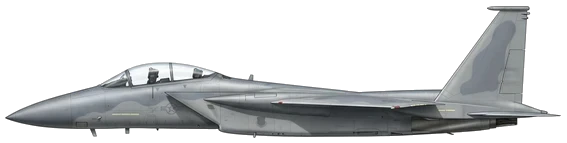
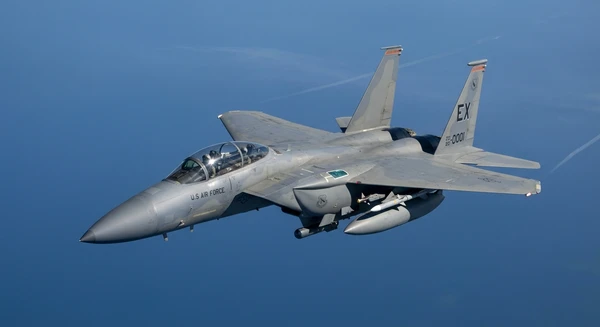
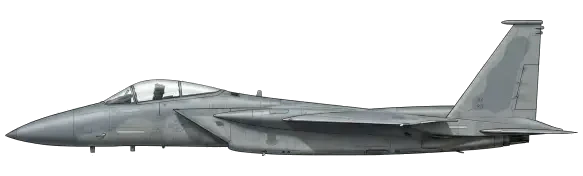
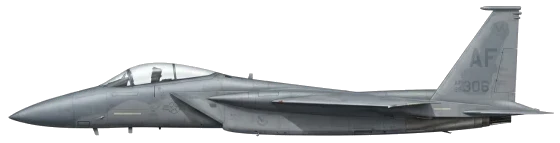
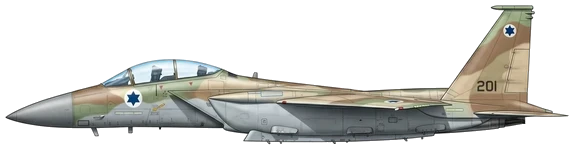
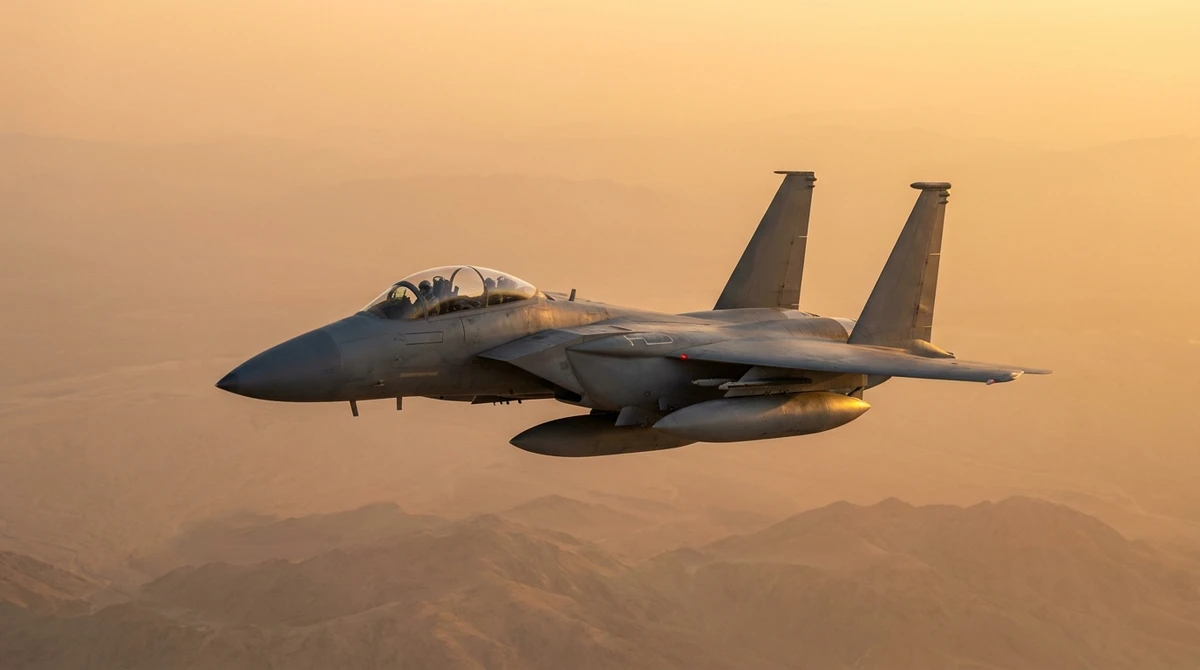
The Boeing F-15EX Eagle II is the most advanced variant of the F-15 family and a 4.5-generation multirole fighter designed to replace the F-15C/D fleet in USAF service. Rather than a simple upgrade of the original Eagle, it is derived from the F-15 Advanced Eagle — a redesigned export lineage that began with the Saudi F-15SA (first flight 2013) and Qatari F-15QA (2020) — and brings those improvements into U.S. service. The production total on this page counts the whole Advanced Eagle line — 84 F-15SA, 48 F-15QA and 22 F-15EX delivered by September 2026 — since the three variants share one airframe and one St. Louis production line. Its role is to perform homeland air defense missions and to serve as an affordable, high-payload platform that complements the F-22 and F-35 in contested environments.
Design
Compared to the F-15C/D it replaces, the F-15EX introduces several structural and systemic changes. The airframe is rebuilt for a 20,000-hour service life, roughly double that of the F-15C. The legacy fly-by-wire system is replaced by a fully digital flight control system, which both improves handling and enables activation of two previously dormant outboard wing stations (stations 1 and 9) that were suppressed on older variants for aerodynamic stability reasons. This increases the standard air-to-air loadout from 8 to 12 missiles, with a proposed Advanced Missile and Bomb Ejector Rack (AMBER) system potentially raising capacity to 22. Compared to the F-15E Strike Eagle from which it is derived, the EX brings a more capable AESA radar, a new-generation electronic warfare suite, and an open mission systems architecture that the F-15E's legacy avionics lacked.
The avionics suite is built on an open systems architecture centered on the Advanced Display Core Processor II (ADCP II) mission computer, enabling faster upgrade cycles than the proprietary systems of legacy Eagles. The cockpit features a large area display (10 in × 19 in LAD) for both crew members, replacing the older multi-function displays. Primary sensor is the Raytheon AN/APG-82(V)1 active electronically scanned array (AESA) radar, a significant step up from the mechanically scanned AN/APG-63(V)1 of the F-15C or the AN/APG-70 of the F-15E. Infrared detection is provided by the Lockheed Martin Legion Pod carrying the AN/ASG-34(V)1 IRST21 infrared search and track sensor.
Electronic warfare is handled by the BAE Systems AN/ALQ-250 Eagle Passive/Active Warning Survivability System (EPAWSS), replacing the older AN/ALQ-135/128 found on previous Eagles. EPAWSS integrates radar warning, threat geolocation, and the AN/ALE-47 countermeasures dispenser into a single coherent system. The aircraft has 25 hardpoints and a maximum payload of 29,500 lb. Internal armament is a 20 mm M61A1 Vulcan cannon. Standard air-to-air weapons include AIM-120 AMRAAM and AIM-9X Sidewinder; air-to-surface options include the AGM-158 JASSM, GBU-39 Small Diameter Bomb, and AGM-88 HARM. Propulsion comes from two General Electric F110-GE-129 afterburning turbofans.
Operational History
The USAF declared initial operational capability on 10 July 2024, with the 142nd Wing in Oregon among the first units to receive the type. The USAF originally planned to procure 144 aircraft, later cut to 129, before raising the program to 269 in April 2026; the Lot 7 contract for 22 aircraft, awarded on 29 September 2026, brought the number under contract to 120. Internationally, Israel signed a contract for 25 F-15IA fighters in December 2025. Egypt has entered talks for up to 46 aircraft, and Boeing has proposed 54 units to Saudi Arabia.
Variants
- F-15SA: Saudi Advanced Eagle; the first Advanced Eagle variant, featuring AESA radar and a digital EW system. First flew 2013.
- F-15QA: Qatari Advanced Eagle; introduced the large area display cockpit and ADCP II mission computer. First flew 2020.
- F-15EX: The two-seat USAF production variant; adds EPAWSS and the AN/APG-82(V)1 radar to the Advanced Eagle baseline.
- F-15IA: Israeli variant based on the F-15EX design, ordered in 2025.