F-15 Eagle vs Su-35 Flanker-E
F-15 Eagle vs Su-35 Flanker-E at a glance — top speed 2,655 vs 2,400 km/h, range 3,971 vs 4,500 km, max takeoff weight 30,844 vs 34,500 kg, built 1,198 vs 151 units.
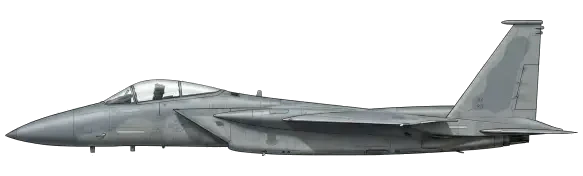
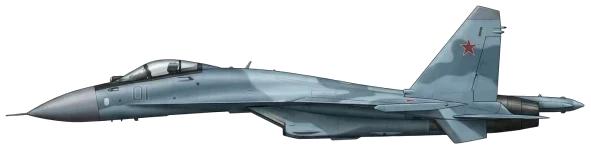
| F-15 Eagle | Su-35 Flanker-E | |
|---|---|---|
| Origin country | 🇺🇸 United States | 🇷🇺 Russia |
| Category | Combat Aircraft | Combat Aircraft |
| Manufacturer | McDonnell Douglas | Sukhoi |
| First flight | 27 July 1972 | 19 February 2008 |
| Year introduced | 1976 | 2014 |
| Number produced | 1198 units | 151 units |
| Average unit price | $29 million | $83 million |
| Wing area | 56.5 m² | 62.0 m² |
| Wingspan | 13.1 m | 15.3 m |
| Height | 5.6 m | 5.9 m |
| Length | 19.4 m | 21.9 m |
| Maximum speed | 2655 km/h | 2400 km/h |
| Operational range | 3,971 km | 4,500 km |
| Service ceiling | 19,812 m | 18,000 m |
| Max. takeoff weight | 30,844 kg | 34,500 kg |
| Empty weight | 12,701 kg | 19,000 kg |
| Total thrust | 2 x 10,782 kgf | 2 x 14,000 kgf |
Detailed Comparison
The F-15 Eagle, a product of Cold War air superiority doctrine, stands in contrast to the Su-35 Flanker-E, a heavily modernized multirole derivative of the Su-27. While both are twin-engine fighters, the F-15 was optimized for high-speed, high-altitude performance and energy-maneuverability, achieving a significant combat record. The Su-35, entering service nearly four decades later, leverages thrust-vectoring engines for enhanced maneuverability and integrates advanced sensors and a broader weapons suite, reflecting a modern emphasis on multi-mission capability.
Development and Design
The F-15's design was a direct response to lessons from the Vietnam War and the emergence of the Soviet MiG-25. The "F-X" program prioritized a high thrust-to-weight ratio, speed, and agility, resulting in a robust airframe of mostly aluminum and titanium. Its development was a clean-sheet approach to air dominance. The Su-35 follows an evolutionary path, representing an extensive modernization of the Su-27 Flanker airframe, which was the Soviet counterpart to the F-15. Its key innovations are not in the basic aerodynamic concept but in its systems: powerful AL-41F1S thrust-vectoring engines, a digital fly-by-wire system, and the Irbis-E passive electronically scanned array (PESA) radar, all integrated into a reinforced structure.
Specifications and Performances
The F-15’s original design priorities are evident in its performance metrics: a higher maximum speed (2,655 km/h vs. the Su-35's 2,500 km/h) and a greater service ceiling (19,812 m vs. 18,000 m). The Su-35 is a physically larger and heavier aircraft, with an empty weight of 18,400 kg compared to the F-15's 12,701 kg. This allows the Su-35 to carry a heavier ordnance load (8,000 kg across 12 hardpoints) and a more diverse array of munitions, including long-range missiles like the R-37M and extensive air-to-ground weapons. The F-15A/C variants are primarily air-to-air platforms, armed with AIM-7, AIM-9, and AIM-120 missiles, alongside an internal 20mm cannon.
Deployment and usage
The F-15 has one of the most extensive combat records of any modern fighter. In service with the USAF and Israeli Air Force, it demonstrated high effectiveness in conflicts like the 1982 Lebanon War and the 1991 Gulf War, where USAF F-15s were credited with 36 of 39 air-to-air victories. It has consistently performed its role as an air superiority fighter. The Su-35's operational history is more recent and limited. Its primary combat deployment has been in Syria since 2016, where it has served as a high-end air superiority asset and a platform to test its advanced systems. It has been exported to China but has not engaged in combat on the same scale as the Eagle.
Conclusion
The F-15 Eagle is a combat-proven specialist, a benchmark for air superiority defined by high-energy performance and a notable combat history. The Su-35 Flanker-E represents a different approach: an evolutionary design that maximizes a successful airframe with superior thrust, advanced avionics, and multirole flexibility. While the Su-35's capabilities, particularly its sensor suite and maneuverability, are significant, it lacks the decades of operational validation that define the F-15's service record. The two aircraft effectively represent different generations and design philosophies in fighter development.