F/A-18 Hornet vs JAS 39 Gripen
F/A-18 Hornet vs JAS 39 Gripen at a glance — top speed 1,915 vs 2,100 km/h, range 2,017 vs 4,000 km, max takeoff weight 23,541 vs 14,000 kg, built 1,480 vs 300 units.
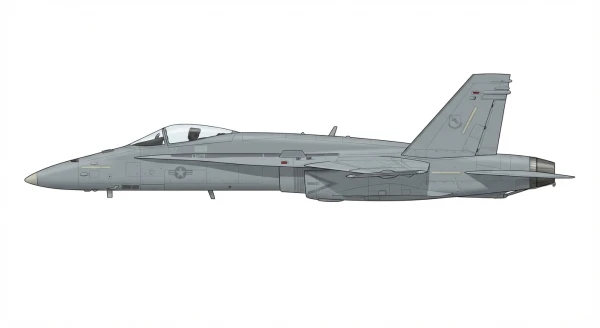
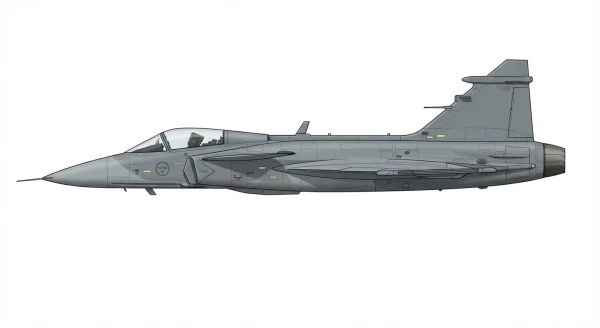
| F/A-18 Hornet | JAS 39 Gripen | |
|---|---|---|
| Origin country | 🇺🇸 United States | 🇸🇪 Sweden |
| Category | Combat Aircraft | Combat Aircraft |
| Manufacturer | McDonnell Douglas | Saab |
| First flight | 18 November 1978 | 9 December 1988 |
| Year introduced | 1983 | 1996 |
| Number produced | 1480 units | 300 units |
| Average unit price | $29 million | $30 million |
| Wing area | 38.0 m² | 30.0 m² |
| Wingspan | 12.3 m | 8.4 m |
| Height | 4.7 m | 4.5 m |
| Length | 17.1 m | 14.9 m |
| Maximum speed | 1915 km/h | 2100 km/h |
| Operational range | 2,017 km | 4,000 km |
| Service ceiling | 15,000 m | 15,240 m |
| Max. takeoff weight | 23,541 kg | 14,000 kg |
| Empty weight | 10,433 kg | 6,800 kg |
| Total thrust | 2 x 8,051 kgf | 1 x 8,209 kgf |
Detailed Comparison
McDonnell Douglas designed the F/A-18 Hornet for the US Navy’s carrier-based strike fighter requirements, optimizing for twin-engine survivability, structural reinforcement, and heavy payload delivery. Saab engineered the JAS 39 Gripen a decade later to satisfy Sweden’s Bas 90 dispersed basing doctrine, trading expeditionary range for a low logistical footprint and short-takeoff capability from rural highway strips. The Hornet functions as a medium-heavy power projection platform; the Gripen operates as a lightweight interceptor tailored for territorial defense.
Development and Design
The Hornet is a derivative of the YF-17 lightweight fighter prototype, modified for the punishing environment of naval aviation. McDonnell Douglas added folding wings, a tailhook, a strengthened undercarriage, and the first production quadruple-redundant digital fly-by-wire system. Saab adopted a canard-delta configuration for the Gripen, providing positive lift at all speeds and permitting +9/−3 g loads. While both airframes emphasize reduced maintenance, their approaches diverge. The F/A-18 focuses on modular component swapping, allowing a four-person team to change a GE F404 engine in under 20 minutes. Saab engineered the Gripen for austere environments, allowing a single technician and five conscripts to re-arm, refuel, and inspect the aircraft in ten minutes.
Specifications and Performances
The Hornet’s physical dimensions dictate a heavy kinetic envelope. With a maximum takeoff weight of 23,541 kg, it outweighs the initial Gripen variants by nearly 10,000 kg. This allows the F/A-18 to carry 13,700 pounds of ordnance across nine hardpoints and fly an unrefueled range of over 2,000 km. The Gripen relies on energy kinematics over endurance. It reaches a maximum speed of 2,100 km/h compared to the Hornet’s 1,915 km/h, but its 805 km range confines it to localized defense perimeters. The later Gripen E increases maximum takeoff weight to 16,500 kg and adds fuel capacity, yet it remains fundamentally a lighter tactical airframe compared to the F/A-18.
Deployment and usage
The F/A-18 holds a continuous combat record since 1986. During Operation Desert Storm in 1991, Hornets shot down Iraqi fighters and bombed ground targets on the same sortie. It served as the primary strike asset over Bosnia, Kosovo, and Iraq. The Gripen’s combat history is largely non-kinetic. Swedish airframes flew reconnaissance during operations over Libya in 2011, with the aircraft’s first air-to-ground strikes occurring in 2025 during the Cambodia-Thailand border conflict. However, the Gripen secures export contracts by offering procurement incentives typically blocked by the US Foreign Military Sales process:
- Full technology transfer and domestic assembly rights
- Direct access to avionics source code
- Agnostic integration of US, European, or indigenous munitions
Conclusion
The F/A-18 Hornet wins in long-range strike and maritime operations. Its twin-engine redundancy, payload mass, and 2,000 km range dictate its use for air forces that project power over hostile environments. The JAS 39 Gripen has the absolute edge in airspace denial and asymmetric basing. For nations expecting to fight outnumbered from degraded runways, the Gripen’s ten-minute turnaround, $4,700 cost per flight hour, and source-code access provide a strictly better return on investment than heavy, maintenance-intensive airframes.