F-16 Fighting Falcon vs F/A-18 Hornet
F-16 Fighting Falcon vs F/A-18 Hornet at a glance — top speed 2,178 vs 1,915 km/h, range 4,217 vs 2,017 km, max takeoff weight 19,200 vs 23,541 kg, built 4,604 vs 1,480 units.
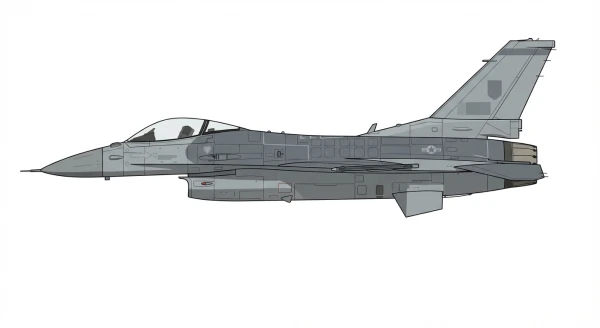
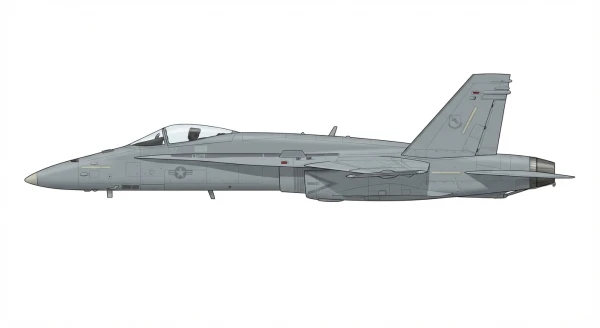
| F-16 Fighting Falcon | F/A-18 Hornet | |
|---|---|---|
| Origin country | 🇺🇸 United States | 🇺🇸 United States |
| Category | Combat Aircraft | Combat Aircraft |
| Manufacturer | General Dynamics | McDonnell Douglas |
| First flight | 2 February 1974 | 18 November 1978 |
| Year introduced | 1979 | 1983 |
| Number produced | 4604 units | 1480 units |
| Average unit price | $18.8 million | $29 million |
| Wing area | 27.9 m² | 38.0 m² |
| Wingspan | 10.0 m | 12.3 m |
| Height | 4.9 m | 4.7 m |
| Length | 15.1 m | 17.1 m |
| Maximum speed | 2178 km/h | 1915 km/h |
| Operational range | 4,217 km | 2,017 km |
| Service ceiling | 15,240 m | 15,000 m |
| Max. takeoff weight | 19,200 kg | 23,541 kg |
| Empty weight | 8,570 kg | 10,433 kg |
| Total thrust | 1 x 12,701 kgf | 2 x 8,051 kgf |
Detailed Comparison
The F/A-18 Hornet and F-16 Fighting Falcon originated from the U.S. Lightweight Fighter (LWF) competition, yet evolved to meet distinct operational needs. The twin-engine Hornet was developed from the losing YF-17 prototype to fulfill a U.S. Navy requirement for a carrier-capable multirole aircraft, prioritizing structural robustness and systems redundancy for over-water operations. Conversely, the single-engine F-16 was the LWF winner, designed for the U.S. Air Force as a lower-cost, highly agile, land-based air superiority fighter that was later adapted for all-weather, multirole missions.
Development and Design
The design philosophies reflect their parent services. The F/A-18 was engineered for the demanding environment of aircraft carriers. Its twin General Electric F404/F414 engines provide critical redundancy for maritime flights. Structural features like a strengthened undercarriage, arrestor hook, and folding wings are essential for carrier operations but add weight and complexity. Its "F/A" designation underscores its conception as a dual-role fighter and attack aircraft from the outset.
The F-16, in contrast, was built for performance and affordability. Its single Pratt & Whitney F100 or General Electric F110 engine, blended wing-body, and relaxed static stability (managed by a fly-by-wire system) grant it exceptional agility. Key innovations included a side-stick controller and a frameless bubble canopy for superior pilot visibility. Its design prioritized air-to-air combat, with ground-attack capabilities being integrated and expanded in later variants.
Specifications and Performances
A comparison of specifications reveals a clear trade-off between performance and mission-specific design. The F-16 is significantly lighter (8,570 kg empty weight vs. the F/A-18E/F's 15,011 kg) and aerodynamically cleaner, resulting in a higher maximum speed (2,410 km/h vs. 1,915 km/h) and service ceiling (18,288 m vs. 15,240 m). The Hornet's larger size and greater maximum takeoff weight (29,937 kg vs. 19,200 kg) allow it to carry substantial payloads, though it sacrifices some kinematic performance. The Hornet's twin engines offer less thrust individually but provide a safety margin absent in the single-engine F-16, a vital consideration for naval aviation.
Deployment and usage
Both aircraft have extensive and proven operational histories. The F/A-18 has been a principal asset for the U.S. Navy and Marine Corps since the 1980s, serving in every major U.S. conflict from Operation El Dorado Canyon to operations in the Middle East. Its role as a carrier-based platform defines its deployment, providing flexible air power from the sea. The F-16's lower cost and high performance led to its adoption by the USAF and more than 25 other nations, making it one of the most numerous and widely used combat aircraft globally. It has seen combat with numerous air forces, including extensive use by the U.S., Israel, and NATO partners in conflicts such as Desert Storm and Allied Force.
Conclusion
The two aircraft represent successful but divergent solutions to modern air combat requirements. The F-16 Fighting Falcon offers exceptional kinematic performance, agility, and cost-effectiveness, making it an ideal land-based fighter for a wide array of air forces. The F/A-18 Hornet prioritizes mission flexibility and operational safety over raw performance, providing a robust, redundant, and capable multirole platform optimized for the unique and unforgiving conditions of naval carrier operations. Its development into the larger Super Hornet further underscores the value of its foundational design principles for maritime air power.