F/A-18 Hornet vs Rafale
F/A-18 Hornet vs Rafale at a glance — top speed 1,915 vs 1,912 km/h, range 2,017 vs 3,700 km, max takeoff weight 23,541 vs 24,500 kg, built 1,480 vs 316 units.
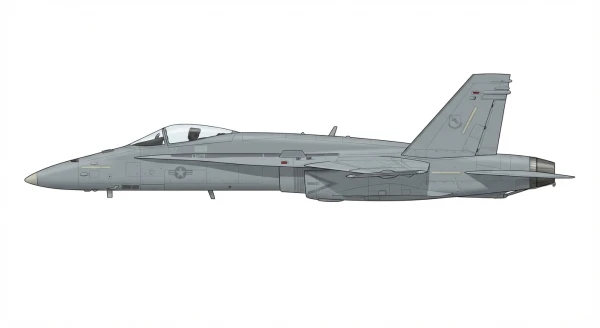
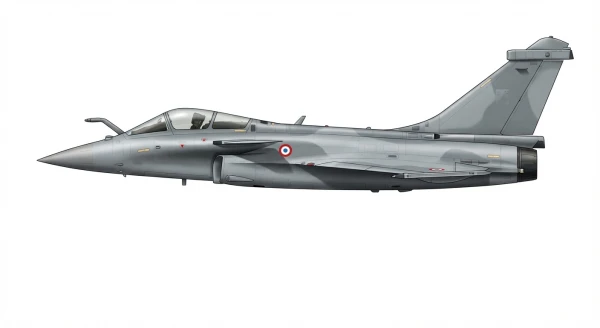
| F/A-18 Hornet | Rafale | |
|---|---|---|
| Origin country | 🇺🇸 United States | 🇫🇷 France |
| Category | Combat Aircraft | Combat Aircraft |
| Manufacturer | McDonnell Douglas | Dassault |
| First flight | 18 November 1978 | 4 July 1986 |
| Year introduced | 1983 | 2001 |
| Number produced | 1480 units | 316 units |
| Average unit price | $29 million | $95 million |
| Wing area | 38.0 m² | 45.7 m² |
| Wingspan | 12.3 m | 10.9 m |
| Height | 4.7 m | 5.3 m |
| Length | 17.1 m | 15.3 m |
| Maximum speed | 1915 km/h | 1912 km/h |
| Operational range | 2,017 km | 3,700 km |
| Service ceiling | 15,000 m | 15,835 m |
| Max. takeoff weight | 23,541 kg | 24,500 kg |
| Empty weight | 10,433 kg | 9,850 kg |
| Total thrust | 2 x 8,051 kgf | 2 x 7,648 kgf |
Detailed Comparison
The F/A-18 Hornet and Dassault Rafale are twin-engine, multirole combat aircraft, but they stem from different strategic and design doctrines. The F/A-18 was developed for the U.S. Navy as a carrier-capable replacement for multiple aircraft, prioritizing reliability and multi-mission flexibility. In contrast, the Rafale was a French clean-sheet design, pursued after withdrawing from the Eurofighter consortium, emphasizing aerodynamic performance and system integration for strategic autonomy. The Hornet’s conventional trapezoidal wing and twin-tail layout contrasts with the Rafale’s delta-wing and close-coupled canard configuration, which provides enhanced agility.
Development and Design
The F/A-18 originated from the YF-17 prototype, adapted specifically for the rigors of U.S. Navy carrier operations. This heritage is evident in its robust airframe, folding wings, and an emphasis on ease of maintenance. The evolution into the F/A-18E/F Super Hornet, reflected in the provided specifications, was a significant redesign, creating a 25% larger airframe for increased range and payload. The Rafale’s design philosophy centers on the "omnirole" concept—the ability to perform different missions during the same sortie. Its design incorporates measures for a reduced radar cross-section and features the highly integrated SPECTRA electronic warfare suite, aiming for survivability through superior situational awareness and self-protection capabilities.
Specifications and Performances
While both aircraft have similar maximum speeds (approx. Mach 1.8), their performance characteristics diverge. The F/A-18E/F Super Hornet is a larger and heavier aircraft, with a max takeoff weight of 29,937 kg compared to the Rafale's 24,500 kg, allowing for a greater payload. The Rafale’s lighter airframe and delta-canard aerodynamics give it a distinct kinematic advantage, particularly in its rate of climb (305 m/s) and a short takeoff distance of 400 meters. Both platforms utilize advanced AESA radars, but the Rafale’s systems are noted for their deep integration and data fusion from the outset.
Deployment and usage
The F/A-18 has a longer and more extensive combat history, serving as a workhorse for the U.S. Navy and Marine Corps since the 1980s. It has seen action in nearly every major U.S. conflict from Libya in 1986 to operations in the Middle East. It has proven its value in strike, air superiority, and suppression of enemy air defenses roles. The Rafale entered service in 2001 and has since been combat-proven in Afghanistan, Libya, Mali, and Syria. During these operations, it validated its omnirole design, conducting simultaneous reconnaissance and strike missions, often with minimal support. The Rafale has also achieved significant export success, being adopted by air forces in Egypt, India, and Qatar.
Conclusion
The F/A-18 Super Hornet and Dassault Rafale represent two effective, yet different, approaches to the 4.5-generation multirole fighter. The Super Hornet is a combat-proven, evolutionary design maximized for payload, range, and operational availability within the U.S. naval aviation structure. The Rafale is a testament to an independent design philosophy, offering exceptional agility and a highly integrated avionics and electronic warfare suite in a more compact airframe. The choice between the two is contingent on an operator's specific strategic goals, existing infrastructure, and desired balance between payload capacity and kinematic performance.