F-16 Fighting Falcon vs Rafale
F-16 Fighting Falcon vs Rafale at a glance — top speed 2,178 vs 1,912 km/h, range 4,217 vs 3,700 km, max takeoff weight 19,200 vs 24,500 kg, built 4,604 vs 316 units.
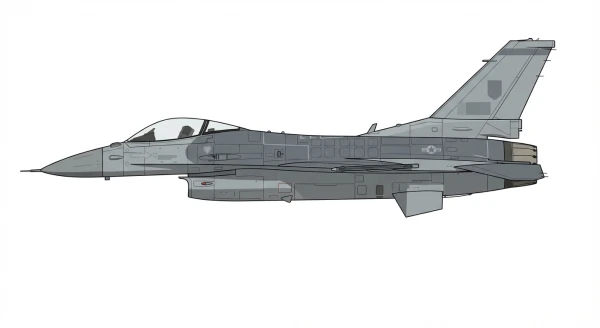
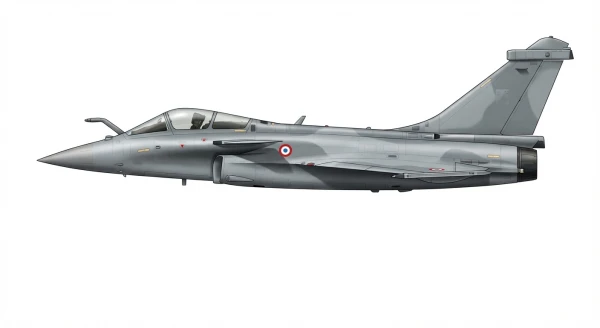
| F-16 Fighting Falcon | Rafale | |
|---|---|---|
| Origin country | 🇺🇸 United States | 🇫🇷 France |
| Category | Combat Aircraft | Combat Aircraft |
| Manufacturer | General Dynamics | Dassault |
| First flight | 2 February 1974 | 4 July 1986 |
| Year introduced | 1979 | 2001 |
| Number produced | 4604 units | 316 units |
| Average unit price | $18.8 million | $95 million |
| Wing area | 27.9 m² | 45.7 m² |
| Wingspan | 10.0 m | 10.9 m |
| Height | 4.9 m | 5.3 m |
| Length | 15.1 m | 15.3 m |
| Maximum speed | 2178 km/h | 1912 km/h |
| Operational range | 4,217 km | 3,700 km |
| Service ceiling | 15,240 m | 15,835 m |
| Max. takeoff weight | 19,200 kg | 24,500 kg |
| Empty weight | 8,570 kg | 9,850 kg |
| Total thrust | 1 x 12,701 kgf | 2 x 7,648 kgf |
Detailed Comparison
The F-16 emerged from the US Air Force's 1970s Lightweight Fighter program as an inexpensive, single-engine daylight dogfighter, subsequently evolving into a ubiquitous multirole platform. Dassault’s Rafale, entering service 22 years later, was conceived as an omnirole, twin-engine delta-canard fighter to replace six separate aircraft types across the French Air Force and Navy. While the F-16 relies on mass production and continuous block upgrades to maintain its position, the Rafale integrates native electronic warfare and sensor fusion from the airframe's inception.
Development and Design
The F-16's design is rooted in energy-maneuverability theory. John Boyd's "Fighter Mafia" prioritized thrust-to-weight ratios and sustained turn rates over heavy radar and Beyond Visual Range (BVR) missiles. It introduced relaxed static stability managed by a fly-by-wire system, alongside a 30-degree reclined seat to help pilots sustain 9G maneuvers. France pursued the Rafale after withdrawing from the Eurofighter consortium in 1985 to protect Dassault's industrial base and ensure aircraft carrier compatibility. The Rafale utilizes a close-coupled canard-delta configuration. Unlike the F-16’s reliance on external jamming pods for contested airspace, Dassault integrated the SPECTRA electronic warfare suite directly into the airframe, providing passive threat detection and active jamming without occupying weapon stations.
Specifications and Performances
The F-16's single Pratt & Whitney F100 or GE F110 engine keeps its empty weight at 8,570 kg, allowing speeds up to Mach 2.0 (2,410 km/h) in a clean configuration. However, external fuel tanks and targeting pods severely degrade its aerodynamic performance. The twin-engine Rafale carries a heavier empty weight of 10,196 kg but provides a Maximum Takeoff Weight (MTOW) of 24,500 kg, exceeding the F-16's 19,200 kg limit. Powered by two SNECMA M88 turbofans generating 20,388 kgf of combined thrust, the Rafale climbs at 305 m/s compared to the F-16's 254 m/s. The French fighter’s 14 hardpoints and ability to supercruise with a combat load grant it a kinematic advantage in heavily armed configurations.
Deployment and usage
The F-16 holds a combat record spanning four decades. Israeli F-16s destroyed Iraq's Osirak reactor in 1981 and shot down Syrian MiGs in the Bekaa Valley in 1982. In US service, F-16CJs executing the Wild Weasel mission have controlled SEAD operations since Operation Desert Storm. The Rafale achieved initial combat capability over Afghanistan in 2002. During Operation Harmattan in Libya (2011), Rafales bypassed dedicated SEAD escorts, relying on SPECTRA to penetrate airspace and strike SAM sites autonomously. While the F-16 controls the global market with over 4,600 airframes built at roughly $75 million each, the $115 million Rafale recently secured high-profile export contracts with India, Egypt, and the UAE, driven by MBDA Meteor missile integration and a lack of US ITAR restrictions.
Conclusion
The F-16 remains the definitive choice for air forces requiring a mass-deployable, cost-effective multirole platform. Its vast user base guarantees parts availability, shared doctrine, and continuous upgrade pathways like the Block 70/72 AESA radar integration. However, the Rafale holds the tactical edge in heavily contested environments. Its twin-engine redundancy, integrated SPECTRA suite, and superiority in payload fraction allow it to execute penetrating strike missions autonomously without support aircraft. For nations willing to pay a premium to secure independence from US weapon release authorizations, the Rafale provides a heavier, more survivable, and self-reliant strike capability.