HH-60 Pave Hawk vs UH-60 Black Hawk
HH-60 Pave Hawk vs UH-60 Black Hawk at a glance — top speed 357 vs 294 km/h, range 691 vs 2,221 km, max takeoff weight 9,979 vs 10,659 kg, built 112 vs 5,000 units.
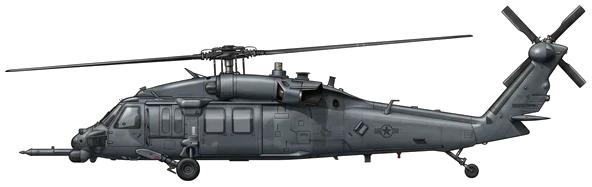
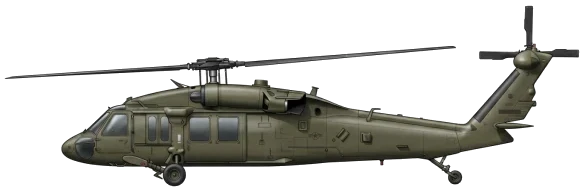
| HH-60 Pave Hawk | UH-60 Black Hawk | |
|---|---|---|
| Origin country | 🇺🇸 United States | 🇺🇸 United States |
| Category | Military Helicopters | Military Helicopters |
| Manufacturer | Sikorsky | Sikorsky |
| First flight | 1 January 1987 | 29 November 1974 |
| Year introduced | 1987 | 1979 |
| Number produced | 112 units | 5000 units |
| Average unit price | -- | $21 million |
| Wingspan | 16.1 m | 16.4 m |
| Height | 5.1 m | 4.9 m |
| Length | 19.8 m | 19.5 m |
| Maximum speed | 357 km/h | 294 km/h |
| Operational range | 691 km | 2,221 km |
| Service ceiling | 4,300 m | 5,791 m |
| Max. takeoff weight | 9,979 kg | 10,659 kg |
| Empty weight | 7,257 kg | 4,819 kg |
| Total thrust | 2 x 1,450 kW | 2 x 1,208 kW |
Detailed Comparison
The UH-60 Black Hawk and HH-60 Pave Hawk stem from the same Sikorsky S-70 airframe but fulfill opposed procurement mandates: mass utility transport versus specialized combat search and rescue (CSAR). While the US Army procured the UH-60 by the thousands to replace the UH-1 as a baseline troop carrier, the US Air Force heavily modified 112 units into the HH-60 series to penetrate contested airspace and extract downed aircrew.
Development and Design
Sikorsky designed the baseline UH-60 in the 1970s around ballistic tolerance and infantry lift requirements. The airframe incorporates a monocoque fuselage, crashworthy seating, and a cabin sized for 11 equipped troops. The Air Force adapted this baseline in the 1980s based on range and sensor requirements. Upgrading UH-60As into HH-60Gs, the USAF added retractable in-flight refueling probes, 8,000-pound cargo hooks, 600-pound rescue hoists, and the Precision Avionics Vectoring Equipment (PAVE) suite. The modern HH-60W Jolly Green II expands on this foundation with doubled internal fuel capacity over the UH-60M and integrated defensive suites lacking on standard Army utility airframes.
Specifications and Performances
The integration of CSAR equipment fundamentally alters the S-70 flight envelope. The baseline UH-60 has an empty weight of 4,819 kg, while the heavily modified HH-60 carries an empty weight of 7,257 kg. To manage this 2,438 kg mass increase, the Air Force models rely on specific adjustments:
- Upgraded General Electric T700-GE-700/701 engines outputting 1,450 kW, compared to the 1,208 kW on earlier Army variants.
- An extended unrefueled range of 691 km (versus the UH-60's 590 km), augmented by in-flight refueling capabilities for indefinite loiter times.
- A higher top speed of 357 km/h to minimize time in hostile airspace, bypassing the UH-60's 294 km/h limit.
Army units occasionally arm utility airframes with Hydra 70 rockets or AGM-114 Hellfires, whereas HH-60 armament strictly focuses on defensive suppression via GAU-18/A .50-caliber or 7.62mm miniguns controlled by aerial gunners.
Deployment and usage
The Army deploys the UH-60 in massed formations, starting with Operation Urgent Fury in 1983. In Iraq and Afghanistan, utility Black Hawks functioned as the logistical spine for troop movement and medical evacuation (MedEvac), routinely absorbing small-arms fire. The HH-60 operates in isolated, low-density profiles. During Operation Allied Force in 1999, Pave Hawks infiltrated Serbian airspace to recover two NATO pilots. In Afghanistan, Air Force rescue squadrons operated HH-60s beyond the standard radiuses of Army aviation, relying on aerial refueling from HC-130 aircraft to loiter during prolonged extraction sequences.
Conclusion
The UH-60 is the necessary choice for theater-level logistics and infantry maneuver. Its lighter 4,819 kg baseline weight and unobstructed 11-troop capacity make it the standard for moving conventional forces across a battlespace. The HH-60 has the absolute edge in deep penetration and prolonged isolation missions. The penalty in internal space and gross weight is a mandatory trade-off for the organic aerial refueling, forward-looking infrared (FLIR), and secure communications required to extract isolated personnel in non-permissive environments.
-
 United States
2205
United States
2205
-
 South Korea
129
South Korea
129
-
 Colombia
84
Colombia
84
- All 35 operators →