UH-60 Black Hawk Variants: UH-60A, L, M, V, the Seahawks and the S-70
How to read an H-60 designation: the Army model letters A, L, M and V, the HH, MH and SH prefixes, the S-70 export numbers, and who flies which version in 2026.
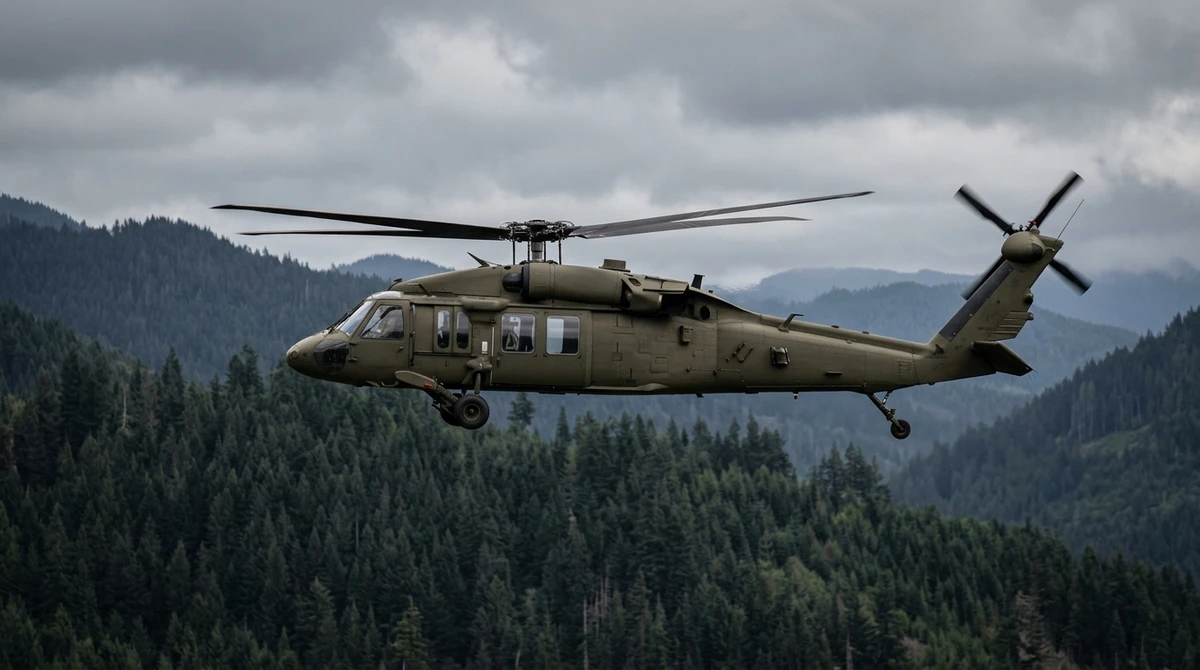
The US Army ordered 16 more UH-60M Black Hawks on 17 September 2026, a $234 million modification to a contract signed in April. Norway was cleared on 21 August 2026 to buy 21 UH-60Ms for $2.3 billion, months after dropping nine HH-60W rescue helicopters. The Philippines took the last of 47 S-70i Black Hawks in August 2026. UH-60M, HH-60W and S-70i are one airframe, and so are the Navy's MH-60R, the Coast Guard's MH-60T, Japan's SH-60K and Türkiye's T-70. The UH-60 Black Hawk has been in production since 1978, with more than 5,000 built, and the names have piled up for 47 years.
Three naming layers overlap. The Army model letter (A, L, M, V) says which generation of engines, rotor and cockpit a Black Hawk carries. The mission prefix in front of the H, read through the US tri-service designation system, says what job it was modified for and which service flies it. The S-70 number is Sikorsky's own, used for exports, the Polish-built S-70i and the licence builds in Japan, South Korea and Türkiye. This page is current to 3 October 2026.
- Model letters: UH-60A (1979, T700-GE-700), UH-60L (1989, T700-GE-701C, stronger gearbox), UH-60M (2006, T700-GE-701D, wide-chord blades, glass cockpit) and UH-60V, an L with the M's cockpit retrofitted by Northrop Grumman. The Army stopped buying UH-60V kits in 2024 and buys new UH-60Ms instead.
- Prefixes: the 60 never changes. EH is electronic warfare, HH rescue or medevac, MH multi-mission or special operations, SH anti-submarine, VH VIP transport; the suffix letter says which service.
- S-70 numbers: S-70A is the Black Hawk export, S-70B the Seahawk export, S-70C the civil-certified line, S-70i the international Black Hawk built by PZL Mielec in Poland since 2010.
- Engine of the future: the 3,000 shp GE T901 first ran on a UH-60M on 25 January 2025 and first flew in May 2025; the production decision is slated for 2029.
- Successor: the Bell MV-75 tiltrotor, formerly the V-280, is to replace the Black Hawk from the 101st Airborne Division; first prototype delivery is due at the end of 2026. The Army still says it will fly Black Hawks "until the 2070s".
The Army models: A, L, M and V
The YUH-60A prototype first flew on 17 October 1974 for the Army's Utility Tactical Transport Aircraft System competition; the production UH-60A entered service in 1979 on two T700-GE-700 turboshafts and was built until 1989. In January 2025 the Army's inventory stood at 20 UH-60As, 800 UH-60Ls, 931 UH-60Ms, 346 HH-60Ms and 90 UH-60Vs.
The UH-60L, built from 1989 to 2007, took the T700-GE-701C engines and the improved durability gearbox developed for the Navy's SH-60B, with the same analog cockpit. Many UH-60As were rebuilt to L standard at Corpus Christi Army Depot.
The UH-60M is a new-production aircraft, not a retrofit: Milestone C on 31 March 2005, production from 2006, full-rate production authorized on 26 June 2007 and a first deployment to Iraq in 2008. It changed four things at once: composite wide-chord main rotor blades, 2,000 shp class T700-GE-701D engines, a stronger gearbox and a digital cockpit with four color multifunction displays, dual digital flight control computers and an Integrated Vehicle Health Management System. A fly-by-wire "UH-60M Upgrade" began flight testing in August 2008 and stayed a test program; production UH-60Ms keep mechanical controls backed by the flight control computers. The HH-60M is the same aircraft with medevac equipment.
The UH-60V is a UH-60L with a Northrop Grumman digital cockpit, four displays "functionally identical" to the M's, first flown on 19 January 2017: about $4 million per aircraft against $16 million for a new M, with more than 750 conversions planned. The first six reached the Pennsylvania National Guard in July 2021. A 2019 operational test was judged "not adequate", a second in August 2022 passed, and the full-rate production decision due in March 2023 was postponed for a "deliberate and rigorous review". The fiscal 2025 budget then scrapped the program, meant to modernize the National Guard's L fleet, in favor of new UH-60Ms for the Guard. About 90 UH-60Vs exist.
| Built | Engines | What changed | Status in 2026 | |
|---|---|---|---|---|
| UH-60A | 1977–1989 | T700-GE-700 | Original UTTAS production aircraft, 11 troops, four crew | About 20 left in the Army (Jan 2025); exports and transfers |
| UH-60L | 1989–2007 | T700-GE-701C | More power, improved durability gearbox from the SH-60B, updated flight controls; same analog cockpit | About 800 in the Army; basis of the MH-60L, HH-60L and the MH-60S fuselage; second-hand sales (Argentina, Sep 2026) |
| UH-60M / HH-60M | 2006 onward | T700-GE-701D | Wide-chord composite blades, stronger gearbox, four-display digital cockpit, dual digital flight control computers, IVHMSHH-60M: medevac fit | 931 UH-60M and 346 HH-60M in the Army (Jan 2025); in production at Stratford; the FMS standard |
| UH-60V | Conversions from 2017 | T700-GE-701C/D (unchanged) | Northrop Grumman digital cockpit on a UH-60L, functionally the M's | Program ended in the FY2025 budget; about 90 converted, National Guard |
The prefixes: one airframe, five services
In the US system the number identifies the design and the letters before the H the mission, so a new prefix means a new job, not a new generation. The suffix letter keeps counting within each prefix, which is why the Navy's MH-60R and MH-60S are younger than the Army's UH-60M, and why the Air Force's HH-60W sits on a UH-60M airframe.
Army: EH, UH-60Q, HH and MH
The EH-60A and EH-60C carried the Quick Fix communications-intercept suite and have all gone back to UH-60A standard; an EH-60L followed. The UH-60Q was a UH-60A medevac conversion named "Dust Off", the HH-60L an L with hoist, oxygen system and patient handling system, and the HH-60M carries that fit into the M.
The 160th Special Operations Aviation Regiment has flown four generations: 30 MH-60As modified in the early 1980s, 37 interim MH-60Ls, the MH-60K ordered in 1988 with a refueling probe, glass cockpit and terrain-following radar, and the MH-60M, a UH-60M with the probe, the Common Avionics Architecture System cockpit, the AN/APQ-187 Silent Knight radar and YT706-GE-700 engines, to which the regiment had converted by 2015. The DAP, Direct Action Penetrator, is the gunship fit, stub wings for a 30 mm cannon, rockets and Hellfires and no troop cabin. The regiment plans to fit the T901 around fiscal 2030.
Air Force: HH-60G Pave Hawk and HH-60W Jolly Green II
The Air Force chose the UH-60A in 1981 to replace the HH-3E Jolly Green Giant, added a refueling probe and cabin tanks for the "Credible Hawk" of 1987, upgraded the fleet into MH-60G Pave Hawks and in 1991 redesignated the rescue aircraft HH-60G; PAVE stands for Precision Avionics Vectoring Equipment. The HH-60W Jolly Green II, a UH-60M derivative chosen after two cancelled CSAR-X competitions, was contracted on 26 June 2014, designated on 24 November 2014, first flew on 17 May 2019 and reached the 41st Rescue Squadron on 5 November 2020. Initial operational capability came on 7 September 2022; 69 are in inventory, with 1,940 shp T700-GE-701D engines and twice the HH-60G's internal fuel.
How many will be bought is open. The program of record was 113; the Air Force tried to cap it at 75 in its fiscal 2023 budget, Congress pushed it back to at least 89 and added $100 million in fiscal 2026, and nothing was requested for fiscal 2027 in April 2026, days after an HH-60W made the type's first combat recovery, of an F-15 pilot in Iran. A Sikorsky representative put the orders at 96 in September 2025.
Navy and Coast Guard: SH-60B to MH-60R, and what R and S mean
The Navy chose Sikorsky's S-70B in early 1978 to carry its LAMPS Mk III shipboard system; the YSH-60B first flew on 12 December 1979 and the SH-60B Seahawk entered service in 1984, 181 built. It kept 83 percent commonality with the UH-60A but moved the tail wheel 13 feet forward, folded rotor and tail and took marinized T700-GE-401 engines. The SH-60F (76 built, first flight 19 March 1987) was the carrier's dipping-sonar submarine hunter; the HH-60H (first flight 17 August 1988) the combat rescue and naval special warfare aircraft. The last SH-60B left the fleet in 2015, the F and H in 2016.
Their replacements are the MH-60R and MH-60S, "Romeo" and "Sierra" in the phonetic alphabet: the M prefix means multi-mission, the letters are simply the next in the H-60 series. The MH-60R began in 1993 as the LAMPS Mk III Block II upgrade, flew as the YSH-60R on 22 December 1999 and deployed in 2006, combining the B's radar with the F's dipping sonar in a Lockheed Martin glass cockpit; Lockheed delivered the 350th to the Navy on 13 January 2026 at Owego, New York; export customers are Australia, Denmark, Saudi Arabia, India, Greece and South Korea, with Spain and Norway to follow. The MH-60S, ordered in 1998 as the CH-60S to replace the Sea Knight and redesignated in February 2001, is a hybrid: the UH-60L's fuselage, two cabin doors and aft tail wheel on the Seahawk's folding tail, engines and rotors, for replenishment, rescue, mine countermeasures and armed support. The two share one cockpit.
The Coast Guard's HH-60J Jayhawk, 42 built between 1990 and 1996, was converted from January 2007 to the MH-60T with a glass cockpit, sensors and an armed interdiction kit, work finished in February 2014; six ex-Navy SH-60Fs were also rebuilt as Jayhawks. The fleet of 45 averaged 16,000 flight hours against a 20,000-hour limit, so Sikorsky is delivering 45 new airframes under a $374 million program, the first on 30 November 2023 and twelve a year through 2027, and the Coast Guard intends an all-MH-60T fleet built from further ex-Navy HH-60H and SH-60F airframes.
| Reading | Service | Members | Note | |
|---|---|---|---|---|
| UH-60 | Utility | Army; exports | UH-60A, L, M, V; UH-60P (Korea), UH-60J/JA (Japan) | The base design; the UH-60Q was a medevac A |
| EH-60 | Electronic warfare | Army | EH-60A, EH-60C, EH-60L | Quick Fix intercept suite; all As and Cs returned to UH-60A |
| HH-60 | Rescue or medevac | Air Force, Army, Navy, Coast Guard | HH-60G Pave Hawk, HH-60W Jolly Green II (USAF); HH-60L, HH-60M (Army medevac); HH-60H (Navy); HH-60J Jayhawk (USCG); HH-60P (Korea) | Same prefix, four services: the suffix letter tells them apart |
| MH-60 | Multi-mission or special operations | Army 160th SOAR, Navy, Coast Guard, Air Force (1991–1999) | MH-60A, K, L, M, L DAP (Army); MH-60R, MH-60S (Navy); MH-60T (USCG); MH-60G (USAF) | MH-60R and S replaced SH-60B/F and HH-60H; MH-60T is the upgraded HH-60J |
| SH-60 | Anti-submarine | Navy; Japan | SH-60B, SH-60F; SH-60J, K, L (Mitsubishi) | Prefix retired in US service with the last SH-60F in 2016; alive in Japan |
| VH-60 | VIP transport | Marine Corps, Army | VH-60N White Hawk (Marine One, nine delivered from 1988), VH-60M "Gold Top" | VH-60P is the Korean VIP variant |
Sikorsky's S-70 numbers: exports and licence builds
Sikorsky's letter follows the airframe rather than the mission: S-70A for Black Hawk exports, S-70B for Seahawk exports, S-70C for civil-certified aircraft, which is how China's S-70C-2s of the mid-1980s and Taiwan's S-70C family were sold. A dash number identifies the customer: S-70A-9 for Australia's 39 aircraft assembled by Hawker de Havilland, S-70A-42 for Austria, S-70B-2 for Australia's Navy, S-70B-6 Aegean Hawk for Greece, S-70B-28 for Türkiye. Taiwan's Navy flies the S-70C(M) Thunderhawk with nose radar and dipping sonar, and its Army took 60 UH-60Ms under a $3.1 billion 2010 sale, 54 for the air cavalry brigades and six rescue aircraft for the National Airborne Service Corps.
The S-70i is the international Black Hawk assembled by PZL Mielec since 2010; the 100th was completed on 29 November 2023 and the type has 18 customers in 11 countries. The Philippines is the largest: 16 ordered in 2019 and delivered in 2020–2021, one lost in a 2021 crash, then 32 ordered on 28 December 2021 for PHP 31.8 billion (about $624 million) and delivered from June 2024 to August 2026, for a fleet of 47. Poland's own forces fly eight S-70i for special operations, the last pair handed over on 19 November 2024; a requirement for 32 more was deferred in June 2025 behind training, anti-submarine and heavy-lift helicopters. The S-70M is the S-70i on a US civil certificate, and the Firehawk a Black Hawk with a 1,000-gallon belly tank converted by United Rotorcraft; CAL FIRE completed a 16-aircraft S-70i Firehawk fleet on 31 July 2025. The rest of the civil market is ex-Army UH-60As.
Three countries build the type under licence. Mitsubishi Heavy Industries has built the SH-60J (deliveries from August 1991, more than 100 built, Japanese avionics, IHI-built T700s), the SH-60K with a lengthened cabin from 10 August 2005 and the SH-60L, flown as the XSH-60L on 11 May 2021 and delivered from 2022, plus the UH-60J rescue aircraft and the Ground Self-Defense Force's UH-60JA from 1997. Korean Air built the UH-60P, an L derivative, in the 1990s; the fleet is 144, with HH-60P rescue and VH-60P VIP versions, and a Korean Air team with LIG Nex1 and Collins Aerospace was named preferred bidder in April 2025 to give 36 of them a digital cockpit, engine and survivability work for 961.3 billion won (about $654 million), deliveries from 2029. Turkish Aerospace builds the T-70 under the Turkish Utility Helicopter Program announced on 21 June 2016, 109 aircraft worth about $3.5 billion for six agencies with Aselsan avionics and TEI-built engines. Production stalled after US sanctions over the S-400 purchase blocked kit transfers: 31 had been delivered by September 2025 and Lockheed had booked a $95 million loss in October 2024, and in July 2026 a renegotiated deal with 39 further kits was reported to restart assembly.
Upgrade programs
Unlike the F-16, the Black Hawk has no block numbers: a UH-60M built in 2008 and one built in 2026 carry the same designation, and improvements arrive as named programs. The largest is the engine. The Improved Turbine Engine Program selected GE's T901 in 2019, 3,000 shp in the size and weight of the 2,000 shp T700, 50 percent more power with better fuel burn, for the UH-60M and the AH-64E. It was nearly two years late by April 2023, low-rate production slipping to the third quarter of fiscal 2026. The first light-off on a UH-60M came on 25 January 2025 at West Palm Beach, and the Army put the production decision in 2029; the first hover followed in May 2025, and the Army granted a preliminary flight rating in August 2026. Funding is the risk: the Army requested nothing for Black Hawk integration in fiscal 2026 or 2027, Congress added $238 million, and fleet integration points at a Block upgrade around fiscal 2030. Sikorsky packages the engine with its MATRIX autonomy as "Black Hawk Next", and in October 2025 showed a cockpit-less S-70UAS "U-Hawk" that Lockheed's chief executive called ready for production.
| Aircraft | Dates | Content | Status | |
|---|---|---|---|---|
| UH-60A to L rebuild | Army UH-60A | 1990s–2010s | 701C engines and L gearbox at Corpus Christi Army Depot | Complete; about 20 UH-60As remained in Jan 2025 |
| UH-60V cockpit | Army UH-60L (750+ planned) | First flight Jan 2017; fielded Jul 2021 | Northrop Grumman digital cockpit, about $4M per aircraft | Ended in the FY2025 budget after about 90; Guard gets new UH-60Ms |
| MH-60T conversion | USCG HH-60J (42) + 6 ex-Navy SH-60F | Jan 2007–Feb 2014 | Glass cockpit, EO/IR and radar, armed interdiction kit | Complete |
| MH-60T service life extension | 45 USCG MH-60T | First airframe 30 Nov 2023; 12 a year to 2027 | New airframes ($374M), systems transferred by the Coast Guard; further ex-Navy conversions toward an all-MH-60T fleet | In progress; fleet to the 2040s |
| ITEP / T901 | Army UH-60M, then AH-64E and MH-60M | Selected 2019; first flight May 2025; production decision 2029 | 3,000 shp engine in the T700's footprint, 50% more power | Flight test; preliminary flight rating Aug 2026; no Army request for FY2026–27, $238M added by Congress |
| Black Hawk Next / U-Hawk | UH-60M; S-70UAS demonstrator | Shown 2025–2026 | T901, MATRIX autonomy, digital backbone; cockpit-less cargo drone | Sikorsky offer for the next production contract |
| Korean UH-60P upgrade | 36 of 144 UH-60P | Preferred bidder Apr 2025; deliveries from 2029 | Digital cockpit, engine, survivability and communications work, 961.3bn won | Korean Air, LIG Nex1 and Collins Aerospace; for special operations |
| T-70 restart | Turkish T-70 (109 planned) | Deal renegotiated 2025–2026 | 39 further Lockheed kits after the sanctions halt | 31 delivered by Sep 2025; restart reported Jul 2026 |
Who flies which version
GMN inventory data lists 38 countries with the UH-60 family, 16 with the Seahawk line and two with the HH-60 Pave Hawk. In 2024 alone Sikorsky received FMS contracts for 84 UH-60Ms, including Greece, Austria, Brazil, Sweden, Thailand, Croatia, Jordan and Romania.
| Operators | Fleets and programs | |
|---|---|---|
| US services | United States | Army UH-60L/M/V, HH-60M and 160th SOAR MH-60M (more than 2,300 UH-60s); Air Force HH-60G and 69 HH-60W; Navy MH-60R (350 delivered) and MH-60S; Coast Guard 45 MH-60T; Marine Corps VH-60N |
| UH-60M, Europe | Greece, Austria, Slovakia, Croatia, Lithuania, Latvia, Sweden, Poland (S-70i) | Greece 35 (LOA 5 Apr 2024, about $1.95bn, deliveries from 2027 to 2030); Austria 9 S-70A-42 plus 12 UH-60M signed Jun 2024 for delivery from 2028 and 12 more approved 17 Jun 2026 for $1.5bn; Slovakia 9 from a 2015 $261M sale plus two FLIR-equipped aircraft on 25 Aug 2026; Croatia 4 plus 8 under a $274M March 2024 LOA, due late 2027; Lithuania 4 ($213M, 2020), first two 18 Oct 2025; Latvia 4 (EUR 175M), first two 11 Dec 2022; Norway 21 approved 21 Aug 2026 for $2.3bn |
| UH-60M, Asia-Pacific and Americas | Australia, Taiwan, Brazil, Mexico, Thailand, Saudi Arabia, Jordan, Bahrain, Tunisia | Australia 40 to replace the MRH90 withdrawn in 2023, IOC 21 Feb 2025 with 12 delivered, all by 2030; Taiwan 60 (2010, $3.1bn) plus S-70C and S-70C(M); Brazil 12 for the Army, first delivered 20 Nov 2025 and the rest 2028–2029, beside S-70A "HM-2" flown since 1997; Argentina cleared for 4 UH-60L in September 2026 for $140M |
| S-70i (Mielec-built) | Philippines, Poland, Thailand (H.12) | Philippines 47, the largest S-70i fleet, completed Aug 2026; Poland 8 for special forces, 32 more deferred Jun 2025; CAL FIRE 16 Firehawks; 18 customers in 11 countries |
| Licence builds | Japan, South Korea, Türkiye, Australia (S-70A-9, assembled locally) | Japan: Mitsubishi UH-60J/JA and SH-60J/K/L; South Korea: 144 Korean Air UH-60P, HH-60P, VH-60P, 36 to be upgraded; Türkiye: T-70, 31 delivered by Sep 2025 of 109 planned; Australia's 39 S-70A-9 of the 1980s have given way to the UH-60M |
| Seahawk line (SH-60B/F, S-70B, MH-60R/S) | Australia, Denmark, Spain, Greece, India, Saudi Arabia, South Korea, Norway, Japan, Taiwan, Türkiye, Thailand, Singapore, Brazil, Israel | MH-60R delivered to Australia, Denmark, Saudi Arabia, India, Greece and South Korea, with Spain and Norway scheduled; S-70B exports to Spain, Australia, Greece (Aegean Hawk), Thailand, Türkiye, Singapore and Brazil; Taiwan's S-70C(M) Thunderhawk; Japan's SH-60J/K/L |
| Legacy UH-60A/L and S-70A | Colombia, Israel, Chile, Egypt, Morocco, Malaysia, Brunei, United Arab Emirates, China, Argentina, Portugal, Albania, Singapore, Afghanistan | Customer dash numbers: Colombia's UH-60L and AH-60L Arpía gunship conversions, Israel's S-70A-50, Chile's S-70A-39, Egypt's S-70A-21, Morocco's S-70A-26, Malaysia's S-70A-34 VIP aircraft, Brunei's S-70A-14 and S-70C-14, the UAE's Battlehawk armament kits (ordered 2011), China's S-70C-2s of the mid-1980s, cut short by the arms embargo; the rest are second-hand UH-60A/L transfers |
| HH-60 Pave Hawk | United States, South Korea | USAF HH-60G being replaced by the HH-60W; Korean Air Force HH-60P with external tanks and FLIR |
What comes next
The successor is a tiltrotor. Bell's V-280 Valor won the Future Long-Range Assault Aircraft competition in late 2022, the program cleared Milestone B in 2024, the Army designated it MV-75 on 16 May 2025 (M for multi-mission, V for vertical take-off, 75 for the Army's founding year) and named it Cheyenne II in April 2026. The 101st Airborne Division is the first unit, with the 160th SOAR's requirements in the design. Eight test aircraft are under contract, six were in assembly at Wichita in June 2026, the first prototype is due at the end of 2026 and flight testing in early 2027, against an original fielding of 2031–2032 that the Army chief of staff wants pulled toward the end of the decade.
For the Black Hawk line the question is the shape of the next contract. Multi-Year X of June 2022, $2.3 billion for 120 H-60Ms, runs to 2027, and Sikorsky said in October 2025 it expected a Multi-Year XI award in December 2026 for 2027 to 2032, 100 aircraft as a base and up to 255. What the Army signed instead, in April 2026, was contract W58RGZ-26-C-0008, a pivot from multiyear to an "agile" structure; its 17 September 2026 modification funds 16 UH-60Ms for $234 million and carries options for more, for the Army or foreign customers. Sikorsky's general manager said the next agreement would "set the infrastructure and the foundation for the Black Hawk that's going to come", and that the Army plans to fly Black Hawks until the 2070s.
Exports fill the line meanwhile: Norway's 21, Austria's second 12, Greece's 35 and Croatia's 8 are due between 2027 and 2030, and Argentina's four UH-60Ls were cleared in September 2026. The MV-75 replaces the Black Hawk in the Army's assault battalions first; the Navy, the Air Force, the Coast Guard and three dozen foreign operators have no tiltrotor on order, and the H-60s they fly will be read through the same three layers for decades.