Mi-17 Hip-H vs UH-60 Black Hawk
Mi-17 Hip-H vs UH-60 Black Hawk at a glance — top speed 250 vs 294 km/h, range 800 vs 2,221 km, max takeoff weight 13,000 vs 10,659 kg, built 12,000 vs 5,000 units.
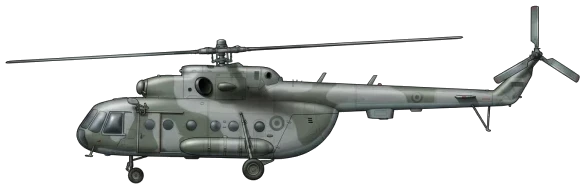
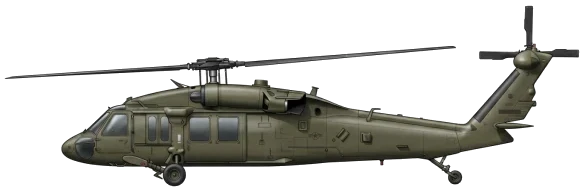
| Mi-17 Hip-H | UH-60 Black Hawk | |
|---|---|---|
| Origin country | 🇷🇺 Ex-USSR | 🇺🇸 United States |
| Category | Military Helicopters | Military Helicopters |
| Manufacturer | Mil | Sikorsky |
| First flight | 1 January 1975 | 29 November 1974 |
| Year introduced | 1977 | 1979 |
| Number produced | 12000 units | 5000 units |
| Average unit price | $15 million | $21 million |
| Wingspan | 21.3 m | 16.4 m |
| Height | 4.8 m | 4.9 m |
| Length | 18.5 m | 19.5 m |
| Maximum speed | 250 km/h | 294 km/h |
| Operational range | 800 km | 2,221 km |
| Service ceiling | 6,000 m | 5,791 m |
| Max. takeoff weight | 13,000 kg | 10,659 kg |
| Empty weight | 7,489 kg | 4,819 kg |
| Total thrust | 2 x 1,491 kW | 2 x 1,208 kW |
Detailed Comparison
The Sikorsky UH-60 Black Hawk is a purpose-built tactical transport helicopter, designed for survivability and performance, while the Mil Mi-17 Hip-H is an evolution of the Mi-8, emphasizing high payload capacity, operational ruggedness, and versatility. The Black Hawk emerged from a specific US Army requirement for a UH-1 Huey replacement, whereas the Mi-17 is a product of continuous Soviet/Russian development focused on creating a multi-purpose workhorse for a wide range of global operators and environments.
Development and Design
The UH-60's design philosophy is centered on crew and passenger survivability. Developed under the US Army's UTTAS program in the 1970s, it incorporates a crashworthy airframe with titanium and composite materials, armored seating, and redundant systems. Its twin General Electric T700 engines and fully articulated four-bladed main rotor provide significant agility and performance reliability. The Mi-17, conversely, is an iteration of the proven Mi-8 airframe. Its primary enhancements are more powerful Klimov TV3-117 engines and a relocated port-side tail rotor, boosting its lift capacity and performance, particularly in "hot and high" conditions. The Mi-17's design is more utilitarian, prioritizing a large, unobstructed cabin, ease of maintenance in austere settings, and the ability to carry heavy loads, with options for a rear loading ramp instead of clamshell doors.
Specifications and Performances
While the Black Hawk is faster with a maximum speed of 294 km/h compared to the Mi-17's 250 km/h, the Mi-17 excels in payload and high-altitude operations. The Hip's maximum takeoff weight of 13,000 kg far exceeds the Black Hawk's 10,659 kg, allowing it to carry up to 24 troops versus the Black Hawk's 11, or a significantly larger internal/external cargo load. The Mi-17 also boasts a superior service ceiling (6,000 m vs. 5,791 m) and a much higher rate of climb (8.0 m/s vs. 3.6 m/s), making it well-suited for mountainous regions. The UH-60's design, however, affords greater maneuverability and superior aerodynamic performance for tactical insertions and extractions.
Deployment and usage
In operational use, the UH-60 functions as the archetypal utility and transport helicopter for the US military and its allies, primarily undertaking troop transport, medevac, and special operations missions. Its armament is typically defensive (pintle-mounted machine guns) or for limited offensive support. The Mi-17's role is often broader, functioning as a "transport-gunship". Its six external hardpoints can carry a formidable array of unguided rockets, gun pods, and on some variants, anti-tank guided missiles. This turns the aircraft into a potent ground-attack platform, a role it has fulfilled in conflicts from Cambodia to the Kargil War. Its widespread use by dozens of air forces is a testament to its lower cost, high capacity, and operational flexibility.
Conclusion
The choice between these two aircraft reflects divergent operational priorities. The UH-60 Black Hawk is a technologically sophisticated helicopter that provides superior survivability, agility, and tactical performance in line with Western military doctrine. It is a specialized tool for delivering troops safely and effectively in high-threat environments. The Mi-17 Hip-H is a robust, multi-role workhorse, valued for its immense transport capacity, cost-effectiveness, and ability to double as a heavily armed gunship. It offers strategic lift and accessible firepower, making it the platform of choice for nations requiring a versatile and resilient airframe for a wider spectrum of missions.


-
 United States
2205
United States
2205
-
 South Korea
129
South Korea
129
-
 Colombia
84
Colombia
84
- All 35 operators →