F-22 Raptor vs Su-57 Felon
F-22 Raptor vs Su-57 Felon at a glance — top speed 2,414 vs 2,135 km/h, range 3,000 vs 4,500 km, max takeoff weight 38,000 vs 35,000 kg, built 195 vs 32 units.
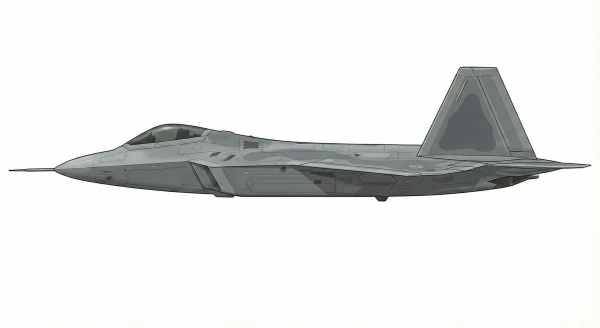
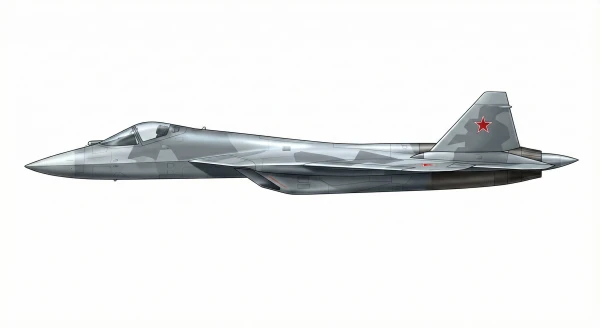
| F-22 Raptor | Su-57 Felon | |
|---|---|---|
| Origin country | 🇺🇸 United States | 🇷🇺 Russia |
| Category | Combat Aircraft | Combat Aircraft |
| Manufacturer | Lockheed Martin | Sukhoi |
| First flight | 7 September 1997 | 29 January 2010 |
| Year introduced | 2005 | 2020 |
| Number produced | 195 units | 32 units |
| Average unit price | $150 million | $42 million |
| Wing area | 78.0 m² | 78.8 m² |
| Wingspan | 13.6 m | 14.1 m |
| Height | 5.1 m | 4.6 m |
| Length | 18.9 m | 20.1 m |
| Maximum speed | 2414 km/h | 2135 km/h |
| Operational range | 3,000 km | 4,500 km |
| Service ceiling | 19,812 m | 20,000 m |
| Max. takeoff weight | 38,000 kg | 35,000 kg |
| Empty weight | 19,700 kg | 18,500 kg |
| Total thrust | 2 x 15,876 kgf | 2 x 14,500 kgf |
Detailed Comparison
The F-22 Raptor is a dedicated air superiority fighter optimized for all-aspect stealth and high-altitude supercruise, a product of the US Advanced Tactical Fighter program designed to counter Soviet threats. In contrast, the Su-57 Felon is a more recent multirole aircraft from Russia's PAK FA program, balancing frontal-aspect stealth with extreme supermaneuverability and a more constrained budget. While the F-22's production run of 195 units concluded in 2009, the Su-57 has only recently entered service with a very small fleet, reflecting their different stages of maturity and national industrial capacity.
Development and Design
The F-22’s design philosophy was uncompromising air dominance. Its development, stemming from the YF-22 prototype's victory over the YF-23 in 1991, pioneered the integration of stealth, supercruise, and advanced sensor fusion. The airframe's meticulous planform alignment, canted vertical stabilizers, and extensive use of radar-absorbent materials give it an extremely low radar cross-section from all angles. Its Pratt & Whitney F119 engines were designed from the outset to enable sustained supersonic flight above Mach 1.5 without afterburners.
The Su-57's development was more protracted, marked by redesigns and the dissolution of its partnership with India. Its design prioritizes aerodynamic performance, featuring unique leading-edge vortex controllers (LEVCONs) and canted 3D thrust-vectoring nozzles on its Saturn AL-41F1 engines, granting exceptional high angle-of-attack control. Stealth is focused on the frontal arc, using engine intake blockers and internal weapons bays, but it is considered less comprehensive than the F-22's. The avionics architecture is distributed, with its N036 Byelka AESA radar system incorporating side-facing arrays for enhanced situational awareness.
Specifications and Performances
While both are twin-engine, single-seat fighters, key performance metrics highlight their different priorities. The F-22 has a higher maximum speed at 2,414 km/h (Mach 2.25) compared to the Su-57's 2,135 km/h (Mach 2.0). The F-22's demonstrated ability to supercruise at Mach 1.5+ is a core, proven tactical advantage, allowing it to dictate engagement terms and conserve fuel. The Su-57 is designed for supercruise, but its performance on current engines is not definitively established in open sources. The Su-57's slightly larger wing area (78.8 m² vs 78.04 m²) and advanced aerodynamic controls underscore its emphasis on maneuverability. Internally, the F-22 can carry a larger air-to-air load of six AIM-120 AMRAAMs, versus the Su-57's typical load of four R-77Ms.
Deployment and usage
The F-22 has been an operational asset for the U.S. Air Force since 2005. Its combat debut was in 2014 over Syria, where it has been used for precision strikes and as a high-value command-and-control node for other coalition aircraft. Its primary role remains deterrence and air control, with deployments to Europe and the Pacific.
The Su-57's operational history is nascent. After entering service in 2020, it has been reportedly used during the invasion of Ukraine, but primarily to launch long-range cruise missiles from the relative safety of Russian airspace. These missions avoid direct air combat and leverage the aircraft as a launch platform rather than a penetrating fighter. The fleet's small size, with approximately 32 built, and a reported drone strike damaging an airframe in June 2024, indicate significant constraints on its operational availability and impact.
Conclusion
The F-22 Raptor is a mature, highly specialized, and expensive air dominance fighter whose capabilities in stealth and sensor fusion remain the benchmark. Its limited production number is a direct result of its high cost and the post-Cold War strategic shift. The Su-57 Felon is a more pragmatic, multirole Russian approach, sacrificing all-aspect stealth for kinematic performance and a reduced unit price. While its design incorporates advanced features, its effectiveness is currently limited by a very small production scale, reliance on interim engines, and a lack of combat-proven performance in the demanding air superiority role for which the F-22 was built.