J-8 Finback vs MiG-21 Fishbed
J-8 Finback vs MiG-21 Fishbed at a glance — top speed 2,300 vs 2,175 km/h, range 1,000 vs 793 km, max takeoff weight 18,879 vs 10,400 kg, built 408 vs 11,496 units.
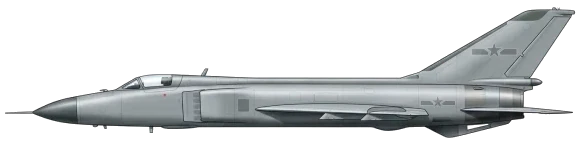
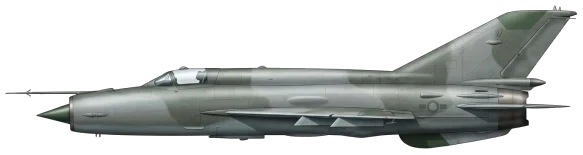
| J-8 Finback | MiG-21 Fishbed | |
|---|---|---|
| Origin country | 🇨🇳 China | 🇷🇺 Ex-USSR |
| Category | Combat Aircraft | Combat Aircraft |
| Manufacturer | Shenyang | Mikoyan-Gurevich |
| First flight | 5 July 1969 | 16 June 1955 |
| Year introduced | 1980 | 1958 |
| Number produced | 408 units | 11496 units |
| Average unit price | $15 million | $2 million |
| Wing area | -- m² | 23.0 m² |
| Wingspan | 9.3 m | 7.2 m |
| Height | 5.4 m | 4.1 m |
| Length | 21.5 m | 14.7 m |
| Maximum speed | 2300 km/h | 2175 km/h |
| Operational range | 1,000 km | 793 km |
| Service ceiling | 18,000 m | 17,500 m |
| Max. takeoff weight | 18,879 kg | 10,400 kg |
| Empty weight | 10,371 kg | 4,871 kg |
| Total thrust | 2 x 6,999 kgf | 1 x 7,095 kgf |
Detailed Comparison
The Shenyang J-8 Finback essentially represents an indigenous attempt by the People's Republic of China to scale up the operational capabilities of the Mikoyan-Gurevich MiG-21 Fishbed. While the MiG-21 was a ubiquitous, lightweight point-defense fighter designed for the Soviet doctrine of the 1950s, the J-8 was developed in the 1960s to address the Fishbed's inherent limitations regarding range, radar aperture, and payload. The J-8 functions as a heavy, twin-engine evolution of the single-engine MiG-21 lineage.
Development and Design
The MiG-21 utilized a tailed delta wing configuration and a nose shock-cone intake, prioritizing speed and simplicity. It was designed to be mass-produced and operate under ground control interception. The J-8 design philosophy originated from the realization that the Chengdu J-7 (Chinese-built MiG-21) lacked the endurance and radar size for high-altitude interception over China's vast territory.
To solve this, Shenyang designers enlarged the MiG-21 layout and installed two turbojets. The initial J-8 retained the MiG-21’s nose intake, but the later J-8B variant radically altered the front fuselage, adopting lateral air intakes and an ogival nose radome. This modification allowed for the installation of the larger Type 208 pulse-Doppler radar, a capability the original MiG-21’s intake cone could not accommodate.
Specifications and Performances
The physical disparity between the two aircraft is significant. The J-8 acts as a heavy interceptor with a Maximum Takeoff Weight (MTOW) of 18,879 kg, more than double the MiG-21's 8,625 kg. This mass allows the J-8 to carry a significantly higher payload and fuel load, resulting in a range of 1,000 km compared to the MiG-21's restrictive 660 km.
While both aircraft are capable of speeds exceeding Mach 2, with the J-8 reaching 2,300 km/h and the MiG-21 reaching 2,125 km/h, the J-8 suffers from aerodynamic penalties due to its size. Flight testing of the J-8 revealed severe buffeting at transonic speeds and lower maneuverability compared to the agile MiG-21. The J-8 relies on its twin-engine configuration for straight-line thrust and energy retention, whereas the MiG-21 relies on small size and lower drag for close-range combat.
Deployment and usage
The MiG-21 is one of the most combat-proven aircraft in history, with 11,496 units built and service in over 60 countries. It has seen extensive action in the Vietnam War, Middle Eastern conflicts, and the Yugoslav Wars, functioning as a multi-role platform for air superiority and ground attack.
In contrast, the J-8 was never exported extensively and saw service almost exclusively with the PLAAF and PLANAF. Only 408 units were built. It served a specialized role as a high-speed interceptor for territorial defense against strategic bombers and spy planes. Its most notable operational incident was the April 2001 collision with a US Navy EP-3E signals intelligence aircraft, underscoring its role in aggressive border interception rather than dogfighting.
Conclusion
The MiG-21 Fishbed stands as a triumph of Cold War export doctrine, balancing cost, speed, and versatility to become a global standard for light fighters. The J-8 Finback, however, represents a specific engineering solution to a geographic problem. By scaling up the MiG-21 design, China successfully increased range and sensor capacity but sacrificed agility and reliability. The J-8 served as a necessary technological bridge, allowing the PLAAF to maintain high-altitude interception capabilities before the acquisition of modern Flanker-series aircraft.


