JAS 39 Gripen vs Mirage 2000
JAS 39 Gripen vs Mirage 2000 at a glance — top speed 2,100 vs 2,336 km/h, range 4,000 vs 3,335 km, max takeoff weight 14,000 vs 17,500 kg, built 300 vs 601 units.
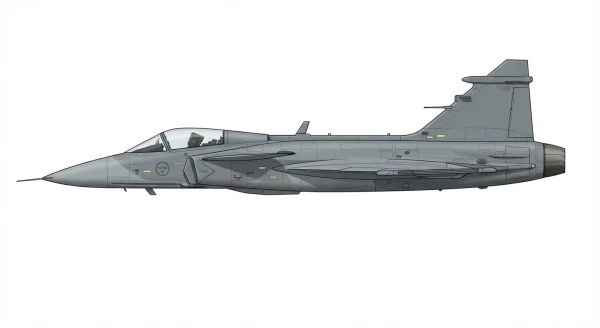

| JAS 39 Gripen | Mirage 2000 | |
|---|---|---|
| Origin country | 🇸🇪 Sweden | 🇫🇷 France |
| Category | Combat Aircraft | Combat Aircraft |
| Manufacturer | Saab | Dassault |
| First flight | 9 December 1988 | 1 March 1978 |
| Year introduced | 1996 | 1983 |
| Number produced | 300 units | 601 units |
| Average unit price | $30 million | $23 million |
| Wing area | 30.0 m² | 41.0 m² |
| Wingspan | 8.4 m | 9.1 m |
| Height | 4.5 m | 5.2 m |
| Length | 14.9 m | 14.4 m |
| Maximum speed | 2100 km/h | 2336 km/h |
| Operational range | 4,000 km | 3,335 km |
| Service ceiling | 15,240 m | 18,300 m |
| Max. takeoff weight | 14,000 kg | 17,500 kg |
| Empty weight | 6,800 kg | 7,500 kg |
| Total thrust | 1 x 8,209 kgf | 1 x 9,697 kgf |
Detailed Comparison
Saab's JAS 39 Gripen and Dassault's Mirage 2000 compete in the light, single-engine bracket, separated by a half-generation of aerodynamic and computing advancements. Dassault designed a high-speed interceptor and deep-strike platform around French strategic autonomy requirements in the 1970s. Saab developed a strictly defensive system a decade later, prioritizing turnaround time, software integration, and austere basing.
Development and Design
Dassault retained the tailless delta wing from the Mirage III to meet a French Air Force requirement for a Mach 2.2 interceptor. The resulting airframe prioritized high-altitude dash speed and structural rigidity, allowing it to accommodate heavy specialized payloads like the ASMP nuclear cruise missile on the 2000N variant.
Saab adopted a relaxed-stability canard-delta configuration to satisfy Sweden's Bas 90 doctrine, demanding operation from 800-meter highway strips. Saab engineered the Gripen for field maintenance by conscript crews, achieving a ten-minute turnaround time. While the Mirage 2000 relies on older federated avionics, the Gripen operates on an open-architecture system with five MIL-STD-1553B data buses, allowing export customers to integrate non-Swedish munitions and modify source code independently.
Specifications and Performances
The Mirage 2000 operates with the SNECMA M53P-2 turbojet, producing 6,626 kgf of thrust and pushing a 17,500 kg maximum takeoff weight (MTOW) airframe. This yields kinematic advantages over the baseline Gripen:
- A higher top speed of 2,336 km/h versus 2,100 km/h
- A superior climb rate of 305 m/s compared to Saab's 254 m/s
- A higher service ceiling of 18,300 m against 15,240 m
However, the Gripen extracts greater low-speed agility from its canards and lighter 14,000 kg MTOW. It trades kinematic mass for economic efficiency; its Volvo RM12 turbofan yields a $4,700 cost per flight hour, roughly half the expense of comparable fourth-generation fighters. The Gripen E variant heavily closes the payload gap, increasing MTOW to 16,500 kg and integrating the F414G engine and Raven ES-05 AESA radar—sensor technology absent from the out-of-production Mirage.
Deployment and usage
The Mirage 2000 holds a deeper combat record. The Indian Air Force used Mirage 2000Hs to drop laser-guided bombs on high-altitude Pakistani bunkers during the 1999 Kargil War, where its delta wing proved stable at extreme elevations. French airframes executed deep strike and air superiority missions during Operation Desert Storm, the Balkans conflicts, and anti-ISIS operations.
The Gripen's combat record is limited. Swedish Gripens flew reconnaissance missions over Libya in 2011, and Royal Thai Air Force units reportedly conducted airstrikes during the 2025 border conflict with Cambodia. In multinational exercises, Gripen operators leverage the aircraft's electronic warfare suite and MBDA Meteor integration to defeat physically larger aircraft.
Conclusion
The Mirage 2000 remains the better platform for high-altitude interception and deep-penetration strikes. Its heavier airframe handles larger payloads at higher sustained speeds, validated by India's continued reliance on the platform for high-risk strikes.
The Gripen possesses the definitive edge in modern contested airspace and the current export market. Its open software architecture, low operating cost, and active AESA radar development line make it the strictly superior system for nations requiring NATO-standard datalinks and beyond-visual-range dominance without the logistical burden of heavy twin-engine fighters.