JAS 39 Gripen vs MiG-29 Fulcrum
JAS 39 Gripen vs MiG-29 Fulcrum at a glance — top speed 2,100 vs 2,450 km/h, range 4,000 vs 2,100 km, max takeoff weight 14,000 vs 18,000 kg, built 300 vs 1,600 units.
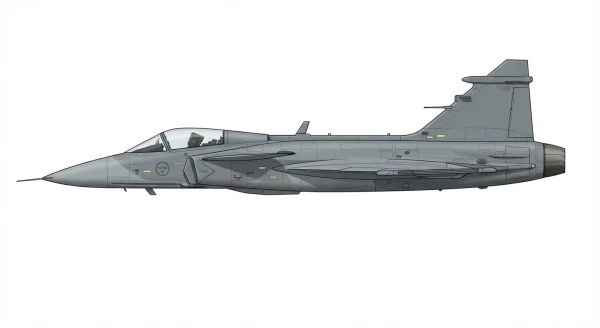
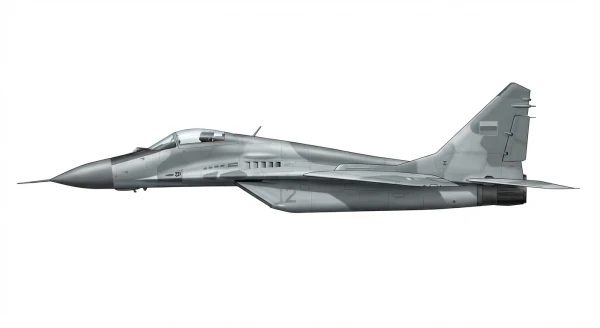
| JAS 39 Gripen | MiG-29 Fulcrum | |
|---|---|---|
| Origin country | 🇸🇪 Sweden | 🇷🇺 Ex-USSR |
| Category | Combat Aircraft | Combat Aircraft |
| Manufacturer | Saab | Mikoyan |
| First flight | 9 December 1988 | 6 October 1977 |
| Year introduced | 1996 | 1983 |
| Number produced | 300 units | 1600 units |
| Average unit price | $30 million | $25 million |
| Wing area | 30.0 m² | 38.0 m² |
| Wingspan | 8.4 m | 11.4 m |
| Height | 4.5 m | 4.7 m |
| Length | 14.9 m | 17.3 m |
| Maximum speed | 2100 km/h | 2450 km/h |
| Operational range | 4,000 km | 2,100 km |
| Service ceiling | 15,240 m | 18,000 m |
| Max. takeoff weight | 14,000 kg | 18,000 kg |
| Empty weight | 6,800 kg | 11,000 kg |
| Total thrust | 1 x 8,209 kgf | 2 x 8,319 kgf |
Detailed Comparison
Designed to operate from 800-meter road strips in dispersed Swedish bases, the JAS 39 Gripen focuses on modular avionics and minimal maintenance footprint. The MiG-29 emerged as the Soviet Union’s frontline point-defense interceptor, built around twin-engine thrust and high angle-of-attack aerodynamics to contest F-15s and F-16s over Central Europe.
Development and Design
Sweden optimized the Gripen for the Bas 90 dispersed basing system, mandating a fighter that a conscript crew could re-arm and refuel in ten minutes. It relies on a delta-canard layout and digital fly-by-wire controls—software that caused two early prototype crashes before stabilization. The architecture is modular, allowing independent integration of diverse Western munitions like the Meteor and Taurus KEPD 350. The MiG-29, developed by Mikoyan, relies on a twin-engine layout with ruggedized landing gear and engine intake louvers to prevent foreign object damage on debris-strewn frontline runways. The MiG introduced the first operational integration of an infrared search and track (IRST) system paired with a helmet-mounted sight and the off-boresight R-73 missile, giving it an early advantage in the merge. However, its cockpit retained high pilot workload and analog instrumentation until later variants like the MiG-29SMT.
Specifications and Performances
The MiG-29 operates in a heavier weight class. Powered by twin Klimov RD-33 engines generating a combined 18,000 kgf of thrust, it achieves Mach 2.25 and sustains a high thrust-to-weight ratio. This kinetic capability comes at the expense of fuel fraction; early Fulcrums were short-legged, with a combat range restricting them to local airspace defense. The Gripen utilizes a single Volvo RM12 outputting 5,507 kgf. While it carries a lower absolute payload and operates at a lighter 14,000 kg maximum takeoff weight, its aerodynamics and fuel efficiency extend its operational radius beyond the baseline MiG-29. At $4,700 per flight hour, the Gripen's operating costs are a fraction of the twin-engine Fulcrum's.
Deployment and usage
Soviet doctrine dictated ground-controlled interception for the MiG-29. Left without this network, export models suffered in beyond-visual-range combat:
- Iraqi MiG-29s took heavy losses against F-15Cs during Operation Desert Storm in 1991.
- Yugoslav Fulcrums were systematically dismantled by NATO forces in 1999 due to inferior situational awareness and electronic warfare vulnerabilities.
- Eritrean MiG-29s failed to secure kills and suffered losses against Ethiopian Su-27s in 1999–2000.
Conversely, Ukrainian MiG-29s adapted to fire AGM-88 HARM missiles against Russian ground targets in 2022. The Gripen’s combat record is smaller but highly networked. Swedish airframes flew reconnaissance in Libya in 2011. Royal Thai Air Force Gripens executed air-to-ground strikes during the 2025 border conflict with Cambodia, validating its swing-role capacity.
Conclusion
The Gripen is the superior platform for modern air forces. Its sensor fusion, open architecture, and low hourly operating cost allow sustained sortie generation and continuous avionics upgrades, culminating in the highly advanced Gripen E. The MiG-29 retains an advantage in raw kinematic acceleration and within-visual-range dogfighting due to its twin-engine thrust and R-73 integration. However, the Fulcrum's high maintenance requirements, short unrefueled range, and poor historical kill-to-loss ratio outside of Soviet ground-controlled interception networks render it obsolete for beyond-visual-range, network-centric warfare.