F-35 Lightning II vs JAS 39 Gripen
F-35 Lightning II vs JAS 39 Gripen at a glance — top speed 1,960 vs 2,100 km/h, range 2,800 vs 4,000 km, max takeoff weight 27,216 vs 14,000 kg, built 965 vs 300 units.
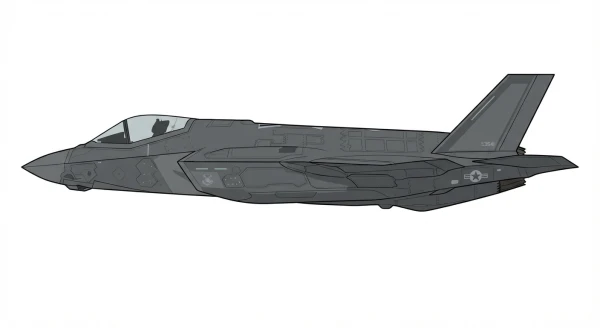
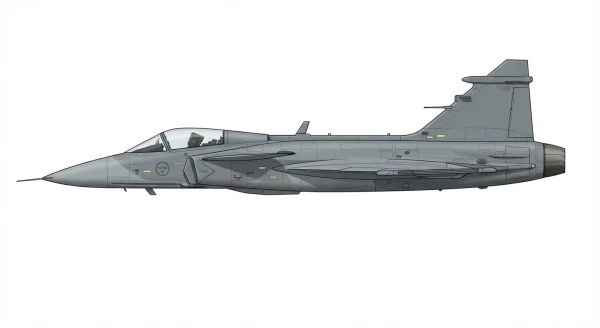
| F-35 Lightning II | JAS 39 Gripen | |
|---|---|---|
| Origin country | 🇺🇸 United States | 🇸🇪 Sweden |
| Category | Combat Aircraft | Combat Aircraft |
| Manufacturer | Lockheed Martin | Saab |
| First flight | 15 December 2006 | 9 December 1988 |
| Year introduced | 2013 | 1996 |
| Number produced | 965 units | 300 units |
| Average unit price | $103 million | $30 million |
| Wing area | 43.0 m² | 30.0 m² |
| Wingspan | 11.0 m | 8.4 m |
| Height | 4.4 m | 4.5 m |
| Length | 15.6 m | 14.9 m |
| Maximum speed | 1960 km/h | 2100 km/h |
| Operational range | 2,800 km | 4,000 km |
| Service ceiling | 15,000 m | 15,240 m |
| Max. takeoff weight | 27,216 kg | 14,000 kg |
| Empty weight | 14,651 kg | 6,800 kg |
| Total thrust | 1 x 19,500 kgf | 1 x 8,209 kgf |
Detailed Comparison
Lockheed Martin's F-35 Lightning II relies on low observability and sensor fusion to penetrate contested airspace, while Saab’s JAS 39 Gripen prioritizes sortie generation rate, low operating costs, and dispersed basing. At $85 million per airframe, the base unit costs align, but their acquisition and lifecycle structures diverge sharply. The F-35 dominates fifth-generation procurement across NATO, securing orders through interoperability and stealth, whereas the Gripen captures markets requiring localized production and independence from US ITAR restrictions, such as Brazil and Colombia.
Development and Design
The F-35 originated from the Joint Strike Fighter program to consolidate US and allied fleets under a common stealth platform. Its design integrates composite materials and radar-absorbent coatings to minimize its cross-section, paired with the AN/APG-81 AESA radar and Distributed Aperture System for omnidirectional threat detection. Conversely, the Gripen was built for Sweden’s Bas 90 doctrine, requiring operations from 800-meter road strips. Saab utilized a delta-canard configuration and relaxed stability to achieve high angle-of-attack maneuverability. The Gripen E evolution transitions the platform to an open architecture system, decoupling flight-critical software from mission systems to allow rapid, localized integration of weapons.
Specifications and Performances
The F-35 operates in a heavier weight class, with a maximum takeoff weight of 27,216 kg compared to the Gripen’s 14,000 kg. This allows the F-35 to carry an 18,000-pound payload and achieve a 2,800 km range. The Gripen trades payload and range (805 km) for turnaround efficiency.
- The F-35 generates 19,500 kgf of thrust from its F135 engine, supporting heavy internal stores while maintaining its stealth profile.
- The Gripen utilizes the 5,507 kgf RM12, upgraded to the F414G in the E variant, reaching a higher maximum speed of 2,100 km/h compared to the F-35's 1,960 km/h.
The Gripen's design yields a $4,700 cost per flight hour, roughly a quarter of the F-35’s operational expenditure.
Deployment and usage
F-35s achieved initial combat capability with Israel in 2018, conducting strikes in Syrian airspace. The platform relies on its electro-optical targeting and stealth to neutralize air defense networks before detection. The Gripen's combat record is limited. Swedish Gripens executed 650 reconnaissance sorties during the 2011 Libya intervention, relying on datalinks to pass target data to NATO assets. In 2025, Thai Gripens conducted the airframe's first air-to-ground combat strikes against Cambodian positions. Both aircraft face operational friction: the F-35 struggles with ALIS/ODIN software integration and parts availability, while the Gripen’s reliance on external pylons limits its survivability against modern integrated air defense systems.
Conclusion
The F-35 holds a definitive edge in first-day-of-war operations and deep strike missions. Its stealth and internal bays allow it to dismantle anti-access/area denial (A2/AD) networks where the non-stealthy Gripen would be intercepted. The Gripen wins in sustained, asymmetric defense scenarios where infrastructure is degraded. Its 10-minute turnaround time, operated by conscripts on road strips, ensures air presence when centralized bases are destroyed. Nations needing to penetrate contested airspace must buy the F-35; air forces focused on territorial defense and constrained budgets should procure the Gripen.