Ka-52 Alligator Hokum-B vs Mi-28 Havoc
Ka-52 Alligator Hokum-B vs Mi-28 Havoc at a glance — top speed 300 vs 324 km/h, range 460 vs 1,100 km, max takeoff weight 10,800 vs 12,000 kg, built 196 vs 126 units.
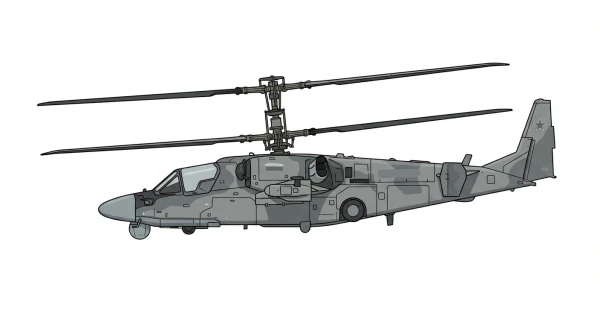
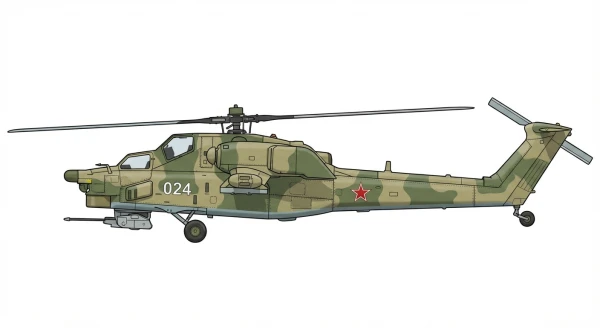
| Ka-52 Alligator Hokum-B | Mi-28 Havoc | |
|---|---|---|
| Origin country | 🇷🇺 Russia | 🇷🇺 Ex-USSR |
| Category | Military Helicopters | Military Helicopters |
| Manufacturer | Kamov | Mil |
| First flight | 25 June 1997 | 10 November 1982 |
| Year introduced | 2011 | 2006 |
| Number produced | 196 units | 126 units |
| Average unit price | $16 million | $15 million |
| Wing area | 330.3 m² | -- m² |
| Wingspan | 7.8 m | 17.2 m |
| Height | 5.0 m | 4.7 m |
| Length | 15.9 m | 17.0 m |
| Maximum speed | 300 km/h | 324 km/h |
| Operational range | 460 km | 1,100 km |
| Service ceiling | 5,500 m | 5,700 m |
| Max. takeoff weight | 10,800 kg | 12,000 kg |
| Empty weight | 7,800 kg | 8,590 kg |
| Total thrust | 2 x 1,790 kW | 2 x 1,641 kW |
Detailed Comparison
The Kamov Ka-52 Alligator and Mil Mi-28 Havoc are two principal Russian attack helicopters originating from different design philosophies. The Ka-52 evolved from the single-seat Ka-50, retaining its unique coaxial rotor system and featuring a side-by-side cockpit for command and control tasks. The Mi-28 was developed as a dedicated, heavily armored anti-tank platform, adhering to a more conventional design with a tandem cockpit layout and a tail rotor, similar to Western counterparts like the AH-64 Apache.
Development and Design
The Ka-52’s design is centered on Kamov's signature coaxial contra-rotating rotor system. This eliminates the need for a tail rotor, dedicating all engine power to lift and thrust, and enabling advanced aerobatic maneuvers. Its side-by-side cockpit is intended to improve crew coordination for complex missions. A unique survival feature inherited from the Ka-50 is the K-37-800 ejection seat system for the crew. In contrast, the Mi-28 follows a more traditional, robust design path. Its development was a longer, more iterative process focused on crew survivability and anti-armor performance. The tandem cockpit is heavily armored, and the airframe is built for resilience, with rotor blades designed to withstand 20mm cannon rounds. While the Ka-52 is protected against 12.7mm rounds, the Mi-28's design emphasizes brute force survivability over the Ka-52's agility and advanced systems.
Specifications and Performances
While both helicopters operate in a similar performance envelope, their design differences create distinct capabilities. The Mi-28 is heavier, with a max takeoff weight of 12,000 kg compared to the Ka-52's 10,800 kg, and has a marginally higher top speed (324 km/h vs 300 km/h). The Ka-52's coaxial design, however, offers superior handling, agility, and high-altitude performance, as demonstrated in operational exercises and leading to specialized variants like the Egyptian anti-corrosion model for hot climates. Both are powered by two Klimov-class turboshaft engines and possess similar combat ranges of around 450 km. The core performance difference is not in raw numbers but in flight characteristics: the Ka-52’s maneuverability versus the Mi-28’s stable, resilient weapons platform.
Deployment and usage
Both helicopters have been extensively used in combat, particularly in Syria and Ukraine. The Ka-52 has often been employed in reconnaissance-strike, special forces support, and command roles, leveraging its advanced sensors. In Ukraine, it has proven effective when using longer-range missiles but has also sustained significant losses, with reports citing vulnerability to ground fire and vibration issues under heavy loads. The Mi-28 has been used as a direct fire support and anti-tank asset, fulfilling its "flying tank" design purpose, notably by Iraqi forces against ISIS and by Russia. The development of the Mi-28NM variant, with an advanced mast-mounted radar and expanded weapon capabilities, significantly modernizes the platform, bringing its sensor suite to a level comparable with the Ka-52. The Ka-52 has a dedicated naval variant, the Ka-52K Katran, a capability not present in the Mi-28 family.
Conclusion
The Ka-52 and Mi-28 are not direct competitors but complementary assets reflecting different operational priorities. The Ka-52 is an innovative, agile, multi-role helicopter suited for reconnaissance, command, and precision strike, though its unconventional design has presented some operational challenges. The Mi-28 is a more conservative, rugged, and specialized anti-armor platform. Its straightforward design prioritizes armor and firepower, and continuous modernization with variants like the Mi-28NM ensures its continued effectiveness. The choice between them is a matter of doctrine: the advanced, multi-faceted capability of the Ka-52 versus the focused, durable firepower of the Mi-28.