Ka-52 Alligator Hokum-B vs EC665 Tiger
Ka-52 Alligator Hokum-B vs EC665 Tiger at a glance — top speed 300 vs 315 km/h, range 460 vs 800 km, max takeoff weight 10,800 vs 6,100 kg, built 196 vs 180 units.
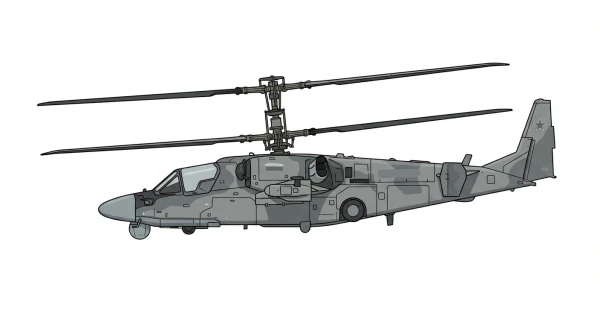
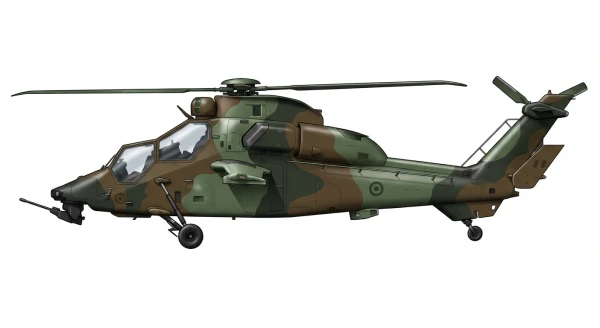
| Ka-52 Alligator Hokum-B | EC665 Tiger | |
|---|---|---|
| Origin country | 🇷🇺 Russia | 🇩🇪 Germany🇫🇷 France |
| Category | Military Helicopters | Military Helicopters |
| Manufacturer | Kamov | Eurocopter |
| First flight | 25 June 1997 | 27 April 1991 |
| Year introduced | 2011 | 2002 |
| Number produced | 196 units | 180 units |
| Average unit price | $16 million | $36 million |
| Wing area | 330.3 m² | -- m² |
| Wingspan | 7.8 m | 4.5 m |
| Height | 5.0 m | 3.8 m |
| Length | 15.9 m | 15.8 m |
| Maximum speed | 300 km/h | 315 km/h |
| Operational range | 460 km | 800 km |
| Service ceiling | 5,500 m | 2,000 m |
| Max. takeoff weight | 10,800 kg | 6,100 kg |
| Empty weight | 7,800 kg | 4,200 kg |
| Total thrust | 2 x 1,790 kW | 2 x 958 kW |
Detailed Comparison
The Russian Ka-52 Alligator and the Franco-German EC665 Tiger are attack helicopters originating from divergent design philosophies. The Ka-52 is a heavily armed and armored platform derived from the unique Ka-50, emphasizing survivability and firepower. The Tiger is a lighter, modular, multi-role helicopter focused on agility, reduced observability, and operational flexibility through a multi-national development program. Their core differences are evident in rotor configuration, crew layout, and armament philosophy.
Development and Design
The Ka-52's design is dominated by the Kamov coaxial counter-rotating rotor system. This eliminates the need for a tail rotor, dedicating all engine power to lift and thrust and enabling advanced aerobatic maneuvers. It retains the Ka-50's heavy cockpit armor, designed to withstand 12.7mm rounds, and the unique NPP Zvezda K-37-800 ejection seat system for its two-person crew, who sit side-by-side.
In contrast, the EC665 Tiger utilizes a conventional main and tail rotor layout with a tandem cockpit. Development focused on creating a lighter, more agile aircraft than its US counterparts. It makes extensive use of composite materials (around 80% of the airframe) and an angular fuselage to reduce its radar cross-section and infrared signature. Its design is inherently modular, allowing for distinct national variants like the French HAP/HAD and German UHT.
Specifications and Performances
While both aircraft are highly capable, their performance metrics reflect their different roles. The Ka-52 is substantially heavier, with a maximum takeoff weight of 10,800 kg compared to the Tiger's 6,100 kg. This allows the Alligator to carry a larger weapons load of over 2,000 kg. The Tiger's key advantage is its operational range of 800 km, nearly double the Ka-52's 460 km. The Ka-52 boasts a significantly higher service ceiling of 5,500 m versus the Tiger's 2,000 m, making it better suited for high-altitude operations. The Ka-52's primary armament is a powerful, side-mounted and semi-rigid 30mm Shipunov 2A42 cannon, while the Tiger fields a more flexible 30mm Nexter cannon in a chin-mounted turret, offering a wider field of fire.
Deployment and usage
The Ka-52 has been battle-tested in high-intensity conflicts, notably in Syria and extensively during the 2022 invasion of Ukraine. In Ukraine, it has proven effective when employing long-range anti-tank guided missiles (ATGMs) but has also sustained significant losses, with reports indicating vulnerabilities to man-portable air-defense systems (MANPADS) and even ground fire. The EC665 Tiger has been deployed primarily in counter-insurgency and fire support roles in Afghanistan, Libya, and Mali. Its combat experience has been against less sophisticated adversaries, where its reconnaissance and precision strike capabilities have been valued. The Australian ARH Tiger variant has faced notable serviceability and technical challenges.
Conclusion
The Ka-52 Alligator is a specialized, heavily armed helicopter designed for high-threat environments, prioritizing firepower and crew survivability through armor and ejection systems. Its combat record underscores both its destructive potential with standoff weapons and its vulnerabilities in contested airspace. The EC665 Tiger is a more versatile, multi-role platform that leverages stealth, agility, and superior range. It represents a Western approach focused on modularity and adaptability across different mission profiles, though it is lighter-armed and has not been tested in a near-peer conflict on the same scale as the Ka-52.