AH-1 Cobra vs EC665 Tiger
AH-1 Cobra vs EC665 Tiger at a glance — top speed 277 vs 315 km/h, range 570 vs 800 km, max takeoff weight 8,391 vs 6,100 kg, built 1,116 vs 180 units.
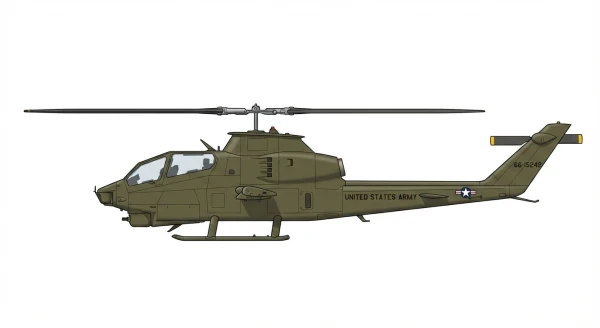
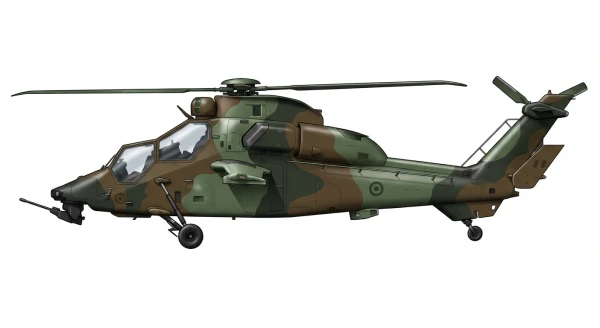
| AH-1 Cobra | EC665 Tiger | |
|---|---|---|
| Origin country | 🇺🇸 United States | 🇩🇪 Germany🇫🇷 France |
| Category | Military Helicopters | Military Helicopters |
| Manufacturer | Bell | Eurocopter |
| First flight | 7 September 1965 | 27 April 1991 |
| Year introduced | 1967 | 2002 |
| Number produced | 1116 units | 180 units |
| Average unit price | $13 million | $36 million |
| Wingspan | 13.4 m | 4.5 m |
| Height | 4.4 m | 3.8 m |
| Length | 17.8 m | 15.8 m |
| Maximum speed | 277 km/h | 315 km/h |
| Operational range | 570 km | 800 km |
| Service ceiling | 6,096 m | 2,000 m |
| Max. takeoff weight | 8,391 kg | 6,100 kg |
| Empty weight | 5,579 kg | 4,200 kg |
| Total thrust | 2 x 1,342 kW | 2 x 958 kW |
Detailed Comparison
The EC665 Tiger, a product of Franco-German collaboration from the 1990s, was designed as a modern, agile multirole attack helicopter with an emphasis on reduced radar signature through the extensive use of composite materials. In contrast, the Bell AH-1 Cobra originated in the 1960s as a dedicated gunship, rapidly developed from the UH-1 Huey airframe to meet urgent combat needs in Vietnam. While the Tiger was a "clean-sheet" design incorporating stealth concepts, the Cobra's legacy is one of continuous, combat-driven evolution from a simple escort to the highly advanced AH-1Z Viper.
Development and Design
The Tiger's development was a deliberate, multinational effort to create a lighter, more maneuverable European counterpart to the AH-64 Apache, integrating advanced glass cockpit avionics and modular weapon systems from the outset. Its airframe, comprising over 80% composite materials, provides ballistic tolerance and a reduced radar cross-section. The Cobra's design philosophy was initially driven by simplicity and speed of production. Its defining features were the narrow fuselage and tandem, stepped seating, which minimized its frontal profile and made it a difficult target. Subsequent variants, especially the twin-engine AH-1W SuperCobra and AH-1Z Viper for the US Marine Corps, represent a complete redesign with four-bladed rotors, uprated engines, and a fully integrated digital mission suite.
Specifications and Performances
A comparison of specifications reveals the results of these different evolutionary paths. The modern AH-1Z variant is a heavier and more powerful aircraft, with a max takeoff weight of 8,391 kg compared to the Tiger's 6,100 kg, supported by significantly more powerful engines. This allows the Cobra to carry a larger ordnance load. The AH-1Z also boasts a much higher service ceiling (6,096 m vs. 2,000 m) and a superior climb rate, reflecting the performance gains of its advanced rotor and powertrain systems. Conversely, the Tiger possesses a substantially greater ferry range (800 km), indicating a design optimized for longer-range support and reconnaissance missions where a heavy payload is not the primary requirement.
Deployment and usage
The AH-1 Cobra has one of the most extensive combat records of any attack helicopter, serving from Vietnam through the Gulf War to recent operations in Iraq and Afghanistan. It has been a workhorse platform, primarily for the US Army and later the US Marine Corps, in direct fire support and anti-armor roles. The EC665 Tiger’s operational history is more recent and limited, with deployments by French and German forces in Afghanistan, Libya, and Mali. In these conflicts, it has been used for armed reconnaissance, escort, and precision strikes, aligning with its multirole design. However, the Australian ARH variant's service life has been marked by significant sustainment and availability issues.
Conclusion
The AH-1 Cobra lineage demonstrates the success of iterative, combat-proven development, evolving a 1960s design into the formidable AH-1Z Viper. It remains a benchmark for payload, power, and battlefield resilience, particularly in the maritime environment. The EC665 Tiger represents a newer design philosophy, prioritizing agility, advanced systems integration, and low observability. While a capable platform in its intended roles, its higher cost, more limited combat exposure, and documented serviceability challenges in some forces present a different operational profile. The choice between them reflects a divergence in doctrine: the Cobra as a heavily armed brawler and the Tiger as a more nimble, high-tech scout and striker.