MiG-23 Flogger vs Su-17 Fitter
MiG-23 Flogger vs Su-17 Fitter at a glance — top speed 2,500 vs 2,140 km/h, range 2,360 vs 2,300 km, max takeoff weight 17,800 vs 7,890 kg, built 5,047 vs 2,867 units.
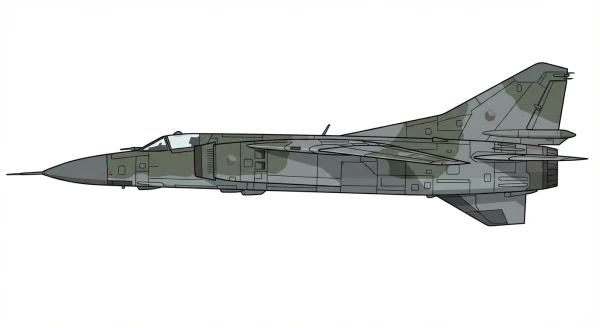
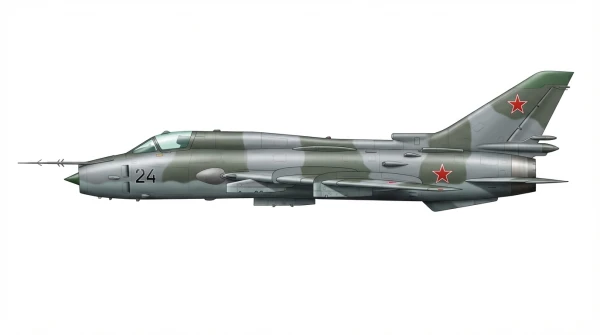
| MiG-23 Flogger | Su-17 Fitter | |
|---|---|---|
| Origin country | 🇷🇺 Ex-USSR | 🇷🇺 Ex-USSR |
| Category | Combat Aircraft | Combat Aircraft |
| Manufacturer | Mikoyan-Gurevich | Sukhoi |
| First flight | 10 June 1967 | 1 January 1966 |
| Year introduced | 1970 | 1970 |
| Number produced | 5047 units | 2867 units |
| Average unit price | $4 million | $6 million |
| Wing area | 37.0 m² | 27.5 m² |
| Wingspan | 14.0 m | 10.0 m |
| Height | 4.8 m | 4.5 m |
| Length | 16.7 m | 15.3 m |
| Maximum speed | 2500 km/h | 2140 km/h |
| Operational range | 2,360 km | 2,300 km |
| Service ceiling | 18,000 m | 14,500 m |
| Max. takeoff weight | 17,800 kg | 7,890 kg |
| Empty weight | 10,230 kg | 5,932 kg |
| Total thrust | 1 x 12,996 kgf | 1 x 4,000 kgf |
Detailed Comparison
The Mikoyan-Gurevich MiG-23 Flogger and the Sukhoi Su-17 Fitter emerged from the Soviet Union's pursuit of variable-geometry technology in the late 1960s to address the conflicting requirements of high-speed performance and low-speed handling. While both utilize swing-wing mechanics, they diverge significantly in mission scope: the MiG-23 was engineered primarily as an advanced air superiority fighter to succeed the MiG-21, whereas the Su-17 evolved from the fixed-wing Su-7 to fulfill a dedicated fighter-bomber and ground attack role.
Development and Design
Both airframes feature variable-geometry wings, a defining innovation of the era allowing adaptation for different flight regimes. The MiG-23 represented a "clean sheet" design relative to its predecessors, incorporating side-mounted intakes to accommodate a large nose cone for advanced avionics. This configuration supported its role as a high-speed interceptor. Conversely, the Su-17 was a direct evolutionary step from the Su-7, retaining the nose intake configuration. Its variable-sweep wings were applied to improve the poor takeoff and landing characteristics inherent in the original swept-wing Su-7 design, rather than solely for high-speed optimization. The Su-17 featured a rugged metal semi-monocoque fuselage, while the MiG-23 utilized a lighter airframe in later variants (MiG-23ML) to enhance aerodynamics.
Specifications and Performances
The MiG-23 exhibits superior kinematic performance, boasting a maximum speed of 2,500 km/h compared to the Su-17's 2,140 km/h. This aligns with the Flogger's interception requirements, supported by a much higher thrust profile; the MiG-23 utilizes a Tumansky R-35 generating nearly 13,000 kgf of thrust. The provided data indicates the Su-17 is a significantly lighter platform (Max Takeoff Weight of 7,890 kg vs 17,800 kg for the MiG-23) with lower thrust (4,000 kgf), emphasizing its role as a tactical striker rather than a heavy interceptor. The MiG-23 also offers a superior service ceiling of 18,000 m, outperforming the Su-17's 14,500 m limit, giving the Flogger a distinct advantage in the vertical maneuvering fight.
Deployment and usage
Operational history further clarifies the divergence in roles. The MiG-23 served as a frontline interceptor, equipped with R-23 medium-range and R-60 short-range missiles for air-to-air engagements. Its avionics suite, including advanced fire control systems, was designed to detect and engage enemy aircraft at range. The Su-17 and its export variants (Su-20/22) functioned primarily as mud-movers. With nine hardpoints capable of carrying rockets, cluster bombs, and air-to-surface missiles like the Kh-23 Grom, it specialized in close air support. Both aircraft saw extensive export to Soviet-aligned nations, seeing combat in the Middle East and Afghanistan, where the Su-17 proved effective in ground attack while the MiG-23 provided air cover.
Conclusion
Ultimately, the MiG-23 and Su-17 illustrate the specialization of Soviet tactical aviation during the Cold War. The MiG-23 Flogger optimized variable geometry for speed and high-altitude interception, prioritizing air-to-air lethality. The Su-17 Fitter applied similar aerodynamic principles to enhance payload lift and runway performance for the strike mission. While the MiG-23 offered higher raw performance, the Su-17's rugged adaptability as a dedicated attack platform ensured a lasting legacy in ground support roles.