MiG-29 Fulcrum vs MiG-29K Fulcrum-D
MiG-29 Fulcrum vs MiG-29K Fulcrum-D at a glance — top speed 2,450 vs 2,200 km/h, range 2,100 vs 3,000 km, max takeoff weight 18,000 vs 24,500 kg, built 1,600 vs 81 units.
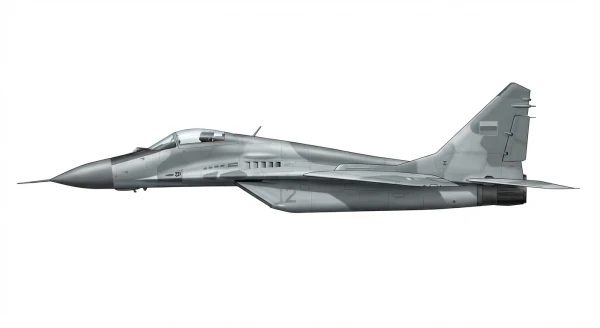
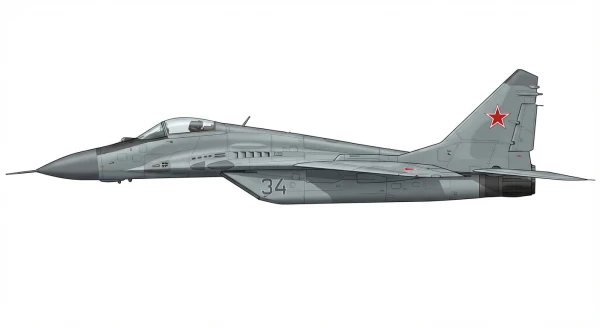
| MiG-29 Fulcrum | MiG-29K Fulcrum-D | |
|---|---|---|
| Origin country | 🇷🇺 Ex-USSR | 🇷🇺 Ex-USSR |
| Category | Combat Aircraft | Combat Aircraft |
| Manufacturer | Mikoyan | Mikoyan |
| First flight | 6 October 1977 | 22 January 2007 |
| Year introduced | 1983 | 2010 |
| Number produced | 1600 units | 81 units |
| Average unit price | $25 million | $35 million |
| Wing area | 38.0 m² | 43.0 m² |
| Wingspan | 11.4 m | 12.0 m |
| Height | 4.7 m | 4.4 m |
| Length | 17.3 m | 17.3 m |
| Maximum speed | 2450 km/h | 2200 km/h |
| Operational range | 2,100 km | 3,000 km |
| Service ceiling | 18,000 m | 17,500 m |
| Max. takeoff weight | 18,000 kg | 24,500 kg |
| Empty weight | 11,000 kg | 12,000 kg |
| Total thrust | 2 x 8,319 kgf | 2 x 9,000 kgf |
Detailed Comparison
The Mikoyan MiG-29 Fulcrum is a land-based, twin-engine air superiority fighter developed by the Soviet Union to counter Western aircraft like the F-15 and F-16. Its naval derivative, the MiG-29K Fulcrum-D, is a distinct, modernized multirole aircraft designed for carrier operations. While sharing a common design lineage, the MiG-29K is a fundamentally more advanced platform, optimized for the maritime environment with significantly greater range and mission flexibility compared to the original Cold War-era Fulcrum.
Development and Design
The original MiG-29 was conceived in the 1970s as a tactical, high-maneuverability fighter for frontline air defense. Its design emphasized raw aerodynamic performance, ruggedness for operations from austere airfields, and a combination of radar and an Infrared Search and Track (IRST) system for air-to-air combat. Its primary role was to achieve and maintain air superiority over the battlefield. The MiG-29K, developed decades later, is based on the advanced MiG-29M airframe, not the original MiG-29A. Its design philosophy shifts from pure air superiority to a balanced multirole capability for a carrier air wing. Key structural and design modifications include:
- A strengthened airframe and landing gear to withstand the stresses of arrested landings.
- An arrestor hook for carrier recovery.
- Folding wings to reduce its footprint on a crowded flight deck.
- A full fly-by-wire control system and significantly modernized avionics.
Specifications and Performances
While the provided data shows identical dimensions, weight, and speed, the most critical performance differentiator is range. The MiG-29K's range of 2,000 km is substantially greater than the baseline MiG-29's 1,500 km. This is achieved through increased internal fuel capacity and the use of more efficient Klimov RD-33MK engines. The MiG-29K also features a higher maximum takeoff weight to accommodate a larger fuel and weapons load. Although not specified in the data, its reinforced structure for naval use makes it heavier than the land-based original. Both aircraft possess exceptional agility, but the MiG-29K's modern flight control system provides superior handling characteristics, especially in complex flight regimes associated with carrier takeoffs and landings.
Deployment and Usage
The MiG-29 has a wide operational history, having been exported globally and used by numerous land-based air forces. It has seen combat in various conflicts, including in the former Yugoslavia, the Horn of Africa, and the Indian subcontinent, primarily in an air-to-air or limited ground-attack capacity. The MiG-29K's deployment is far more specialized. It is operated exclusively by the Russian and Indian Navies from their respective aircraft carriers. Its role is not just fleet air defense but also maritime strike, anti-ship warfare, and power projection, leveraging its expanded payload and compatibility with a wider array of modern precision-guided munitions and anti-ship missiles.
Conclusion
The MiG-29K is not merely a navalized version of the original Fulcrum but a comprehensive redesign that represents a generational leap in capability. It transforms the legacy MiG-29 airframe from a relatively short-range, land-based interceptor into a modern, carrier-capable multirole fighter. By incorporating an advanced airframe, superior avionics, and significantly increased range and payload, the MiG-29K provides a flexible power projection asset for naval forces, a mission set far beyond the scope of its Cold War predecessor.