F-16 Fighting Falcon vs MiG-29 Fulcrum
F-16 Fighting Falcon vs MiG-29 Fulcrum at a glance — top speed 2,178 vs 2,450 km/h, range 4,217 vs 2,100 km, max takeoff weight 19,200 vs 18,000 kg, built 4,604 vs 1,600 units.
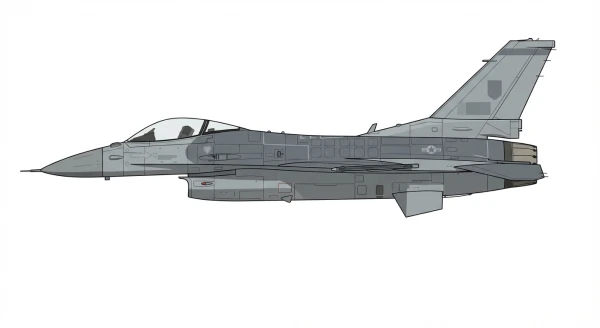
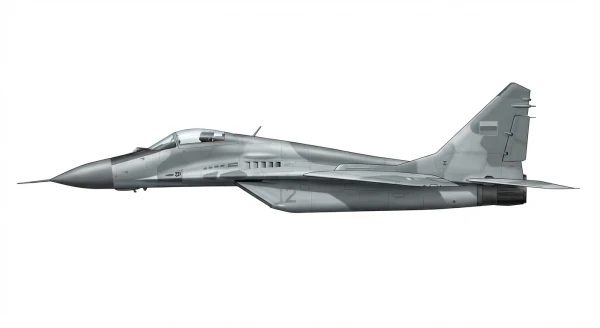
| F-16 Fighting Falcon | MiG-29 Fulcrum | |
|---|---|---|
| Origin country | 🇺🇸 United States | 🇷🇺 Ex-USSR |
| Category | Combat Aircraft | Combat Aircraft |
| Manufacturer | General Dynamics | Mikoyan |
| First flight | 2 February 1974 | 6 October 1977 |
| Year introduced | 1979 | 1983 |
| Number produced | 4604 units | 1600 units |
| Average unit price | $18.8 million | $25 million |
| Wing area | 27.9 m² | 38.0 m² |
| Wingspan | 10.0 m | 11.4 m |
| Height | 4.9 m | 4.7 m |
| Length | 15.1 m | 17.3 m |
| Maximum speed | 2178 km/h | 2450 km/h |
| Operational range | 4,217 km | 2,100 km |
| Service ceiling | 15,240 m | 18,000 m |
| Max. takeoff weight | 19,200 kg | 18,000 kg |
| Empty weight | 8,570 kg | 11,000 kg |
| Total thrust | 1 x 12,701 kgf | 2 x 8,319 kgf |
Detailed Comparison
The MiG-29 Fulcrum and F-16 Fighting Falcon were conceived during the Cold War to fulfill distinct tactical needs. The MiG-29 is a twin-engine, air superiority fighter designed for point-defense and achieving local air dominance, emphasizing raw power, maneuverability, and ruggedness for frontline operations. In contrast, the F-16 is a single-engine, lightweight multirole aircraft, born from a program prioritizing agility, affordability, and adaptability, which allowed it to evolve into a highly successful and versatile platform.
Development and Design
The MiG-29 was developed by the Soviet Union as a direct tactical counter to new American fighters like the F-16. Its design prioritizes short-range air combat performance, featuring a high thrust-to-weight ratio from its twin Klimov RD-33 engines and excellent instantaneous turn rates. Its robust airframe and landing gear were engineered for operations from austere, forward airfields. A key feature is the integrated Infrared Search and Track (IRST) system, allowing for passive target acquisition. The F-16's origin lies in the USAF's Lightweight Fighter program, seeking a cost-effective complement to the heavier F-15. Its design was revolutionary, incorporating a blended wing body for lift, relaxed static stability for agility, a side-stick controller, and a frameless bubble canopy for unparalleled pilot visibility. While initially a day fighter, its core design proved exceptionally adaptable for multirole missions through continuous block upgrades.
Specifications and Performances
Analysis of performance data reveals the F-16's advantages in energy maneuverability. It possesses a higher maximum speed (2,410 km/h vs. 2,200 km/h), a greater service ceiling (18,288 m vs. 17,500 m), and a vastly superior climb rate (254 m/s vs. 109 m/s). The F-16 is also significantly lighter, with an empty weight of 8,570 kg compared to the MiG-29's 18,500 kg, contributing to lower operational costs. The MiG-29's twin engines provide immense thrust, making it a formidable opponent in low-speed, high-alpha maneuvering. However, its relatively low internal fuel capacity and less efficient engines historically limited its combat radius, a critical disadvantage compared to the F-16. The F-16's armament integration is more extensive, particularly with Western precision-guided munitions and advanced targeting pods, although later MiG variants have narrowed this gap.
Deployment and usage
With over 4,600 units built and operated by more than 25 nations, the F-16's operational history is extensive and largely successful. It has been a workhorse in major conflicts, including Operations Desert Storm and Allied Force, where its multirole capabilities were effectively utilized within integrated command structures. In contrast, the MiG-29 (1,600 units built) has a more mixed combat record. Its performance has often been hindered by factors such as inferior avionics on export models, inadequate pilot training, and a lack of support infrastructure like AWACS. While used in conflicts from the Balkans to Syria, its successes have been situational, often failing to match Western opponents in beyond-visual-range (BVR) engagements.
Conclusion
The F-16's design philosophy—emphasizing affordability, adaptability, and continuous technological evolution—has proven more successful and enduring. Its success is a function of not just the airframe, but the entire ecosystem of upgrades, training, and integration with a wide array of advanced Western munitions and support systems. The MiG-29 remains a potent air superiority fighter, highly capable in a close-range dogfight. However, its potential has historically been constrained by its original design focus as a short-range interceptor, higher operational costs, and the inconsistent quality of avionics and support for its export operators. While modernized variants like the MiG-35 are highly capable, the F-16's legacy is that of a truly global, combat-proven multirole platform.