F/A-18 Hornet vs MiG-29 Fulcrum
F/A-18 Hornet vs MiG-29 Fulcrum at a glance — top speed 1,915 vs 2,450 km/h, range 2,017 vs 2,100 km, max takeoff weight 23,541 vs 18,000 kg, built 1,480 vs 1,600 units.
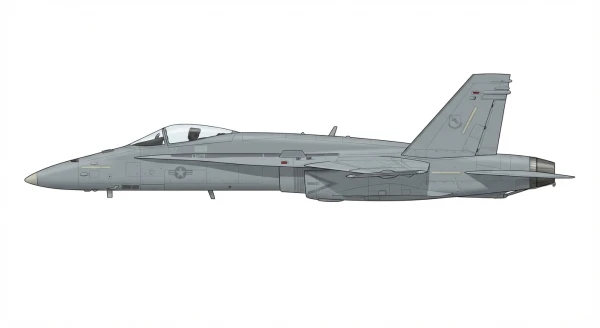
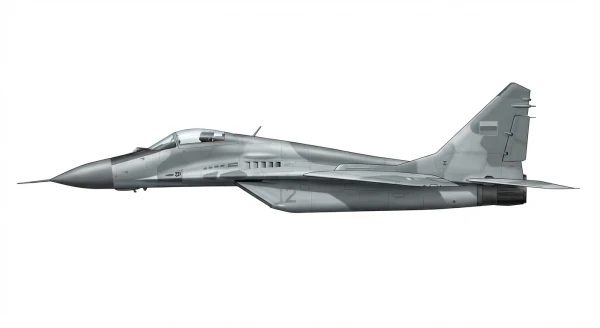
| F/A-18 Hornet | MiG-29 Fulcrum | |
|---|---|---|
| Origin country | 🇺🇸 United States | 🇷🇺 Ex-USSR |
| Category | Combat Aircraft | Combat Aircraft |
| Manufacturer | McDonnell Douglas | Mikoyan |
| First flight | 18 November 1978 | 6 October 1977 |
| Year introduced | 1983 | 1983 |
| Number produced | 1480 units | 1600 units |
| Average unit price | $29 million | $25 million |
| Wing area | 38.0 m² | 38.0 m² |
| Wingspan | 12.3 m | 11.4 m |
| Height | 4.7 m | 4.7 m |
| Length | 17.1 m | 17.3 m |
| Maximum speed | 1915 km/h | 2450 km/h |
| Operational range | 2,017 km | 2,100 km |
| Service ceiling | 15,000 m | 18,000 m |
| Max. takeoff weight | 23,541 kg | 18,000 kg |
| Empty weight | 10,433 kg | 11,000 kg |
| Total thrust | 2 x 8,051 kgf | 2 x 8,319 kgf |
Detailed Comparison
The McDonnell Douglas F/A-18 Hornet and the Mikoyan MiG-29 Fulcrum emerged in the late 1970s as responses to divergent Cold War strategic requirements. While the Hornet was engineered as a carrier-borne, multirole strike fighter to replace multiple U.S. Navy platforms, the Fulcrum was designed as a land-based, high-agility tactical fighter intended to counter American air superiority assets like the F-15 and F-16. Despite sharing twin-engine configurations and similar service entry dates (1983), their operational doctrines differ: the F/A-18 emphasizes avionics integration and sustained sortie generation, whereas the MiG-29 prioritizes raw kinematic performance and short-field ruggedness.
Development and Design
The F/A-18 evolved from the Northrop YF-17, extensively redesigned by McDonnell Douglas for naval operations. Key engineering focus areas included structural strengthening, the implementation of a digital fly-by-wire system, and ease of maintenance; the General Electric F404 engines were designed to be replaced in under 20 minutes, maximizing carrier deck availability. It pioneered the "single pilot, multirole" concept through advanced cockpit ergonomics and multifunction displays.
Conversely, the MiG-29 was engineered to operate from frontline, unprepared airstrips, evidenced by its robust undercarriage and intake design. Its aerodynamic layout utilizes a blended wing-body to generate significant lift. Notably, the MiG-29 integrated an Infrared Search and Track (IRST) system and helmet-mounted sights early in its lifecycle, allowing for passive target engagement and off-boresight missile shots—capabilities the Hornet initially lacked.
Specifications and Performances
Performance metrics highlight the distinct design philosophies. The MiG-29 possesses superior interceptor characteristics, boasting a maximum speed of 2,200 km/h and a service ceiling of 17,500 m, compared to the Hornet’s 1,915 km/h and 15,000 m ceiling. The Fulcrum also utilizes engines producing 9,000 kgf of thrust, favoring high-energy maneuvering.
However, the Hornet demonstrates superior logistical and strike utility. Its operational range of 2,017 km significantly outperforms the MiG-29’s 1,430 km, a critical factor for power projection. While the Fulcrum relies on speed, the Hornet utilizes advanced avionics and a payload capacity supported by nine hardpoints to deliver a wider array of precision ordnance, ranging from AIM-120 AMRAAMs to AGM-84 SLAM-ER and JDAMs. The MiG-29 carries a lighter, more air-to-air focused loadout (R-27, R-73), though later variants improved ground-attack capabilities.
Deployment and usage
The F/A-18 has proven its versatility in continuous combat operations since 1986. During the 1991 Gulf War, Hornets validated their multirole design by shooting down enemy fighters and bombing ground targets in the same sortie. It serves as the primary strike asset for the U.S. Navy and Marines, as well as air forces in Finland, Spain, and Australia.
The MiG-29 saw extensive export to Warsaw Pact and non-aligned nations as a point-defense fighter. In conflicts such as the Kosovo War and Operation Desert Storm, Iraqi and Yugoslav MiG-29s suffered losses against NATO forces, often attributed to disparities in pilot training and command-and-control support rather than airframe deficiencies. Modern variants, including the naval MiG-29K, have been adopted by India and Russia for carrier operations, mirroring the Hornet's original role.
Conclusion
The F/A-18 Hornet represents the triumph of the multirole doctrine, prioritizing avionics suite flexibility, reliability, and payload utility over raw aerodynamic performance. The MiG-29 Fulcrum remains a formidable air superiority fighter with exceptional close-in combat potential, but its shorter operational range and earlier reliance on ground-controlled interception limited its strategic utility compared to its western counterpart. Both airframes have required significant evolution—resulting in the Super Hornet and MiG-35—to remain viable in modern network-centric warfare.