Mirage 2000 vs Rafale
Mirage 2000 vs Rafale at a glance — top speed 2,336 vs 1,912 km/h, range 3,335 vs 3,700 km, max takeoff weight 17,500 vs 24,500 kg, built 601 vs 316 units.

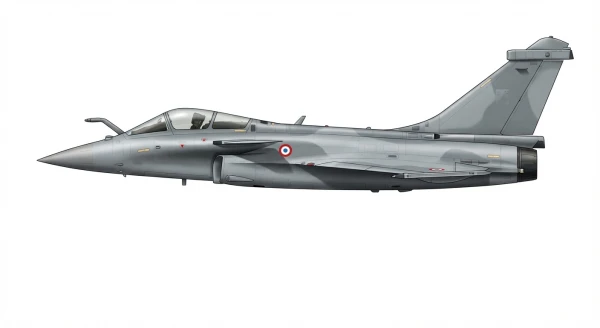
| Mirage 2000 | Rafale | |
|---|---|---|
| Origin country | 🇫🇷 France | 🇫🇷 France |
| Category | Combat Aircraft | Combat Aircraft |
| Manufacturer | Dassault | Dassault |
| First flight | 1 March 1978 | 4 July 1986 |
| Year introduced | 1983 | 2001 |
| Number produced | 601 units | 316 units |
| Average unit price | $23 million | $95 million |
| Wing area | 41.0 m² | 45.7 m² |
| Wingspan | 9.1 m | 10.9 m |
| Height | 5.2 m | 5.3 m |
| Length | 14.4 m | 15.3 m |
| Maximum speed | 2336 km/h | 1912 km/h |
| Operational range | 3,335 km | 3,700 km |
| Service ceiling | 18,300 m | 15,835 m |
| Max. takeoff weight | 17,500 kg | 24,500 kg |
| Empty weight | 7,500 kg | 9,850 kg |
| Total thrust | 1 x 9,697 kgf | 2 x 7,648 kgf |
Detailed Comparison
The Dassault Rafale and Mirage 2000 originate from the same manufacturer but represent distinct generations in combat aircraft design. The Mirage 2000 is a 4th-generation, single-engine fighter that evolved the classic tailless delta-wing concept for multirole capability through specialized variants. The Rafale is a 4.5+ generation twin-engine, canard-delta "omnirole" aircraft, designed from its inception for maximum mission flexibility and survivability in complex, integrated threat environments.
Development and Design
The Mirage 2000 was developed in the 1970s as a successor to the Mirage III, retaining the delta wing but incorporating relaxed stability and fly-by-wire controls to improve handling. Its development path led to dedicated variants, such as the Mirage 2000C for air superiority and the Mirage 2000D for ground attack. The Rafale's design emerged in the 1980s after France withdrew from the Eurofighter program to pursue a platform meeting both air force and unique naval requirements. Its canard-delta configuration provides superior agility and low-speed performance, crucial for its carrier-based variant. Unlike the Mirage, the Rafale was designed with features to reduce its radar cross-section and incorporates a highly integrated defensive aids system (SPECTRA).
Specifications and Performances
Key performance differences stem from their core design philosophies. The single-engine Mirage 2000 is lighter (7,500 kg empty weight) and faster at high altitude, reaching Mach 2.2 with a service ceiling of 18,300 m, making it a formidable interceptor. The twin-engine Rafale is substantially heavier (10,196 kg empty weight) but can carry a much larger payload (9 tons on up to 14 hardpoints) and has superior agility and low-speed handling, enabling a takeoff distance of just 400 meters. The Rafale’s twin M88 engines offer thrust redundancy, a critical factor for naval operations and combat survivability that the single-engine Mirage 2000 lacks.
Deployment and usage
The Rafale's primary advantage is its "omnirole" capability, enabled by advanced sensor fusion. Its RBE2 AESA radar, SPECTRA electronic warfare system, and targeting pods are deeply integrated, allowing a single airframe to concurrently perform air superiority, strike, and reconnaissance tasks. This was demonstrated in Libya, where Rafales conducted strike missions without dedicated Suppression of Enemy Air Defenses (SEAD) support. The Mirage 2000 has an extensive combat record in conflicts like the Gulf War and Kargil War but was typically deployed in more specialized roles. While later variants like the Mirage 2000-5 integrated modern systems and MICA missiles, their avionics architecture is not as holistically integrated as the Rafale's. The Rafale also natively integrates more advanced long-range weaponry, such as the MBDA Meteor missile.
Conclusion
The Mirage 2000 is a successful evolution of the 4th-generation interceptor, adapted into a potent multirole fighter. It remains a credible platform, valued for its high-altitude speed and performance. The Rafale, however, represents a generational advancement. Its design emphasizes comprehensive mission flexibility through superior agility across the flight envelope, advanced sensor fusion, and greater payload capacity. While the Mirage 2000 excels in specific high-altitude intercept profiles, the Rafale’s integrated "omnirole" design makes it a more versatile and survivable asset for the complexities of modern, networked warfare.