GlobalEye vs Saab 340 AEW&C
GlobalEye vs Saab 340 AEW&C at a glance — top speed 1,110 vs 522 km/h, range 11,000 vs 1,300 km, max takeoff weight 45,100 vs 13,155 kg, built 5 vs 12 units.
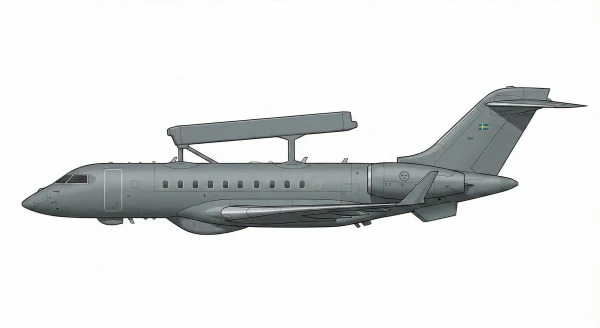
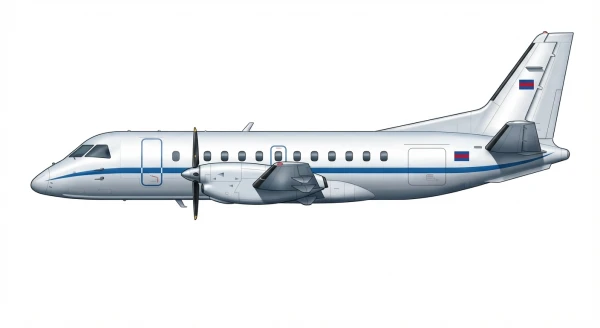
| GlobalEye | Saab 340 AEW&C | |
|---|---|---|
| Origin country | 🇨🇦 Canada🇸🇪 Sweden | 🇸🇪 Sweden |
| Category | Military Special Mission Aircraft | Military Special Mission Aircraft |
| Manufacturer | Saab | Saab |
| First flight | 14 March 2018 | 1 January 1994 |
| Year introduced | 2020 | 1997 |
| Number produced | 5 units | 12 units |
| Average unit price | $350 million | -- |
| Wing area | 94.9 m² | 42.0 m² |
| Wingspan | 29.0 m | 21.4 m |
| Height | 7.8 m | 7.0 m |
| Length | 30.3 m | 20.6 m |
| Maximum speed | 1110 km/h | 522 km/h |
| Operational range | 11,000 km | 1,300 km |
| Service ceiling | 16,000 m | 7,620 m |
| Max. takeoff weight | 45,100 kg | 13,155 kg |
| Empty weight | 23,690 kg | 10,300 kg |
| Total thrust | 2 x 6,690 kgf | 2 x 1,390 kW |
Detailed Comparison
Saab’s airborne early warning and control (AEW&C) lineage spans from the turboprop-driven 340 AEW&C, introduced in 1997 with the first-generation Erieye radar, to the jet-powered GlobalEye, operational since 2020. The transition from a regional turboprop to an ultra-long-range business jet chassis dictates the operational parameters of both systems, shifting Saab's output from localized airspace monitoring to theater-level surveillance.
Development and Design
The 340 AEW&C originated in the 1990s as a domestic radar platform for the Swedish Air Force (S 100B Argus). Saab adapted its civilian 340 commuter airliner by mounting the PS-890 AESA radar dorsally. This fixed design reduced aerodynamic drag compared to rotating radomes like the E-3 Sentry, but it restricted radar coverage to 120 degrees on each side, leaving blind zones directly forward and aft.
Two decades later, the GlobalEye program abandoned the regional airliner airframe for the Bombardier Global 6000/6500 business jet. This heavier, pressurized chassis accommodates the Erieye ER (Extended Range) radar, which utilizes Gallium Nitride (GaN) transmit/receive modules. Furthermore, GlobalEye integrates a Leonardo Seaspray 7500E maritime radar and an EO/IR turret under the forward fuselage, altering the platform's baseline function from a single-mission air defense node to a concurrent air, sea, and land surveillance system.
Specifications and Performances
The underlying airframe variations generate absolute performance disparities between the two platforms:
- Radar Horizon: The GlobalEye’s turbofan engines enable a 16,000-meter service ceiling, allowing its radar to detect targets at 550 km. The 340 operates at a maximum of 7,620 meters, capping its radar range at 300 to 400 km.
- Time on Station: The Global 6000 chassis yields an 11-hour endurance, more than doubling the 340’s 5-hour limit and directly reducing the number of airframes required for 24-hour orbit maintenance.
- Speed and Transit: At 1110 km/h, the GlobalEye can transit to patrol zones at more than twice the speed of the 340 (522 km/h).
While the 340 operates with six crew members, the GlobalEye achieves multi-role coverage with a mission crew of five, relying heavily on modern data links to stream raw sensor feeds to ground-based command centers.
Deployment and usage
The 340 AEW&C established Saab’s export footprint, operating in Sweden, Thailand, and the UAE. It has recently transitioned into active conflict and border-security roles. Sweden announced the transfer of two ASC 890 variants to the Ukrainian Air Force in 2024 to provide low-altitude radar coverage and cue F-16 fighters against Russian aviation. Poland also acquired ex-UAE airframes in 2023 to monitor its eastern flank.
The GlobalEye dominates contemporary high-budget procurements. The UAE replaced its 340s with a five-unit GlobalEye fleet (SRSS) to track targets including ballistic missiles in the Persian Gulf. France ordered two units in 2025, and Sweden will replace its legacy fleet with the S 106 variant by 2027, embedding the platform into NATO's European air defense architecture.
Conclusion
The GlobalEye holds the absolute edge for modern military operations and persistent theater surveillance. Its altitude advantage, GaN-based radar, and 11-hour endurance make it the strict requirement for advanced militaries tracking stealth targets, drone swarms, and ballistic threats.
The 340 AEW&C, constrained by short endurance and legacy processing, is obsolete for top-tier procurement. However, it holds the edge as a rapidly deployable, second-hand gap-filler. For militaries like Ukraine requiring immediate radar coverage to network with tactical fighters, the 340 provides early warning capacity without the $350 million unit cost and infrastructure demands of the GlobalEye.