E-7 Wedgetail vs GlobalEye
E-7 Wedgetail vs GlobalEye at a glance — top speed 853 vs 1,110 km/h, range 6,500 vs 11,000 km, max takeoff weight 77,600 vs 45,100 kg, built 15 vs 5 units.
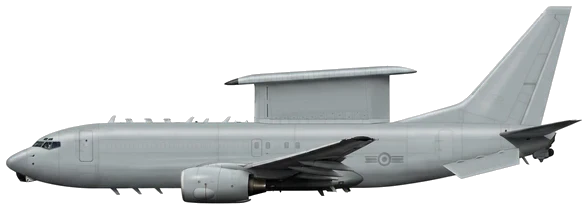
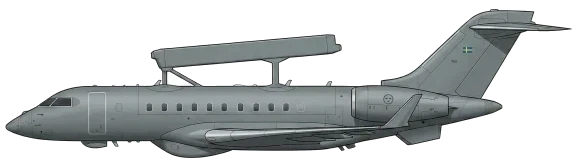
| E-7 Wedgetail | GlobalEye | |
|---|---|---|
| Origin country | 🇺🇸 United States | 🇨🇦 Canada🇸🇪 Sweden |
| Category | Military Special Mission Aircraft | Military Special Mission Aircraft |
| Manufacturer | Boeing | Saab |
| First flight | 1 January 2004 | 14 March 2018 |
| Year introduced | 2010 | 2020 |
| Number produced | 15 units | 5 units |
| Average unit price | $400 million | $350 million |
| Wing area | 91.0 m² | 94.9 m² |
| Wingspan | 35.8 m | 29.0 m |
| Height | 12.5 m | 7.8 m |
| Length | 33.6 m | 30.3 m |
| Maximum speed | 853 km/h | 1110 km/h |
| Operational range | 6,500 km | 11,000 km |
| Service ceiling | 12,500 m | 16,000 m |
| Max. takeoff weight | 77,600 kg | 45,100 kg |
| Empty weight | 46,606 kg | 23,690 kg |
| Total thrust | 2 x 121 kN | 2 x 6,690 kgf |
Detailed Comparison
Boeing’s E-7 Wedgetail leverages a 737-700ER commercial airliner airframe to support a large onboard battle management staff, prioritizing command and control (C2). Saab’s GlobalEye integrates the Erieye ER radar onto a Bombardier Global 6000/6500 business jet, trading cabin volume for extreme altitude and unrefueled range to maximize sensor horizons.
Development and Design
The E-7 originated in a 1999 Royal Australian Air Force requirement for an Airborne Early Warning and Control (AEW&C) platform. Its core is the Northrop Grumman Multi-role Electronically Scanned Array (MESA) radar. The fixed dorsal "top hat" structure provides 360-degree coverage—120 degrees broadside and 60 degrees fore/aft—eliminating the mechanical rotation of legacy AWACS. This airliner-sized airframe accommodates up to 19 mission crew members and 10 operator consoles, enabling the platform to direct large-scale air campaigns autonomously.
Saab launched the GlobalEye in 2016 to push the Erieye radar system into the multi-domain space. By adopting a business jet base, Saab sacrificed operator capacity (five stations) for aerodynamic efficiency. The design incorporates Gallium Nitride (GaN) transmit/receive modules in the dorsal AESA radar, paired with a ventral Leonardo Seaspray 7500E maritime radar and an electro-optical/infrared (EO/IR) turret. This configuration allows a single airframe to track aerial, naval, and ground targets simultaneously.
Specifications and Performances
The contrasting airframes dictate distinct performance profiles. The GlobalEye operates fundamentally as a high-altitude sensor node, while the E-7 functions as a flying command post.
- The GlobalEye reaches a service ceiling of 16,000 meters, physically pushing the radar horizon outward to maximize its 550 km sensor range.
- The lighter Saab airframe (45,100 kg MTOW) cruises at 1,110 km/h with an 11,000 km unrefueled range.
- The E-7 is heavily constrained by aerodynamic drag and weight (77,600 kg MTOW), limiting its speed to 853 km/h and unrefueled range to 6,500 km.
- The E-7 offsets lower kinematic performance with superior ELINT range (850 km) and higher power-generation for the MESA radar.
Deployment and usage
The E-7 has a matured combat record. RAAF Wedgetails executed 17-hour C2 sorties during coalition operations in Iraq starting in 2014, and deployed to Europe in 2023 and 2025 to monitor Ukrainian supply lines. It serves as the standard AWACS replacement for Australia, Turkey, and South Korea, though the USAF recently canceled its planned 26-aircraft procurement in favor of continuing prototype development.
The GlobalEye entered service in 2020 with the UAE, which employs its five airframes for border security, maritime overwatch, and ballistic missile detection. Sweden and France ordered fleets for delivery beginning in 2027. The Saab platform lacks the Wedgetail’s combat-tested battle management pedigree, operating primarily as a peacetime or gray-zone surveillance asset sending data to ground nodes.
Conclusion
The E-7 Wedgetail holds the definitive edge in contested airspace and complex air campaigns. Its superior ELINT integration and large operator cabin allow it to manage dozens of fighter assets and coordinate strike packages in real-time, a necessity for high-intensity warfare. The GlobalEye is the better platform for border and maritime patrol. Its 16,000-meter operating altitude, longer unrefueled range, and integrated EO/IR and maritime radars make it a more efficient, multi-domain intelligence gatherer for nations that rely on ground-based C2 rather than airborne battle managers.