Su-27 Flanker vs Su-30 Flanker-C
Su-27 Flanker vs Su-30 Flanker-C at a glance — top speed 2,500 vs 2,125 km/h, range 3,530 vs 3,000 km, max takeoff weight 30,000 vs 33,000 kg, built 680 vs 630 units.
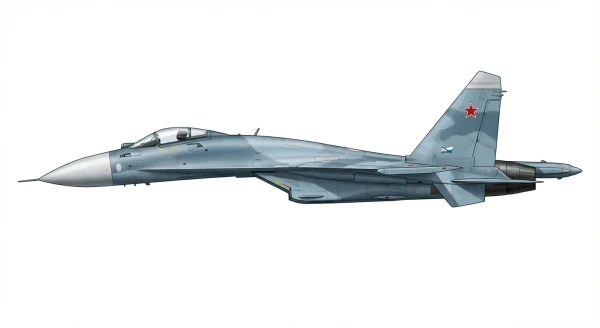
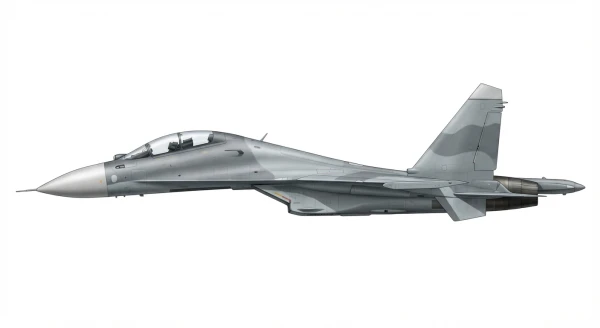
| Su-27 Flanker | Su-30 Flanker-C | |
|---|---|---|
| Origin country | 🇷🇺 Ex-USSR | 🇷🇺 Ex-USSR |
| Category | Combat Aircraft | Combat Aircraft |
| Manufacturer | Sukhoi | Sukhoi |
| First flight | 20 May 1977 | 30 December 1989 |
| Year introduced | 1985 | 1996 |
| Number produced | 680 units | 630 units |
| Average unit price | $30 million | $37 million |
| Wing area | 62.0 m² | 62.0 m² |
| Wingspan | 14.7 m | 14.7 m |
| Height | 5.9 m | 6.4 m |
| Length | 21.9 m | 21.9 m |
| Maximum speed | 2500 km/h | 2125 km/h |
| Operational range | 3,530 km | 3,000 km |
| Service ceiling | 18,500 m | 17,500 m |
| Max. takeoff weight | 30,000 kg | 33,000 kg |
| Empty weight | 16,300 kg | 17,700 kg |
| Total thrust | 2 x 12,502 kgf | 2 x 12,500 kgf |
Detailed Comparison
The Su-27 Flanker was developed as a dedicated air superiority fighter to counter its Western counterparts, while the Su-30 Flanker-C is a direct evolution, transforming the single-seat airframe into a two-seat, multirole combat aircraft. This fundamental difference in mission dictates their design, capabilities, and operational use. The Su-27 established the Flanker's reputation for exceptional agility and long range, whereas the Su-30 builds upon that foundation, adding significant air-to-ground strike and command capabilities.
Development and Design
The Su-27's design philosophy prioritized kinematic performance. Its blended wing-body and large internal fuel capacity provided a combination of high maneuverability and extended range, making it a formidable air-to-air platform. Development focused on achieving superiority over the F-15 Eagle.
The Su-30's genesis lies in the Su-27UB two-seat trainer. The potential for a second crew member to manage complex missions, particularly long-range interception and ground-attack, was recognized. This led to the Su-30. Key export variants like the Su-30MKI introduced critical innovations not present on the original Su-27, including:
- Canards: Forward-mounted control surfaces that significantly improve maneuverability and control at high angles of attack.
- Thrust-Vectoring Nozzles: These allow the pilot to direct engine thrust, granting extreme agility in dogfights.
- Second Crew Member: A Weapon Systems Officer (WSO) in the rear seat manages navigation, targeting pods, and complex guided munitions, reducing the pilot's workload.
Specifications and Performances
While sharing the same basic airframe, their performance metrics reflect their differing roles. The original Su-27 is lighter (16,300 kg empty weight vs. 17,700 kg for the Su-30) and boasts a higher top speed (2500 km/h vs. 2125 km/h) and service ceiling. This is consistent with its specialization as a pure air interceptor. In contrast, the Su-30 has a significantly higher Maximum Takeoff Weight (33,000 kg vs. 30,000 kg), allowing it to carry more fuel and a heavier, more diverse weapons payload on its 12 hardpoints. The Su-30's AL-31FP engines, featured on advanced variants, provide thrust vectoring, a capability the baseline Su-27 lacks.
Deployment and usage
The Su-27's operational history, such as its use by Ethiopia in the Eritrean-Ethiopian War, highlights its effectiveness in its intended air superiority role, securing air dominance. Russian Su-27s have primarily served in air defense and patrol missions. The Su-30, however, is employed more broadly. The Indian Air Force uses its Su-30MKI fleet for a wide spectrum of missions, from air defense and long-range strike to maritime patrol and nuclear delivery. Similarly, China's Su-30MKK variant was specifically acquired to bolster its maritime strike capabilities. The two-seat configuration makes the Su-30 a more suitable platform for complex, long-endurance missions requiring intensive sensor and weapons management.
Conclusion
The Su-27 remains a highly capable air superiority fighter, defined by its speed, altitude, and agility. The Su-30 represents a logical and highly successful evolution, sacrificing some peak kinematic performance for immense multirole flexibility. Its primary advancements—the two-person crew, sophisticated avionics, and expanded payload for precision air-to-surface munitions—make it a far more versatile asset on the modern battlefield. The addition of the WSO is the most critical differentiator, enabling the platform to effectively employ its advanced systems in complex combat environments where a single pilot would be task-saturated.