Su-30 Variants, Suffixes and Upgrade Programs
How to read a Su-30 designation: the two production lines, what each suffix letter means, which upgrade programs change the name and which do not, and who flies which version in 2026.
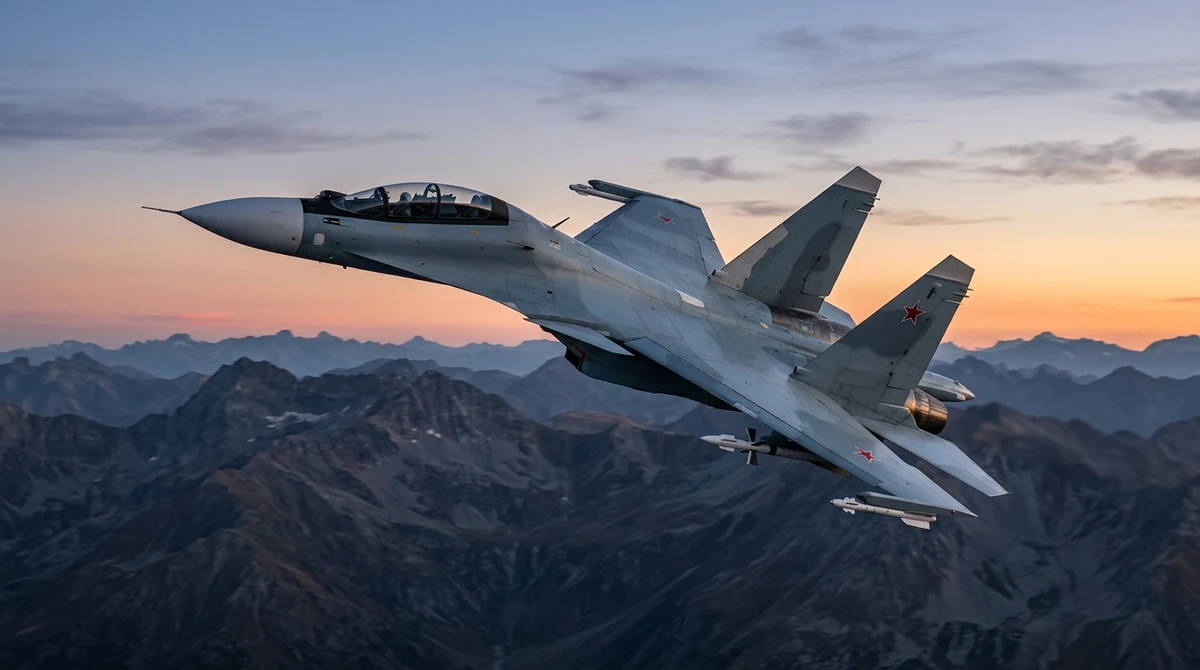
Unlike the Rafale's numbered F-standards, the Sukhoi Su-30 has no blocks or tranches. Every Su-30 instead carries three labels at once: its production lineage (two plants built two physically different aircraft under one name, with or without canards and thrust vectoring), its suffix string (which records whether it was modernized, whether it was built for export, and for whom), and the national upgrade program applied later, which in most cases leaves the designation unchanged.
All three are changing in 2025–2026. Russia's newest step, the Su-30SM2, reached its first export customer, Belarus, with deliveries from May 2025; India's Su-30MKI mid-life upgrade, cleared to proceed by the Defence Acquisition Council on 30 November 2023, was still awaiting Cabinet Committee on Security clearance in the latest report found (The Week, 25 February 2026); and Russia renewed its offer of a new engine for the Indian fleet in September 2026. This guide reads the family as of October 2026.
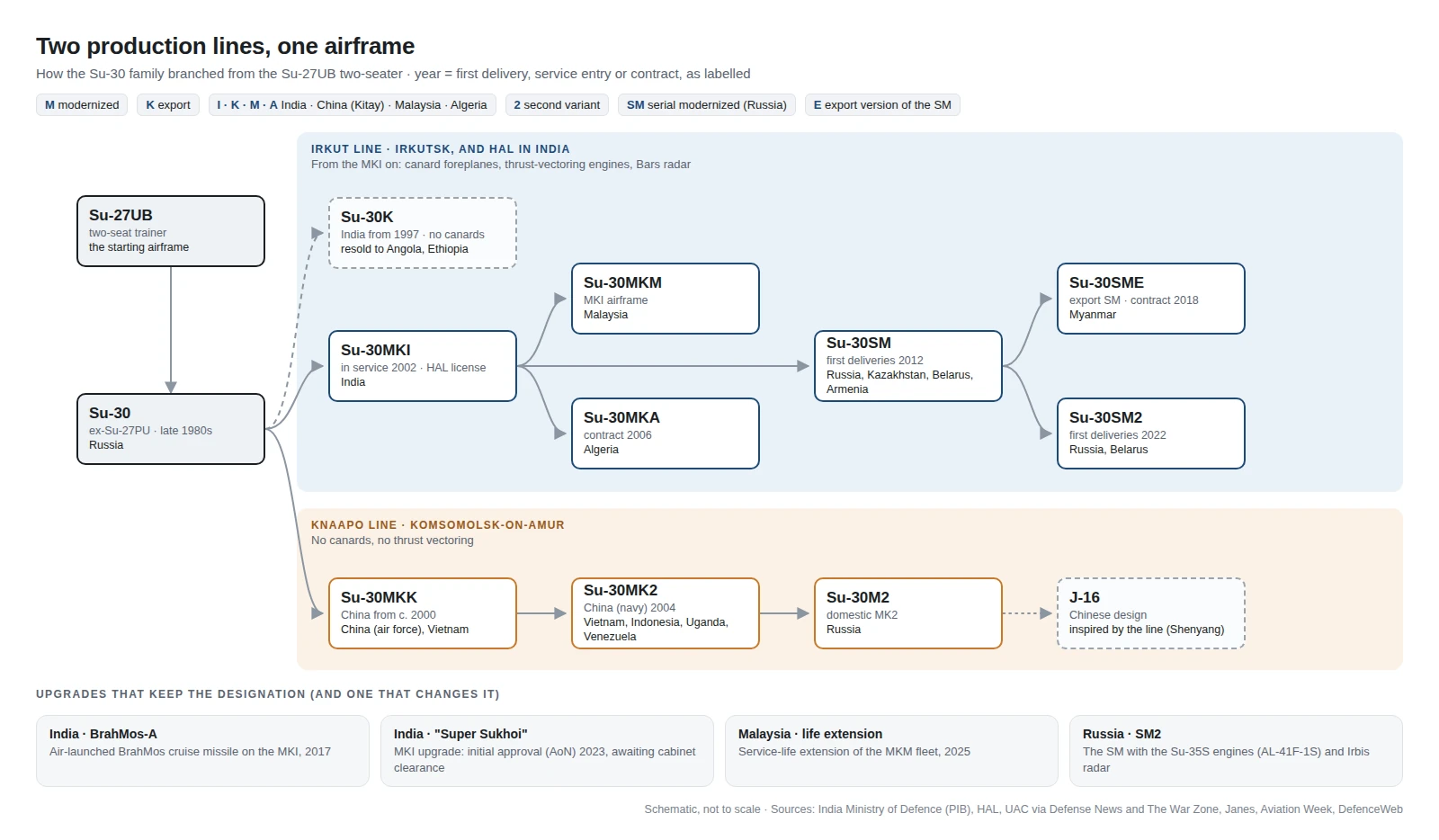
- Two lineages: KnAAPO at Komsomolsk-on-Amur built the Su-30MKK and MK2 line without canards or thrust vectoring, commonly reported under the NATO name Flanker-G; Irkut at Irkutsk, and Hindustan Aeronautics under license in India, built the Su-30MKI line with both, commonly reported as Flanker-H. Russia's own Su-30SM and SM2 belong to the Irkut line.
- The letters: M means modernized and K means export; the next letter usually names the launch customer (I for India, K for China, M for Malaysia, A for Algeria). SM is Russia's domestic "serial modernized" version, E marks its export model, and 2 marks a second modification (MK2, SM2).
- Upgrades rarely rename: India's "Super Sukhoi" program upgrades Su-30MKIs that remain Su-30MKIs, and Malaysia's life-extended jets remain Su-30MKMs. Russia's Su-30SM2 is the exception: a new designation that is also built new.
- Same letters, different jets: the Su-30K flown by Angola and Ethiopia is not a Su-30MKI; the SME is the export Su-30SM, with Myanmar its only confirmed customer; Russia's Su-30M2 is a domestic KnAAPO jet, not a re-lettered MK2.
Two production lineages
The Su-30 began as a two-seat long-range interceptor derived from the Su-27UB trainer. Developed in the late 1980s as the Su-27PU and then renamed, it flew in production form on 14 April 1992 (first flight of the first series aircraft); Russia's air defense forces received a handful in the mid-1990s. Export demand then split the design between two plants under the Sukhoi umbrella, and that split explains how a given Su-30 looks and what it does.
The KnAAPO line, from Komsomolsk-on-Amur, was built first for China and kept the Su-27 planform: no canards, no thrust-vectoring nozzles, and a radar of the N001 "Myech" family. Its members are the Su-30MKK, the improved Su-30MK2 and Russia's own Su-30M2, and it was configured mainly for strike.
The Irkut line, from Irkutsk, was built first for India and then by Hindustan Aeronautics Limited (HAL) under license. It added canard foreplanes, AL-31FP engines with thrust-vectoring nozzles and the N011M Bars passive electronically scanned radar, drawing on Sukhoi's thrust-vectoring Su-37 demonstrator. Its members are the Su-30MKI, its Malaysian and Algerian derivatives, and Russia's Su-30SM, SME and SM2, whose airframe Airforce Technology describes as based on the Su-30MKI. The two lineages share a name and a parent, but none of the upgrade programs described below moves an aircraft from one line to the other.
One Chinese aircraft is often filed with the family and should not be. The Shenyang J-16 is built on a J-11BS airframe with Su-30MKK-derived features (a refueling probe, strengthened landing gear and more fuel), WS-10B engines and an AESA radar, according to The Aviationist; it is not a Su-30 variant. For the single-seat Flankers and the Chinese derivatives, see the Su-27 Flanker family explainer.
Reading the suffix letters
The suffix is read letter by letter. The readings below are the commonly published ones; the SM expansion is confirmed by GlobalSecurity, but no official Russian decoder has been published, so they are conventions rather than doctrine. Two are safe in any context: M for modernizirovanny, modernized, and K for kommercheskiy, commercial, which in Soviet and Russian practice means export. After the K comes the letter of the launch customer, so that Su-30MKI reads "modernized, export, India".
| Reading | Example | Line | |
|---|---|---|---|
| M | Modernized (modernizirovanny) | Su-30MK | Both |
| K (first K) | Commercial, i.e. export (kommercheskiy) | Su-30K, Su-30MK | Both |
| I | India | Su-30MKI | Irkut |
| K (second K) | China | Su-30MKK | KnAAPO |
| M (after MK) | Malaysia | Su-30MKM | Irkut |
| A | Algeria | Su-30MKA | Irkut |
| 2 | Second modification | Su-30MK2, Su-30SM2 | KnAAPO (MK2), Irkut (SM2) |
| SM | Serial modernized, Russian domestic (seriyny modernizirovanny) | Su-30SM | Irkut |
| E | Export (eksportny), applied to the SM | Su-30SME | Irkut |
| M2 | Russian domestic version of the MK2 (no K, so not export) | Su-30M2 | KnAAPO |
Two names cause confusion in coverage. "Super Sukhoi" means two different things: in India it is the Su-30MKI mid-life upgrade program (Defense News, The Week), while some Russian-leaning outlets apply it to the Su-30SM2. This guide writes "India's Super Sukhoi upgrade" and "Russia's Su-30SM2", never the name alone. And 117S is not 177S: the SM2's engine is the AL-41F-1S, product (izdeliye) 117S, taken from the Su-35S (Milmag, citing UAC), while the izdeliye 177S offered to India in 2026 is a different, newer engine (The Week).
The versions in service
The Irkut line: canards and thrust vectoring
Su-30K. The basic export Su-30, without canards or thrust vectoring, was India's entry into the family. The first kits arrived in March 1997 and No. 24 Squadron inducted the type on 11 June 1997 (Bharat Rakshak); 18 early-model Su-30s were delivered between 1997 and 1999. They were retired in 2006, exchanged for full MKIs and moved to the 558th Aircraft Repair Plant at Baranovichi, Belarus, between August and November 2011 (DefenceWeb). The airframes could not be brought to MKI standard; twelve were sold on to Angola and six to Ethiopia.
Su-30MKI. The definitive Indian aircraft combined the canard-and-vectoring airframe with the N011M Bars radar and an avionics mix of Russian, Indian, French and Israeli origin. India inducted its first MKIs with No. 20 Squadron at Lohegaon on 27 September 2002 (entry into service), and HAL handed over its first license-built aircraft on 29 November 2004 (Bharat Rakshak). The order book reached 272: 50 from Russia and 222 built by HAL, the last two of which were completed in early 2021 (Janes). On 12 December 2024 the Ministry of Defence contracted HAL for 12 more at ₹13,500 crore with 62.6% indigenous content, to be built at Nashik as attrition replacements (PIB, Janes); Business Today, citing Economic Times, reported on 10 August 2026 a first delivery in 2027-28 and completion by 2029.
Su-30MKM and Su-30MKA. Malaysia's 18 MKMs (FlightGlobal, January 2025) and Algeria's MKAs are MKI derivatives with Western avionics fits. Algeria contracted 28 MKAs in January 2006, fitted with Thales and Sagem head-up and multifunction displays and the Thales Damocles targeting pod, then 16 more in 2010 for a total of 44 (Aviation Week); in September 2019 DefenceWeb, citing Vedomosti, reported 58 in service and a further 16 on order, taking the total to 74.
Su-30SM. The SM is the MKI airframe "Russified" with domestic systems and weapons (GlobalSecurity). Russia signed two contracts for 30 aircraft each in March and December 2012; the first SM flew in September 2012 (first flight) and the first two were delivered in November 2012 (Airforce Technology). It serves with the Aerospace Forces and Naval Aviation and was exported to Kazakhstan, Belarus and Armenia.
Su-30SME. The export version of the SM, with Russian avionics, has one confirmed customer. Myanmar contracted six in 2018 for about $400 million and received the final pair in December 2024 (The Defense Post, Aviation Week).
Su-30SM2. The current Russian step takes two major systems from the Su-35S: the AL-41F-1S (izdeliye 117S) engine, rated at 142 kN against the AL-31FP's 123 kN, about 16% more thrust, and the Su-35S's Irbis radar, together with new electronic warfare, communications and datalink equipment (Milmag, citing UAC and Rostec). First deliveries came in January 2022; Russia disclosed 21 aircraft delivered before it stopped publishing numbers, and Naval Aviation received a batch on 21 November 2025 (Milmag). Belarus became the first export customer, with deliveries from May 2025 (Militarnyi).
The KnAAPO line: no canards
Su-30MKK. Built for China's air force and in service from 2000, the MKK is the Su-27 planform with the Myech radar and a strike-oriented fit. Vietnam's first Flankers were also MKKs, under a deal signed in December 2003 (FlightGlobal).
Su-30MK2. The improved MKK adds anti-ship weapons, the Kh-31A and the Kh-59MK (Airforce Technology). China took 24 for its naval air arm in August 2004; Venezuela contracted 24 in July 2006; Indonesia signed in July 2007 and December 2011; Uganda ordered in April 2010; and Vietnam signed three contracts, in January 2009, July 2010 and August 2013 (Airforce Technology). Uganda's six were delivered between July 2011 and May 2012 under a $740 million deal (DefenceWeb).
Su-30M2. Russia also bought a small domestic batch of the KnAAPO design, the Su-30M2, which GMN's inventory data counts together with the Aerospace Forces' SM and SM2 fleet. Apart from the handful of original Su-30 interceptors, it is the only Russian Su-30 without canards.
| Line | Customers | What sets it apart | Key date | |
|---|---|---|---|---|
| Su-30 | Irkut | Russia | Original interceptor, no canards | First series aircraft flew 14 Apr 1992 |
| Su-30K | Irkut | India (1997–99), then Angola, Ethiopia | Basic export, no canards or thrust vectoring | Inducted by India 11 Jun 1997 |
| Su-30MKI | Irkut, HAL | India | Canards, AL-31FP thrust vectoring, Bars radar, mixed avionics | In service 27 Sep 2002 |
| Su-30MKM | Irkut | Malaysia | MKI derivative, Western avionics | Life extension completed Jan 2025 |
| Su-30MKA | Irkut | Algeria | MKI derivative, French avionics, Damocles pod | 28 contracted Jan 2006 |
| Su-30SM | Irkut | Russia, Kazakhstan, Belarus, Armenia | MKI airframe with Russian systems | First flight Sep 2012 |
| Su-30SME | Irkut | Myanmar | Export SM | Final pair delivered Dec 2024 |
| Su-30SM2 | Irkut | Russia, Belarus | Su-35S engines (117S) and Irbis radar, new EW | First deliveries Jan 2022 |
| Su-30MKK | KnAAPO | China (air force), Vietnam | No canards, Myech radar, strike fit | In service from 2000 |
| Su-30MK2 | KnAAPO | China (navy), Vietnam, Indonesia, Uganda, Venezuela | MKK plus anti-ship missiles | China's 24 delivered Aug 2004 |
| Su-30M2 | KnAAPO | Russia | Domestic version of the MK2 | Small domestic batch |
Upgrade programs
With one exception, these programs change what an aircraft carries, not what it is called.
India: weapons, engines, then a mid-life upgrade. The BrahMos-A supersonic cruise missile made its first air launch from a Su-30MKI on 22 November 2017 (flight test, PIB); it is carried on the centerline by a subset of the fleet whose size is not reliably published. On 9 September 2024 the Ministry of Defence signed a ₹26,000 crore contract with HAL for 240 AL-31FP engines from its Koraput plant, 30 a year over eight years, with indigenous content rising from 54% to 63% (PIB). The mid-life upgrade, called "Super Sukhoi" in India, received its Acceptance of Necessity from the Defence Acquisition Council on 30 November 2023 (PIB), an approval to proceed rather than a contract. Its first phase covers 84 aircraft and, per Defense News, modifies 51 systems with 78% indigenous content, led by the Virupaksha AESA radar, a new electronic warfare suite and an Indian infrared search-and-track sensor; Business Today, citing Economic Times, reports that radar, EW and IRST come first and flight-control changes in a second phase. As of The Week's report of 25 February 2026, Cabinet Committee on Security clearance was still pending, the program was expected to take at least seven years from approval, and the Indian Air Force was weighing a parallel Russian-assisted track for about 175 aircraft, modeled on the MiG-21 Bison route of upgrading some jets in Russia and others in India from kits.
India: the 177S engine offer. During the BRICS summit in New Delhi in September 2026, Russia renewed its offer of the izdeliye 177S engine for the MKI fleet, claiming 14,500 kgf of afterburning thrust against the AL-31FP's 12,500 kgf and 7% lower fuel burn (Russian figures reported by The Week, 13 September 2026). India's evaluation is ongoing, with no decision and a demand for at least 80% technology transfer (The Week).
Russia: SM to SM2. The SM2 is both a new-build aircraft and the upgrade step for the SM line. New-build deliveries to Russia and Belarus are confirmed (Milmag, Militarnyi), while the number of existing SMs to be brought to SM2 standard has not been confirmed by independent reporting. Belarus's 12-aircraft order, which began with Su-30SMs, switched to SM2s for its later batches, with pairs delivered in May, August and December 2025 and on 29 January 2026; Aerospace Global News counted a fleet of 16 in February 2026, eight Su-30SM and eight Su-30SM2.
Angola: refurbished Su-30Ks. Angola's 12 ex-Indian Su-30Ks were overhauled at the 558th Aircraft Repair Plant in Belarus before delivery between September 2017 and April 2019, with radar and navigation improvements, anti-ship and air-to-air missile capability and jammers, a package DefenceWeb describes as "upgraded to Su-30SM standard". The airframes remain Su-30Ks, without canards or thrust vectoring: this was an avionics and weapons refresh, not a conversion to the canard version.
Malaysia: life extension. FlightGlobal reported on 22 January 2025 that all 18 Su-30MKMs had completed a service life extension program giving them at least ten more years.
| Aircraft | Status | What it changes | |
|---|---|---|---|
| Su-30K to MKI exchange (India) | 18 early Su-30s | Retired 2006, airframes resold to Angola and Ethiopia | Not an upgrade: the airframes were swapped |
| BrahMos-A integration (India) | Su-30MKI, part of the fleet | First air launch 22 Nov 2017 | Supersonic cruise missile on the centerline |
| AL-31FP replenishment (India) | Su-30MKI fleet | Contract 9 Sep 2024 | 240 new engines over eight yearsSustainment, not a new standard |
| Super Sukhoi upgrade (India) | 84 Su-30MKI in the first phase | AoN 30 Nov 2023; CCS clearance pending (Feb 2026) | Virupaksha AESA radar, EW suite, IRST, 51 systemsDesignation unchanged |
| 177S engine offer (India) | Su-30MKI | Renewed Sep 2026, no decision | New engine; Russian claim 14,500 kgf |
| SM to SM2 (Russia) | Su-30SM line, new-build | Deliveries from Jan 2022 | 117S engines, Irbis radar, EW, datalinkNew designation |
| Su-30K refurbishment (Angola) | 12 ex-Indian Su-30K | Delivered Sep 2017–Apr 2019 | Avionics and weapons refresh at the 558th ARPAirframe unchanged |
| Service life extension (Malaysia) | 18 Su-30MKM | Completed Jan 2025 | At least ten more years of service |
Who flies which version
The operators split along the two lineages: the Irkut line flies with India, Malaysia, Algeria, Russia, Kazakhstan, Belarus, Armenia and Myanmar, plus the no-canard Su-30Ks of Angola and Ethiopia; the KnAAPO line with China, Vietnam, Indonesia, Uganda and Venezuela, and with Russia as the Su-30M2.
Russian holdings have no Western published figure available for this guide; GMN's inventory data, as of January 2026, counts 129 Su-30SM, SM2 and M2 with the Aerospace Forces and 30 with Naval Aviation, with 15 more on order for the latter. Two other figures need care. China's 24 MK2s belong to the naval air arm, not the air force (Airforce Technology). And Belarus's figure below is the February 2026 count by Aerospace Global News, which postdates the SM2 deliveries.
One reported operator is not counted. Russian media reported in June 2026 that Iran would receive 12 second-hand Su-30SM2s with deliveries from mid-2027; the report has not been independently confirmed, and Iran is not listed as a customer here.
| Version | Fleet | Source | |
|---|---|---|---|
| India | Su-30MKI | About 259, 12 on order | The Week, Feb 2026; PIB |
| Russia, Aerospace Forces | Su-30SM, SM2, M2 | 129 | GMN data, Jan 2026 |
| Russia, Naval Aviation | Su-30SM, SM2 | 30, 15 on order | GMN data, Jan 2026 |
| China | Su-30MKK (air force), Su-30MK2 (navy) | 24 MK2 with the navy; 97 MKK and MK2 in GMN data | Airforce Technology; GMN data, Jan 2026 |
| Algeria | Su-30MKA | 58 in service, 16 ordered | DefenceWeb, Sep 2019 |
| Malaysia | Su-30MKM | 18 | FlightGlobal, Jan 2025 |
| Vietnam | Su-30MK2, early MKK | 35 | GMN data, Jan 2026 |
| Indonesia | Su-30MK2, early MK | 11, to be retired | The Aviationist, Sep 2025 |
| Venezuela | Su-30MK2 | "Four squadrons"; about 12 airworthy (open-source estimate) | IISS Military Balance 2025; Breaking Defense, Jan 2026 |
| Uganda | Su-30MK2 | 6 | DefenceWeb, Jun 2012 |
| Kazakhstan | Su-30SM | At least 30 received since 2015; 10 ordered | Forecast International, Aug 2024 |
| Belarus | Su-30SM, SM2 | 16: 8 SM, 8 SM2 | Aerospace Global News, Feb 2026 |
| Armenia | Su-30SM | 4 | Defence Blog, May 2026 |
| Myanmar | Su-30SME | 6 | The Defense Post, Jan 2025 |
| Angola | Su-30K | 12 | DefenceWeb, May 2019 |
| Ethiopia | Su-30K | 6 acquired, 2 shown at the Jan 2024 induction | DefenceWeb, Jan 2024 |
One figure in the table needs context: Breaking Defense reported on 9 January 2026 that Venezuela’s MK2s stayed on the ground during the US operation of 3 January 2026, and cited an open-source estimate of about 12 airworthy aircraft.
What comes next
- India: CCS clearance for the Super Sukhoi upgrade remained outstanding in the latest report found (The Week, February 2026); the first of the 12 new MKIs is due in 2027-28 and the last by 2029 (Business Today, citing Economic Times); the 177S engine decision is open.
- Russia: SM2 production continues, the Naval Aviation batch of 21 November 2025 being the latest confirmed delivery (Milmag). A Russian Su-30 entered Estonian airspace in March 2026 (GMN's airspace tally), and Ukraine's military intelligence chief said in May 2025 that two Russian Su-30s had been downed by AIM-9 missiles fired from uncrewed surface vessels (The War Zone, 4 May 2025), a claim GMN records in its coverage of Ukraine's naval drones.
- Belarus: eight SM2s delivered by January 2026 completed the switch from the SM in its 12-aircraft order (Aerospace Global News, Militarnyi).
- Algeria: the MKA fleet now flies alongside newly delivered Su-35E, Su-57E and Su-34 aircraft (Military Africa, September 2026) and sent four jets with an Il-78 tanker to Niamey on 30 August 2026 (GMN report).
- Armenia: its Su-30SMs, bought without a missile package, flew at the Republic Day parade on 28 May 2026 carrying what open-source analysts identified as Iranian Yasin glide bombs (Defence Blog).
- Indonesia: its 11 Su-30MK2s are to be retired as Rafale deliveries begin in 2026 (The Aviationist, September 2025, citing the Journal of Indo-Pacific Affairs).
In practice, canards identify the Irkut line; the suffix letters give the customer and show whether the aircraft is a Russian SM; and an upgrade program, Russia's SM2 apart, leaves the name unchanged.