T-38 Talon vs T-7 Red Hawk
T-38 Talon vs T-7 Red Hawk at a glance — top speed 1,381 vs 1,300 km/h, range 1,835 vs 1,830 km, max takeoff weight 5,670 vs 5,500 kg, built 1,189 vs 2 units.
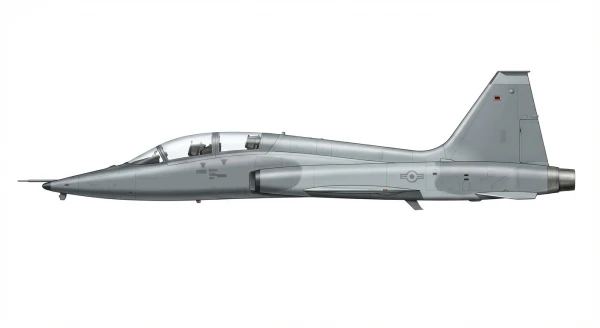
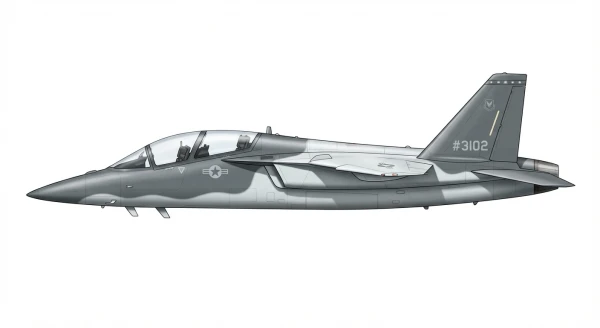
| T-38 Talon | T-7 Red Hawk | |
|---|---|---|
| Origin country | 🇺🇸 United States | 🇺🇸 United States |
| Category | Military Training Aircraft | Military Training Aircraft |
| Manufacturer | Northrop | Boeing |
| First flight | 10 March 1959 | 20 December 2016 |
| Year introduced | 1961 | 2028 |
| Number produced | 1189 units | 2 units |
| Average unit price | -- | $22 million |
| Wing area | 16.0 m² | -- m² |
| Wingspan | 7.7 m | 10.0 m |
| Height | 3.9 m | 4.0 m |
| Length | 14.1 m | 15.2 m |
| Maximum speed | 1381 km/h | 1300 km/h |
| Operational range | 1,835 km | 1,830 km |
| Service ceiling | 15,240 m | 15,240 m |
| Max. takeoff weight | 5,670 kg | 5,500 kg |
| Empty weight | 3,266 kg | 3,250 kg |
| Total thrust | 2 x 1,216 kgf | 1 x 8,029 kgf |
Detailed Comparison
The Northrop T-38 Talon, a derivative of the N-156 lightweight fighter project, has defined U.S. Air Force pilot training for six decades, relying on raw kinematics and high-speed characteristics typical of Century Series interceptors. In contrast, the Boeing-Saab T-7A Red Hawk prioritizes software-defined flight control and high-angle-of-attack (AOA) handling to bridge the gap to fifth-generation platforms like the F-35. While the T-38 forces students to master energy management through high wing loading, the T-7A focuses on information management and systems integration, reflecting a fundamental shift in air combat doctrine.
Development and Design
Northrop designed the T-38 in the late 1950s using a "coke bottle" fuselage area rule and a low-aspect-ratio wing, prioritizing supersonic dash speed to emulate the F-104 and F-4. It is a mechanically complex twin-engine aircraft; while the T-38C Avionics Upgrade Program (AUP) added glass displays, the underlying airframe remains analog. The T-7A represents a pivot to "Digital Century Series" acquisition. Boeing and Saab utilized Model-Based Engineering to move from concept to first flight in three years. The T-7A uses a single GE F404 engine (common with the F/A-18 and Gripen) and twin tails to provide aerodynamic authority at slow speeds—a regime where the T-38 is notoriously dangerous due to its high stall speed and limited lift.
Specifications and Performances
The T-38's performance profile is dominated by its twin J85 turbojets, producing 1,216 kgf thrust each. While it can reach Mach 1.3 (1,381 km/h), its climb rate of 170.7 m/s requires afterburner, burning fuel rapidly. The T-7A matches this climb rate (170.0 m/s) with a single F404 turbofan generating 4,990 kgf—more than double the T-38’s total dry thrust. Although the T-7A has a slightly lower top speed (1,300 km/h), raw velocity is less relevant for modern training than sustained turn rates and high-AOA flight. The T-38’s 16.0 m² wing area and high loading result in significant turn radius penalties, whereas the T-7A is designed to replicate the high-g maneuverability of the F-22 and F-35.
Deployment and Usage
The T-38 has trained over 72,000 USAF pilots since 1961. Beyond UPT (Undergraduate Pilot Training), it serves extensively as an adversary aircraft (Red Air) for the F-22, despite its inability to simulate modern high-off-boresight threats. Its age is a liability; structural fatigue limits g-loading, and compressor stalls remain a risk during aggressive maneuvering. The T-7A is slated to replace the T-38C. Unlike the T-38, the T-7A includes an embedded training system capable of simulating radar and weapons engagement on a "clean" aircraft, reducing the cost per flight hour by eliminating the need for external pods. However, the T-7 program has faced delays regarding its escape system and flight control software, pushing its operational entry to the right.
Conclusion
The T-38 Talon remains a competent stick-and-rudder trainer for energy management, but it is aerodynamically and avionicly disconnected from the frontline fleet. It trains pilots for a war of speed rather than information. The T-7A Red Hawk is the superior platform for the modern battlespace, specifically for its ability to simulate sensor fusion and high-AOA maneuvers. The T-38 cannot replicate the handling characteristics of a delta-canard or thrust-vectored adversary; the T-7A can. However, until the T-7A overcomes its developmental hurdles and achieves Initial Operational Capability, the USAF remains dependent on an airframe that predates the Cuban Missile Crisis.